 11

Continued from…
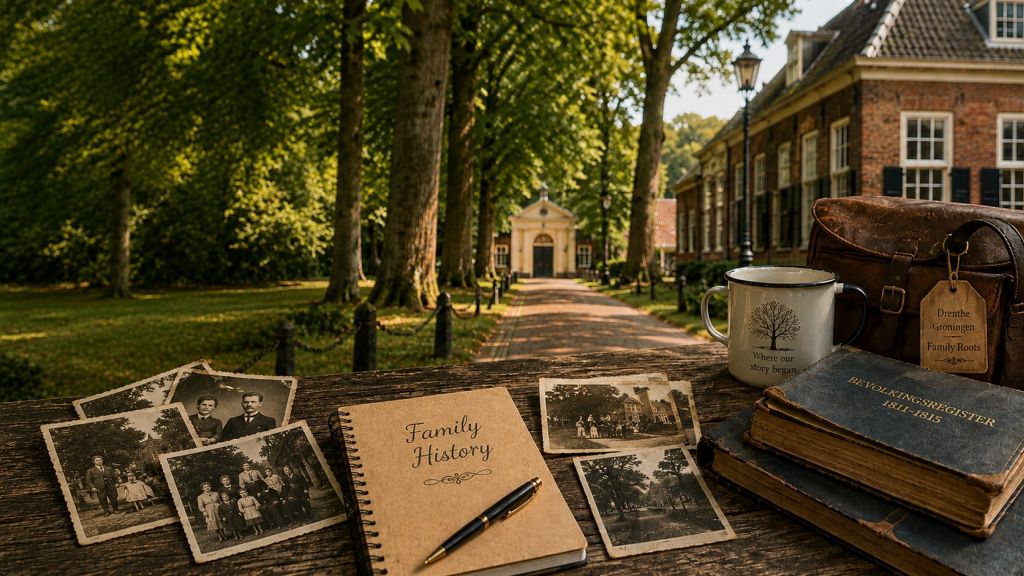
After my visit to Drenthe and Groningen in February 2026, the wish remained to go back to the region again, but this time with my daughter. I loved being there with my husband, but he didn’t experience our time there the same way I did. To him, it was just a weekend away from home, while to me, it was like treading in the footsteps of my ancestors.
During our family research, my daughter, Susan, and I downloaded several documents from archival websites linked to the provinces where family members were born, passed away, or lived during their lives. We followed our ancestral lines but we encountered a frustrating gap in our research when we couldn’t find the mother of Grietje Alberts Kuiper. Her father’s name was on her death certificate, but her mother’s name appeared nowhere, which means we couldn’t research her maternal line. We could also not find any baptism records for Grietje, but did find a baptism record for her father, or rather, we believe it is him.
No matter how hard we searched, and what we omitted or added to our search, we couldn’t find more information. That was where the idea originated to visit the actual archives, hoping the documents would be there.
What followed was three days of archives, cemeteries, discoveries, and moments of connection.
We left early this morning with no fixed plan for the day. It was just before our first coffee stop, just an hour into our journey, that my daughter asked what we would do on this day. I suggested going to Frederiksoord, and that I could be her tour guide, showing her the sights I’d seen earlier this year. She was instantly enthusiastic about it.


Another hour later, we stopped for brunch, then drove another half an hour to our destination. We parked in front of the hotel where my husband and I’d stayed in February, then started walking. What I knew beforehand now happened: my daughter loved the place as much as I had. After walking through the pear tree lane, then seeing the colony school, the punishment cage (something I’d missed in February), and the civil servants’ residences, I suggested having coffee at the museum cafe, as we were a stone’s throw away from it.
My daughter said she would love to see the inside of the museum, and I was definitely in for it. We were frequently quiet while walking on the grounds of what once was the experimental colony, both my daughter and I feeling the same emotions, the same connection to the place. Even though our ancestors have never lived in Frederiksoord, this is where the colonies originated, and that fact alone makes it special.


We had plans to also go to Veenhuizen, where Grietje Alberts Kuiper and her son, Marten, were for several years, but we didn’t have enough time for that as we still had to check into the hotel and had a dinner reservation in Roden for 6pm.
On driving into Roden, we passed a cemetery and instantly decided to stop there. We wanted to take photos of every grave that had a surname appearing in our family tree, or at least those that rang a bell. The path running between the graves gave me an idea, and I suggested my daughter take one side, and I would take the other. I think we were busy for about 45 minutes, then we were on the other side of the graveyard, each having taken several photos. There were a lot of familiar names!
When we were finally on our way to the hotel, my daughter mentioned she had taken photos of some graves she couldn’t read, as she hoped by adjusting the contrast, the words would become clear.
That evening, each with a laptop on our laps, we checked the photos we’d taken that afternoon. We were both in awe when we realized that one of the unreadable graves was that of a direct ancestor. It was also an image our cousin, Marja, had sent us some months ago, of the oldest child of Marten and Lutske, Jan, and his wife, Tjipke, to be precise: my maternal great-great-grandparents and Susan’s maternal great-great-great-grandparents.

We had reserved this day for a visit to the Groninger Archief, and didn’t know what to expect of it. Of course, we hoped for some monumental discoveries, at least finding out who Grietje’s mother was, but also for more information on her father and his parents.
Sadly, this didn’t happen, but it doesn’t mean we learned nothing. In fact, we came away from the archives in Groningen feeling energized and content.
At first, we had a conversation with a genealogist, who complimented us on how far we had come with our search, as people normally visited the archives having found much less information than we did. This boosted our self-confidence!
He showed us an easy way to navigate through documents on FamilySearch, which turned out to be such a practical tip. The first name he searched for was Marten Kuiper (1830-1881) and specifically records of his marriage to Lutske Tel (1832-1892). We already had this document, but what we couldn’t find were the attachments to the marriage certificate. Those were extracts from the birth certificates of both candidates, and extracts from the death certificates of their parents (if applicable) when they still needed permission for the marriage.
While the staff member showed us where to find those attachments, we discovered the military record of Marten, and Susan and I looked at each other in amazement. If we found nothing else that day, at least we had this discovery!
He showed us how to request actual documents or books to look into, and we then found a table in the study hall, where several other people were already sitting. This was where we both faltered. Everything that looked so logical when the genealogist explained it now seemed like abracadabra. But eventually we found our way, with a bit of help from one of the staff.
I am planning to write an article about this, because some months ago, the idea popped up that our ancestors might have been Mennonites. Concentrating on baptism records, we requested church records from before 1811 (when the civil registry started in the Netherlands), and also baptism and marriage registers of the Mennonites. We paged through several books but couldn’t find any of our ancestors in them.


Another book we wanted to see was the register of name changes. Until 1811, the population of the Netherlands worked with patronyms, and not fixed surnames. However, in 1811, after the French annexation of the Netherlands, Napoleon decreed that everyone had to choose a family name. We wanted to know who had chosen the surname Kuiper. Was it Grietje, or did her father decide on it? Sadly, not all records of name changes in Groningen had been recovered, and of course Kuiper was among those.
Fun fact, while we were in the study hall, the lady who had done the research about the name changes and wrote a book about it, was there too. It almost felt like being in the company of a celebrity.
After being in the archives for hours, and taking only one coffee break, it was time to leave. There were no eureka moments, but we were both grateful that we had gone there.
From the archives, we drove to Zevenhuizen, to the same cemetery where my husband and I had been in February, and I quit taking pictures because of the pouring rain. We followed the same routine as the day before – taking pictures of every grave that had a familiar name on it. It was remarkable to find so many graves for the surname Tel in the same place, but also graves with the names Kuiper and Hummel on them.
But that wasn’t the last stop at a cemetery. We drove back to Roden, and I spotted a sign pointing to a second graveyard in the town, the first one I visited on that rainy Sunday in February. Back then, I found the grave of a direct family member and his wife, but then quickly retreated to the car because of the weather. Now, walking there with my daughter, I saw how many other graves there were with family names appearing in our family tree.
Of course, that evening, while watching football, we compared our pictures with the family tree again.
After our last night in the hotel, we were ready for a visit to the next archive, this time in Assen, Drenthe. The only thing we wanted to find here was the proposal for Grietje Alberts Kuiper and her son, Marten’s discharge from the colonies.
Sadly, this was not available. However, the friendly lady gave us a tip to go back to the document we already had, where Grietje and Marten were listed as about to be discharged. Once we had that, we should page through earlier pages, where we would probably find what they had written back then before they listed the names.
Another tip she gave us was to note the sources of all documents we have, as there might always be a situation where you want to return to the source, as was the case with the discharge proposal we sought.
We paged through more documents, but knew we could do that at home, so after two hours, we left the Drentsch Archief. We had known beforehand that this would be a brief visit, which is why we planned it for the day we would return home.


Besides the friendliness of the staff, what stays with me after the visit is the building in which these archives are housed. It looks as though it could’ve been a castle of centuries ago, and the inside of the building, despite being modernly renovated, felt ancient too. This is a perfect location for such old and memorable documents.
Despite not having made major discoveries, both Susan and I feel our visit to the north-east of the country has been useful.
We have learned some useful tricks, but also know that our research is solid and thorough. That last fact definitely gave us both a boost! Also, being there together, knowing that we were where our ancestors once breathed the air, gave us several moments of pause. Those were beautiful moments to share.
Yes, we both wanted to find answers to the questions we still have, but sometimes it’s not about what you discover, but about what you cannot find at all. I will address some of that in future articles.

Continued here…


2 thoughts on “BECOMING KUIPER – Part 9: Following Footsteps of Our Ancestors”