 11

Continued from…
While the massacre in Paris was a sudden explosion of violence, the terror in the Netherlands had been building for years. To understand why the Du Toit family eventually had to run, we must look at the year 1567.
At that time, the Netherlands—including the city of Lille—was ruled by Philip II of Spain. He was a king who demanded two things: total taxes and total loyalty to the Catholic Church. But the people were angry. They were tired of paying for distant wars, and many had embraced the new Protestant faith. In 1566, this anger boiled over. During the Iconoclastic Fury, also known as the Beeldenstorm, Protestant groups burst into churches, smashing statues and tearing down religious images.
King Philip was furious. To him, this wasn’t just a protest; it was an attack on God and his crown. He sent his most feared general, Fernando Álvarez de Toledo, known as the “Iron Duke of Alba,” to crush the rebellion. Alba arrived with 10,000 hardened Spanish soldiers. He didn’t come to talk or make peace. He came to bring order through blood.


As soon as Alba arrived, he set up a special court. It was officially called the Council of Troubles, but the people quickly gave it a truer name: The Council of Blood.
This was not a place of justice; it was a factory for death sentences. Thousands of people were arrested. To get confessions, the Council used terrible torture. One of the most feared methods was the Toca. A cloth was pushed deep into a prisoner’s throat, and water was poured over it slowly. It created the horrific feeling of drowning while standing still. Even the strongest men broke under this pain, confessing to crimes they never committed just to make it stop.
The Iron Duke showed the world that no one was safe. On June 5, 1568, he shocked all of Europe by arresting the Count of Egmont and the Count of Hoorn. These men were not rebels; they were war heroes and loyal servants of the King. Their only “crime” was asking the King to show mercy to the Protestants.
Alba tricked them. He invited them to a grand dinner, pretending he wanted their advice. They came in good faith, trusting the honor of a fellow nobleman. But as soon as the meal ended, Alba’s guards surrounded them. They were dragged to a dungeon and later led to a scaffold draped in black velvet in the center of Brussels. Thousands of Spanish soldiers surrounded the square, their pikes glinting in the sun, to prevent any rescue attempt.
With two swings of the sword, the most powerful men in the land were beheaded. To make the message even clearer, Alba ordered their heads to be stuck on poles for everyone to see.


This act shocked the world because it was a ‘legal massacre.’ If the Duke of Alba could behead the King’s own cousins and most decorated generals for simply asking for peace, a Protestant family like the Du Toit’s knew they had no chance. Alba’s message was simple: obey or die. He believed it was better to destroy the country for God than to let it live for the devil. This was not just violence—it was a cold, legal machine. No matter who you were, you were never safe.
In Lille, the air became thick with suspicion. The Inquisition turned neighbors into spies. People were encouraged to report anyone who looked “different” or prayed quietly. Even a small mistake could lead to the sanbenito—a yellow garment of shame that prisoners had to wear while walking barefoot through mocking crowds.
The executions were designed to be as cruel as possible. Men accused of preaching were often burned at the stake. To make it worse, executioners sometimes used damp wood so the victim would suffocate slowly in the smoke, or they would burn the person’s feet first. The Council of Blood often ordered women to be buried alive. A hole was dug in the square, the woman was placed inside, and she was covered with earth while the crowd watched in silence.
If the rebels, called the Hurlus, tried to attack the city gates, the punishment was even worse. Captured rebels were “quartered”—their arms and legs tied to four different horses and pulled apart until their bodies broke.
On top of this violence, Alba introduced the “Tenth Penny”—a massive tax on every sale. This destroyed trade and left families starving. Unpaid Spanish soldiers often turned into monsters, looting homes and killing civilians in what became known as the Spanish Fury.
It was during these “Years of Blood” (1567–1573) that the first cracks appeared in the Du Toit family tree. We find the story of Guillaume du Toit, a humble baker in Lille.
For Guillaume, life had become impossible. Every loaf of bread he sold helped pay for the very soldiers who wanted him dead. The pressure of watching the smoky fires in the square and hearing the screams of the tortured became too much to bear.
Around 1567, Guillaume made a choice that changed our history forever. He became a “Scout of Freedom.” In the middle of the night, he left behind the familiar smell of the Lille markets and fled north. He headed for the rebel city of Leiden, seeking safety behind its strong walls and cold canals.
He was likely the great-grandfather of the brothers who would one day make the even bigger leap to Africa. He was the first to realize that you cannot build a home under a roof of fear.
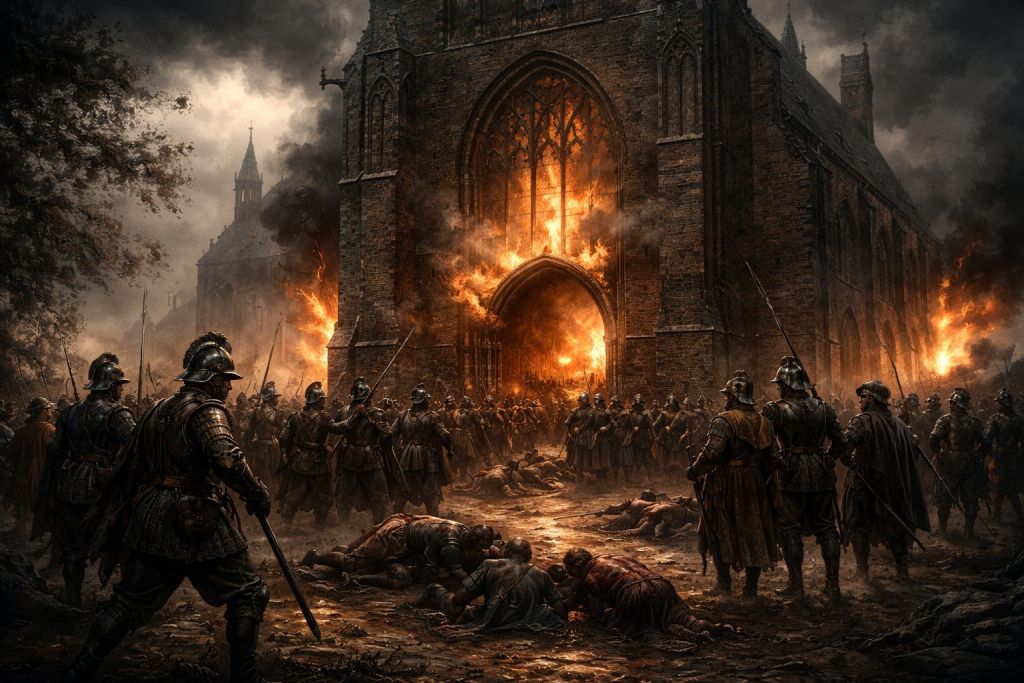
The Iron Duke was proud of his work. In 1572, the same year as the massacre in Paris, his soldiers attacked the town of Naarden. After the town surrendered, the citizens were told they were safe. They were invited to the large town church for a ‘peace meeting’ to talk about the future.
Trusting the soldiers, hundreds of men, women, and children gathered inside the church. But as soon as the building was full, the Spanish soldiers locked the heavy doors from the outside. There was no way out. Then, they set the church on fire.
While the people inside screamed for mercy, the soldiers stood outside with their weapons ready. Those who tried to climb out of the windows were pushed back into the flames. Almost every person in the town died that day, either by the fire or by the sword. Alba proudly wrote to the King: ‘Not a mother’s son was left alive.’
This was the ‘Spanish Fury’—a cold, calculated plan to break the spirit of the people through pure horror.
For the Du Toit family, this dark period became more than just a history lesson; it became part of their very soul. What Guillaume began with his midnight escape was not just a single act of saving himself. It was the first step on a long path that others in his family would one day follow. He showed them that when the roof above you is no longer safe, you must find the courage to build a new one somewhere else.
Even after the “Iron Duke” of Alba was gone, the fear he left behind did not fade away. It lived on in the stories told around the dinner table, in the quiet warnings whispered from father to son, and in the careful way the family learned to watch the world around them. They lived with a “quiet strength,” always aware that peace could be fragile.
That shadow of the past never truly disappeared. It stayed with the family like a ghost, reminding them that their freedom was precious and could be taken at any moment. In time, this old memory would rise again. It would be the spark that pushed future generations to make even greater journeys. It was this deep-seated need for safety and faith that would eventually lead the Du Toits away from the green fields of Europe and toward the distant, unknown shores of South Africa.
The fog is thick tonight, but it cannot hide the smell. It is a terrible mix of wet wood, old blood, and cold iron.
I stand in the corner of the Grand Place, my back pressed so hard against the stone wall that the cold runs through my bones. My father always warned me to stay away from this square. “Keep your eyes on the flour, Guillaume,” he would say. “The square is only for the dead.”
But tonight, the sound of the drum would not let me sleep. It beats slowly and deep, like a dying heart. Thump. Thump. Thump.
The Spanish soldiers do not look like men; they look like statues carved from hate. In the center of the square, the Duke’s shadow is long and sharp. He does not move. He just watches with eyes like grey ice.
I see them dragging a woman toward a dark hole in the ground. She does not scream. That is the most terrifying part. Her voice is gone, or perhaps she has seen so much horror that there are no sounds left inside her. She is our neighbor. I remember her hands—they used to smell like lavender when she bought our bread. Now, they are covered in dirt and dark bruises.
The soldiers throw her into the deep, narrow pit. I hear the dull sound of her body hitting the bottom. My breath catches in my throat. I want to run, to scream, to pull her out, but I am frozen. If I move, the Duke will turn his cold eyes toward me. And if he looks at you, you are already dead.
“Cover the heretic,” a voice commands. It is a flat, bored voice. To them, this is just another day of work.
Then, the shovels begin. Scrape. Thud. Scrape. Thud.
The dirt falls onto her. I can hear her gasping for air as the earth fills the hole. I close my eyes, but the sound is even louder in the dark. I hear the soil hitting her clothes, then her shoulders. I hear a muffled, choking sound—the last breath of a woman whose only crime was reading a book in her own language.
Then, silence.
The soldiers stomp on the dirt to make it flat. They want to erase her from the world. They want to make sure no one even knows she was ever there.
I look at my hands. They are shaking so hard that I have to bite my lip to keep from crying out. I realize then that Lille is not a city anymore. It is a graveyard with walls. Every stone in this square feels like it is watching me. Every neighbor could be a spy. Every shadow could be the Duke.
I turn and slip away into the dark alleys, moving like a ghost. I reach our house, my breath coming fast and uneven. My father looks at my shaking hands and the blood on my palms where I dug in my nails. He knows. He knows the smell of the Duke’s fires.
We stand in the dark kitchen. The smell of flour is still there, soft and familiar. But it brings no comfort tonight. Nothing is safe now. The danger is too great for all of us to leave together. A whole family is too easy to see. Too easy to stop.
But one man… one man can disappear.
My father puts his hand on my shoulder. His grip is strong, but I feel his fingers trembling. He knows that in a city of spies, a single witness is a target. If even one person saw me near that square tonight, our whole family is finished.
He leans close to my ear. His voice breaks as he whispers the hardest words I have ever heard.
“You have to go. Now.”
Fear had turned the streets of Lille into a graveyard. The family knew they had to find a new horizon to survive. The era of the Iron Duke was fading, but a new shadow was growing. The ‘Sun King’ was rising, and he would soon force the world to choose between their home and their faith.
Continued here…


2 thoughts on “BLOOD OF THE HUGUENOT – Part 6: The Iron Duke”