 11

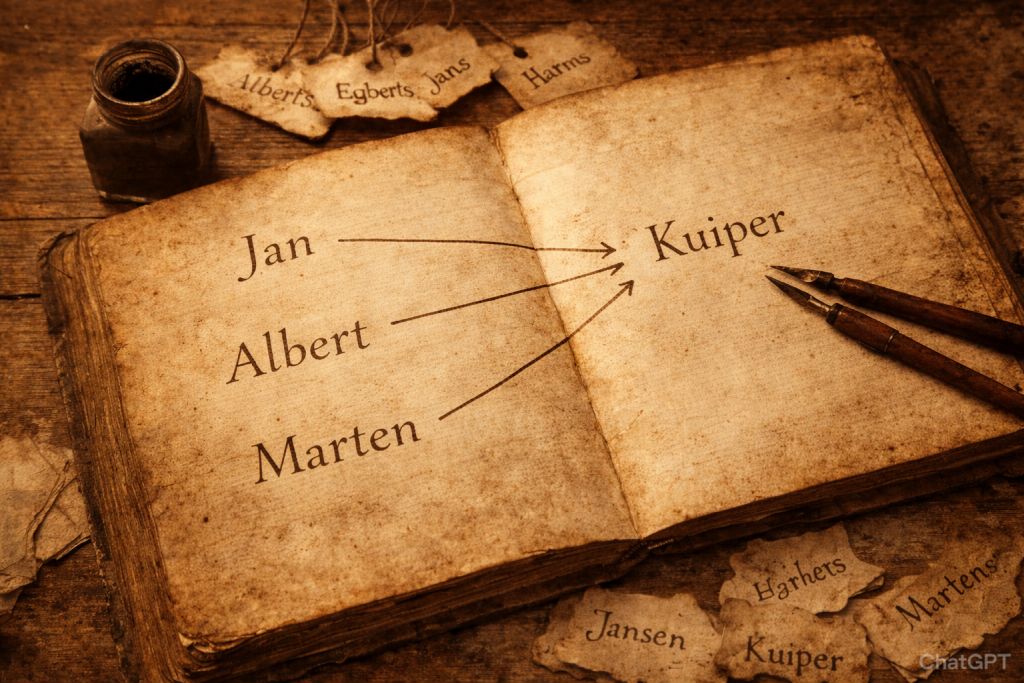
Grietje Alberts was the daughter of Albert Martens and lived in the province of Groningen, Netherlands, from 10 January 1794 to 19 January 1869. At the time of her passing, she had adopted the surname Kuiper, probably chosen by her father. Up to the time when the law required them to choose a surname, they, and many others with them, used patronyms.
In 18th-century Groningen, most people did not use fixed surnames as we understand them today. Instead, they used patronyms, which were names derived from the father’s given name. A patronym identified a person as the son or daughter of a specific man.
For example, if a father named Jan had a son and called him Pieter, the son was recorded to be Pieter Jans. The ‘Jans’ meant ‘son of Jan’. If he had a daughter called Anna, her name would’ve been Anna Jans. In written records, variations such as Jans, Jansen, Jansz, or Janssen can all reflect the same basic meaning: “child of Jan.” The spelling often depended on the clerk who recorded the name rather than on any standardized form.
Patronyms were not family surnames passed down unchanged through generations. They shifted with each new generation because each child’s second name was based on their own father’s first name.
Jan → His son: Harm Jans → His son: Egbert Harms → His son: Jan Egberts
This system functioned effectively in small, close-knit communities where personal relationships were well known, but it creates complexity for modern researchers tracing family lines.
To make things even more complex, in Groningen, patronyms were sometimes used alongside additional identifiers, such as occupations or places of origin, to distinguish between individuals with similar names.
The use of patronyms remained common until the early 19th century, when civil registration under Napoleonic rule (from 1811 onward) required families to adopt fixed surnames. Many families formalized their existing patronym as a permanent surname, which is why names ending in -s, -sen, or -se are still widespread in the northern Netherlands today.
Grietje’s patronym was ‘Alberts’, which simply meant ‘daughter of Albert’. Her father had the patronym ‘Martens’, which meant his father’s name was Marten. That’s where the line stops – for now.
Napoleon Bonaparte introduced the obligation to adopt fixed, hereditary surnames in an imperial decree of 18 August 1811. By then the Netherlands had been incorporated into the French Empire, and had to live according to the French civil law, which included the system of civil registration (Burgerlijke Stand).
This decree required all residents who didn’t yet use a permanent family surname to choose and register one. The purpose was administrative rather than cultural, as a standardized naming system enabled more efficient taxation, military conscription, and legal identification across the empire.
These fixed surnames became the official record for all births, marriages, and deaths beginning January 1, 1812.
The decree wasn’t followed by everyone, especially in the countryside where patronyms were still a strong part of everyday existence. When the French period ended in 1813 and William 1 became sovereign, and later King of the Netherlands, the civil registry system and the requirement for hereditary surnames were maintained.
Although the legal foundation dated from 1811, not everyone had formally registered a surname. Therefore, King William I issued a Royal Decree on 5 November 1825 reiterating the obligation to adopt a fixed family name, this time with explicit penalties for non-compliance.
As a result, the period between 1811 and roughly 1826 marks the definitive establishment of hereditary surnames in the Netherlands.
When choosing a fixed surname, many families just formalized the patronym they were already using, such as Jansen, Harms or Alberts. Others chose a nickname, a place-identifier or an occupation.
The surname Kuiper is an occupational name derived from the Dutch word for a cooper—a maker or repairer of wooden barrels, casks, and tubs. In the 17th and 18th centuries, coopers played an essential role in daily and commercial life, as barrels were necessary for the storing and transporting of goods such as beer, butter, fish, grain, and peat.
The name occurs widely throughout the Netherlands, including Groningen, and may appear in variant forms such as Kuijper, Kuyper, or Kuipers, reflecting historical spelling differences. As with many occupational surnames formalized around 1811, Kuiper likely originated as a description of the trade practiced by an ancestor before becoming a fixed family name.
In 18th-century Groningen, naming patterns followed a fairly consistent and deeply rooted tradition that revolved around family continuity. Parents named their children after their grandparents according to a fixed order. The first son got the name of the paternal grandfather, the second son that of the maternal grandfather. Similarly, the first daughter carried the name of the maternal grandmother, and the second daughter that of the paternal grandmother. This pattern was not a legal requirement, but a strong social custom, and you can often trace this across multiple generations.
In Groningen, the third son and daughter were mostly named after the oldest brother on the father’s side, or the oldest sister on the mother’s side.
After researching for weeks, we have still not found the name of Grietje’s mother, nor have we found any trace of Albert’s father. Hours have already been spent on this investigation.
What we did find was a baptism record from 1763 for Albert Martens, born out of wedlock and son of Geertje/Geertien Martens.

However, when we look at the patronyms and the naming rules, then we can can readily accept the following:
Although we still have found no proof of Grietje’s maternal line, the patronymic system and traditional naming patterns of 18th-century Groningen offer valuable clues. They didn’t choose names randomly, but it reflected family structure, memory and continuity. Though the complete records are (currently) absent, these patterns help us to form reasoned hypotheses about earlier generations.
Grietje Alberts Kuiper stands at the intersection of two naming worlds — the shifting patronymic tradition of her ancestors and the fixed surnames that would define future generations.
Continued here…


2 thoughts on “BECOMING KUIPER – Part 1: Patronyms and the Birth of Surnames”