 11

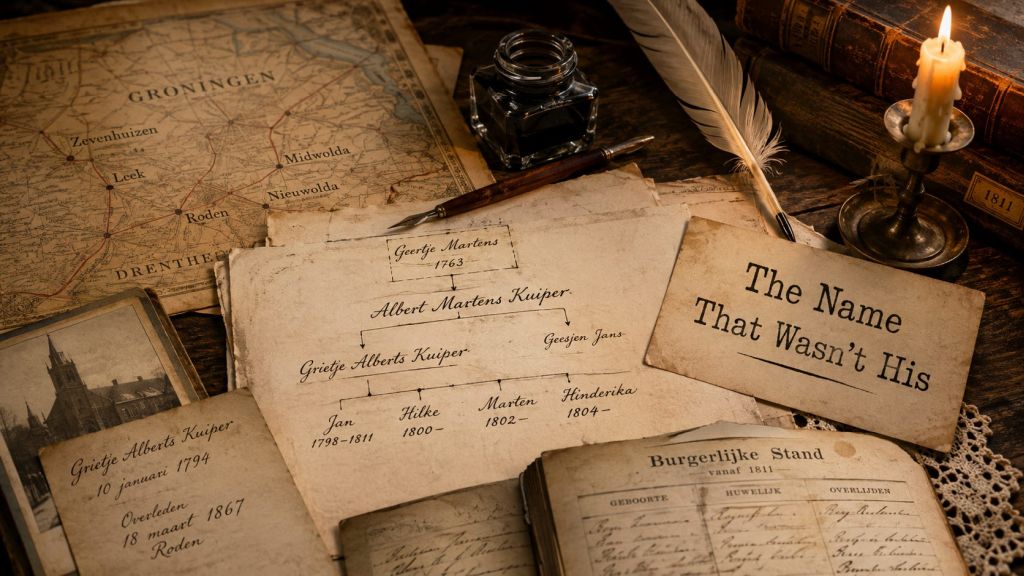
We all come from somewhere. Behind every name stands a mother and a father, and behind them, countless others whose lives made ours possible. It is a comforting thought.
However, in the Netherlands, research becomes far more challenging before 1811. The introduction of the civil registry marked a turning point in record-keeping. Prior to that, information must be pieced together from scattered sources, where certainty is rare and gaps are inevitable.
The civil registry in the Netherlands was introduced in 1811 during the period of French rule under Napoleon Bonaparte. It marked a fundamental shift in how personal information was recorded. From that point onward, municipalities were required to systematically register births, marriages, and deaths. These records were kept by local officials and followed standardized formats, making them far more consistent and reliable than earlier sources.
Before 1811, most vital events were recorded by churches, meaning that documentation depended on religious affiliation and the diligence of individual clergy. The new civil system, however, applied to everyone regardless of faith, creating a more complete and uniform population record. Birth certificates included details such as parents’ names, ages, and occupations, while marriage and death records often provided additional generational information.
For genealogical research, not only the introduction of the civil registry but also obliging people to choose a surname is invaluable. It allows researchers to trace families with a high degree of certainty. It also highlights the contrast with earlier periods, where records are fragmented and require careful interpretation to reconstruct family histories.
Because of the patronym system before people had to choose their family surname, we assumed Albert Martens was the one who chose the surname ‘Kuiper’, probably because he worked as a cooper, a maker or repairer of wooden barrels, casks, and tubs.
On the death certificate of Grietje Alberts Kuiper, we saw the name of her father: Albert Martens Kuiper. This would have been the perfect place to trace her maternal line, were it not that those who reported her death to the authorities hadn’t known who her mother was.

Maybe her mother died in childbirth, and her father cared for her by himself? This is something that does not fit the zeitgeist of the eighteenth-and-nineteenth centuries. When men found themselves alone with a child, they remarried fairly quickly. Maybe Albert Martens Kuiper did just that?
Another possibility is that Albert passed away before 1811, when it became obligatory to choose a surname, and Grietje chose the name to honor her father’s memory.
All of this is, of course, only speculation. We found no proof, but with the documents we discovered, and also those we couldn’t find, we have built a bigger picture. As said at the end of part 9: we both wanted to find answers to the questions we still have, but sometimes it’s not about what you discover, but about what you cannot find at all.
While we have her father’s name on her death certificate, there is absolutely no record of Grietje’s birth. The only way we know she was born on 10 January 1794 is because of the registers of the colonies, where she and her son, Marten, had been confined for 7 years. The civil registry didn’t exist yet in 1794, which had us turning to church records in Groningen and Drenthe, but we still couldn’t find any record of her birth, and therefore, of her mother.
We hoped discovering more information about Albert Martens Kuiper might help us find Grietje’s mother.
While we discovered a lot about Grietje’s life, the only thing we could confirm about her Albert was… well, that he was her father. Also, we knew his father’s name was Marten, since he carried that patronym.
Most people in the eighteenth-and nineteenth centuries were strongly tied to their region because of poverty, a lack of fast means of transportation, and the absence of large-scale housing markets. Daily life took place almost entirely within a radius that could be reached on foot.
For this reason, we searched the archives, concentrating on the region of Zevenhuizen, Leek, and Midwolda in the province of Groningen, where we knew this family came from. This is just over the border with the province of Drenthe, where the Kuiper family later lived in Roden, and Grietje also lived for some time.
We started at his birth, finding only two records, but immediately dismissing one because the names didn’t fit.
Grietje’s father, Albert Martens, was baptized as an illegitimate child of Geertje Martens in the Nieuwe Kerk in Groningen on 19 May 1763.

This means Albert Martens Kuiper was 31 years old when his daughter, Grietje, was born. We can also reasonably assume that Grietje was named after her grandmother, Geertje, a name which would also appear several times in later generations.
While we could find a baptism record for Albert, we couldn’t find one for Grietje. There was one for her son, Marten, as he had to be baptized in the colony, but we are still searching for the baptism records of his children, as well as their children. Curious? Certainly!
This made us wonder why Geertje Martens had Albert baptized. Was it because she wasn’t married and needed financial help from the church? Also, where the life of this family seemed to center around the region of Zevenhuizen, Leek, and Midwolda, the baptism happened in Groningen, which is only 35 kilometers away, but in those days far enough away to hide a scandal from the family.
Back to our search regarding Albert Martens we found the following:


Albert’s baptism took place in May 1763, and we can assume he was also born in 1763. When you add 44 years to that, you get 1807. Since his death notice mentions ‘plus-minus 44 years old’, we assume his wife didn’t know exactly how old he was. This also means he died before the civil registry started in the Netherlands, and that he wasn’t the one who chose the name Kuiper.
One thing we don’t know is what happened to Grietje. At the time Marten got married to Geesjen – as we assume this was her father – she was only four years old. Did she live with her mother? Her grandmother? An aunt? Or was she confined to an orphanage?
While at the Groninger Archives in July 2026, we paged through the records of several orphanages but couldn’t find Grietje’s name. Where she was during her childhood years remains a mystery, as she was clearly not included in the mention when her father passed away.
Looking at the above, we are fairly confident (let’s say 95%) that our research is solid. However, the patronym system from before 1811 will always leave that inkling of doubt.
Despite that, we took our research one step further to look at Albert’s mother, Geertje Martens.


2 thoughts on “BECOMING KUIPER – Part 10: The Name That Wasn’t His”