 11

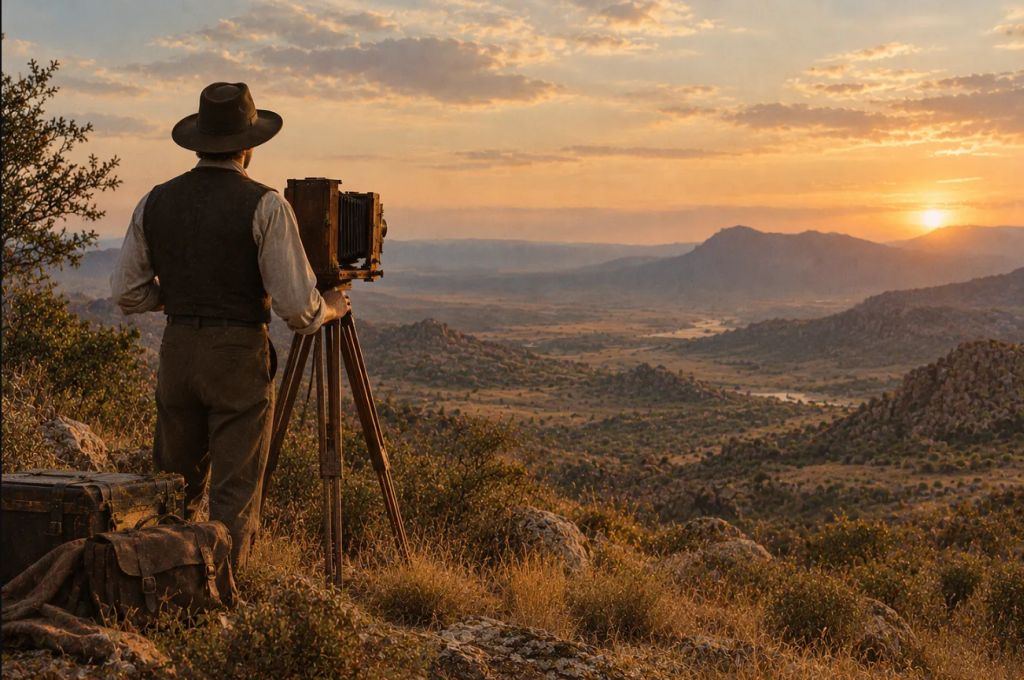
Mombolo, Angola — 1921
The earth was red beneath their feet.
Somewhere in the quiet hills of Mombolo, a small group of people stood around a fresh grave. Above them, the African sun hung heavy and bright, casting long shadows across an endless landscape that stretched away in every direction.
His wife stood trembling in the heat. His children pressed close against her side. Surrounding them were the weathered faces of men, women, and children who had shared the brutal, beautiful years of his life. They had cleared fields together, prayed together, and endured the relentless hardships of the Angolan wilderness side by side.
For the community, this was the heartbreaking end of a chapter they had built together. For the man resting beneath the red soil, it was the final stop of a journey that had begun thousands of kilometers away.
He had arrived in Africa as a young man, driven by a simple, fierce desire to teach. He had crossed a massive ocean with nothing but dreams of a new life. Along the way, he had become a husband, a father, and a pillar of the wilderness. He had educated children, worked the land, traded goods, and written countless letters back across the sea, begging for books, Bibles, and hope for his community.
He had also carried a heavy camera through the dust of the Angolan countryside. With endless patience, he had captured the world around him. Their faces. Their families. Their small, fragile churches. Their everyday lives.
Now, his own life had come to an end.
Years earlier, he had written that he hoped his grave would one day stand in Africa.
In 1921, at just forty-two years old, it did. His resting place would forever be known as the lonely grave at Mombolo.
His name was Pieter van der Smit.
If you have followed Daughters of Time for a while, you might wonder why I am writing about Pieter van der Smit. His name does not appear on our family tree. He was not a Vorster, a Steyn, or one of our blood ancestors. Yet, his story is deeply woven into ours, and it all began with a single photograph.
Long before we actively started building our family tree, an old digital photograph was already circulating on genealogy websites. It was connected to Pieter Jacobus Vorster (born 1868), my mother’s paternal great-grandfather, and my maternal great-great-grandfather. The image showed him, his wife Cecilia Johanna Steyn (born 1872), and four children—two older children standing in the back, and two small children sitting in the front.

For a long time, this photograph caused a lot of confusion for us. Through our family research, we discovered that Pieter and Cecilia actually had nine children in total. Their very first baby, Barend Johannes Marthinus Vorster, was born in 1892 in Bethal, Transvaal. A year later, in January 1893, Pieter Jacobus Vorster became the only member of our Vorster family to join his wife Cecilia and her family on the brutal Dorsland Trek to Angola. However, when we examined the historical documents listing the names of the people who participated in that 6th Dorsland Trek group, their baby boy was not mentioned. Because of this, we knew he must have passed away in the months just after his birth.
Through our research and by looking at the baptism records, we managed to piece their lives back together. These documents proved that their other eight children—four sons and four daughters—were all born in Angola as the family moved through the wild landscape. This meant the photograph had to be taken in Angola, but it left us with a burning question: where were the other children? We knew that one of the children born in Angola had also died very young, but that still did not explain why the remaining children were missing from the frame.
To make matters more confusing, it wasn’t just strangers online who were mistaken; even family members had widely accepted this narrative, linking the photo to their own family trees under the firm belief that the oldest boy standing behind his father was their grandfather, Pieter Jacobus Vorster (born 1903).
The pieces of the puzzle simply did not fit.
The breakthrough came when we made contact with Oom Josua. To place him in our family tree, Oom Josua (Josua Johannes Filiphus Vorster) is the half-brother of Antoinette’s father, Willem Johannes Vorster (1941–2021), and the son of her paternal grandfather, Pieter Jacobus Vorster (1903), and his third wife, Anna Catharina Wolff.
Oom Josua sent us several precious family documents. And then, came a photograph.
When the image appeared on our screen, we realized we were looking at the very same family portrait we had seen online. However, this version was completely different. It was an original color print, and it revealed a stunning secret. The digital image online had been cropped. On the far right of the original photo, two more children appeared. They had been there all along, suddenly brought back into the light. It felt magical, as if the family had instantly become more complete.
Thanks to this original print, and with the invaluable help of other grandchildren of Pieter and Cecilia whom we connected with on genealogy websites, we were finally able to identify every single child in the photo and give them their rightful names. The online assumptions were completely wrong; the older boy standing in the back was not my mother’s grandfather, the young Pieter Jacobus (born 1903). It was actually his older brother, Johannes Hermanus Vorster (born 1898).
Then, we noticed something else written on the original paper frame surrounding the photograph. On the bottom left was the name of the photographer: Pieter van der Smit. On the bottom right, it read: Caconda. Suddenly, the mysterious photograph had a birthplace, a history, and a creator. Caconda was a remote town in Angola, the harsh region where many Dorsland trekkers had settled. Without even looking for him, we had found the man behind the camera.
To understand how he ended up in that distant corner of Africa, we began to piece together his remarkable life.
Pieter van der Smit was born in the Netherlands in 1878. He trained as a schoolteacher and left his homeland at the young age of twenty, driven by a desire to teach Boer children in South Africa. He eventually became the head of a farm school near Bronkhorstspruit, but his peaceful life was soon disrupted by the Anglo-Boer War. Pieter joined the Boer side as a volunteer, was captured after the fall of Pretoria in 1900, and was deported back to the Netherlands.
Yet, Africa had already captured his heart. By 1901, Pieter returned to the continent, this time traveling to the remote trekker communities in Angola. He settled in Humpata, married Martha Maria Prinsloo, and became a pillar of the local community. His life became a mixture of many trades: he taught, farmed, traded, and supported the local church.
He also carried a rare, precious tool for that time: a camera. Photography had interested him since his youth in the Netherlands, and in Angola, it became his mission. Cameras were incredibly rare in these isolated settlements. Pieter used his equipment to document a unique world, capturing families, children, and church gatherings, knowing that this way of life would one day vanish.
And then, there was that moment, somewhere in 1912…
Through the lens of his heavy camera, the world outside turns upside down.
Pieter van der Smit adjusts the brass focus ring, his hands steady despite the dust of Caconda. In the glass of his viewfinder, a family slowly comes into focus. They do not look like a group of travelers weary from the dusty roads of Angola. Instead, they have dressed in their absolute finest clothes for this day.
Pieter steps back, looking at them directly.
He sees a proud father with a thick, dark beard, sitting calmly in a dark coat, his waistcoat neatly buttoned beneath it. Next to him sits his wife in a dark dress, her hair neatly tied back. You can feel her quiet strength as she carefully holds her little toddler in a white dress on her lap. Behind them stand three older children, tall and serious, their faces bearing the quiet maturity of youth spent in a wild, unforgiving land.
In front of the father stands a young boy in simple clothes, holding a small stick firmly in his hands. And standing at his father’s side, another boy has his hand tucked casually into his pocket, his light hair messy from the African wind. He looks straight back at Pieter. There is a fierce, thoughtful intensity in that boy’s eyes—an unbroken, piercing gaze that seems to stare right through the camera lens and directly into Pieter’s soul.
Nobody smiles. In this remote corner of Africa, having your photograph taken is a rare, sacred event.
Pieter breathes in, looking at this beautiful circle of lives.
Hold still, he thinks.
For a fraction of a second, the universe holds its breath. Pieter presses the shutter. A sharp click echoes through the quiet air, locking their breath, their youth, and their love into a single piece of fragile paper.
Pieter van der Smit could never have known that more than a century later, two descendants would look at those exact faces and try to imagine the souls behind them.
Let us introduce you to the family standing in that sunlit moment in Caconda.

The proud parents sitting in the center are Pieter Jacobus Vorster and his wife, Cecilia Johanna Steyn. Standing seriously in the back row, from left to right, are their older children: Susara Susanna, born in Humpata in 1894; Johannes Hermanus, born in Catumbela in 1898; and Aletta Johanna, born in Catumbela in 1900.
Gathering in the front are the younger children. The little toddler held so closely in her mother’s arms is Cecilia Johanna, born in Cubal, Benguela in 1910, making her about two years old here. Standing proudly in the very center is little Paul, born in Qué in 1908, who is about three years old.
And that boy standing on the far right, next to his father—the one with the unforgettable, piercing gaze and his hand tucked into his pocket? That is my mother’s grandfather, the young Pieter Jacobus, born in 1903 on the long trek from Catumbela to Qué. He is around eight years old here.
When you look closely at this complete family, however, the photograph also holds a hidden sorrow. Someone is painfully missing from the frame. Pieter and Cecilia had another son, Hermanus Johannes Vorster, born in Qué in 1906. He died before 1907, only a tiny baby. He was already gone by the time the family gathered in front of Pieter’s lens. Yet, there is also a silent promise of the future hidden in this moment. Another daughter, Cornelia Catharina Adriana Vorster, would be born in Mombolo in 1916. She is missing too, simply because she had not yet entered the world. Even this beautiful image of a whole family carries both the quiet, invisible ache of a missing child and the deep promise of a future one.
After that day in Caconda, the fragile piece of paper began its own long and dangerous journey through time. It belonged to Pieter and Cecilia first, who carried it with them through the wilderness of Angola as the family moved onward.
Life moved on ruthlessly, and the family changed.
Cecilia died in Angola during the devastating 1918 Spanish flu pandemic.
A decade later, in 1928, the remnants of the family prepared for the massive trek back to South West Africa (now Namibia).
Sadly, some did not make it.
Susara Susanna and her husband both passed away in Angola before the journey could even begin. Aletta Johanna and her husband were officially listed on the paperwork for the 1928 return trek, but after that, all historical records of her vanish. We can only assume she tragically lost her life during that brutal journey across the continent.
Yet, through all the grief, heartbreak, and unimaginable loss that the family endured, the photograph survived. The people standing in that frame were gone forever, making this fragile print one of the family’s most precious and sacred belongings.
At some point, it came into the hands of their son, the young Pieter Jacobus. The print stayed safely with him as he built his life in Outjo, South West Africa (Namibia). Years later, when he left Outjo with his own children and returned to Bronkhorstspruit, South Africa—the very place where Pieter van der Smit had once taught—the photograph traveled with him. Through every hardship and every house move, the paper endured. After he passed away in Bronkhorstspruit in 1955 at the age of 51, his children kept it safely.
The surviving children from the photograph lived long lives in different corners of Southern Africa. Johannes Hermanus passed away in 1971 at the age of 73. Paul lived until 1987, passing away in Windhoek, Namibia. Little Cecilia Johanna, the baby on her mother’s lap, lived a long life until 2004, passing away in Cape Town. And Cornelia, the unborn baby of the family, passed away in Johannesburg in 1992.
Yet, despite the vast distances, separations, and deaths, their faces remained locked together on that single piece of paper.
More than a century passed before a digital copy finally traveled across the world to us. We have never held the original; it remains safely with Oom Josua. But through it, Pieter van der Smit brought our past to life. Today, as we look at those faces, it is breathtaking to realize that this fragile piece of paper has survived for 114 years.
Our search did not stop there. We desperately wanted to know more about the man who had captured our family. When we discovered that his son had later written a book about him based on his personal diaries and letters—titled Die eensame graf by Mombolo—we ordered it immediately. We hoped that perhaps, somewhere between those pages, we would find a hidden mention of our Vorster family, or even another undiscovered photograph.
The book turned out to be an incredible historical treasure, bringing us much closer to the unforgiving world our ancestors faced. However, our family remained entirely in the background. There were no hidden collections of photos waiting for us.
Except for one small, intriguing connection.
As Pieter van der Smit had prepared for his own death in 1921, he wrote down his final funeral arrangements. Among the names of the community members he listed to handle his affairs was a man named Koos Vorster. Could this have been our Pieter Jacobus jnr.? We will never know for sure, but it reminds us of how tiny and interconnected this world was. In such an isolated, tight-knit pioneer community, deep bonds were forged out of survival and shared faith. It is comforting to think that the lonely school teacher might have shared a close, enduring connection with our Vorster family. Whether it was him or another man, it remains a beautiful mystery in our family history.
Then, we found a second photograph that brought the entire story to a breathtaking circle.
On January 12, 1919, a group gathered after a church service in Mombolo. The image shows the local congregation arranged for the camera. And there, standing in the crowd, was Pieter van der Smit himself. The man behind the lens was suddenly in front of it. But as we looked closer at the faces around him, our breath caught. Right there, in the same frame, stood a familiar face: our very own Pieter Jacobus Vorster (1868), the father from the Caconda photograph!

The date of this second photo is heartbreaking. It was taken just a few months after Cecilia Johanna had died. She is completely absent from this image. She is gone. Between these two photographs lie lives that changed forever. One image shows a family whole and together in Caconda; the other shows a fractured community years later. And behind both moments stood the same man with his camera.
I often think about what Pieter saw through his lens during his short life. He recorded everyday moments without ever knowing what they would mean to the future. He could never have known that his work would become the only surviving image of Cecilia Johanna Steyn. Or that of Susara Susanna, who would die so young in Angola. Or of Aletta Johanna, who would vanish into the wilderness during the great return trek.
We will never hear any of the voices of our ancestors. We will never know their laughter, or see how they moved through their homes. But because of Pieter, we can see their faces. We can see Cecilia holding her youngest child close. We can see the serious, innocent eyes of daughters who were destined to be lost to history, but are now safely found.
When they posed for the photograph that day in Caconda, they were simply a family having their picture taken. For a brief, magical moment, they are all still there. Cecilia is alive, her children are young, and the past is whole.
Pieter van der Smit does not share our blood, but he belongs in Daughters of Time. Sometimes the people who preserve our history stand outside the family tree. Sometimes they carry a camera, press the shutter at exactly the right moment, and give us the only way to see someone we love, but never got to meet.
Pieter took a photograph. A family stood before him. The image traveled across borders and through generations, until that single moment finally found its way back to us. And through his lens, an entire generation of our ancestors didn’t just survive—they returned home.


