 11

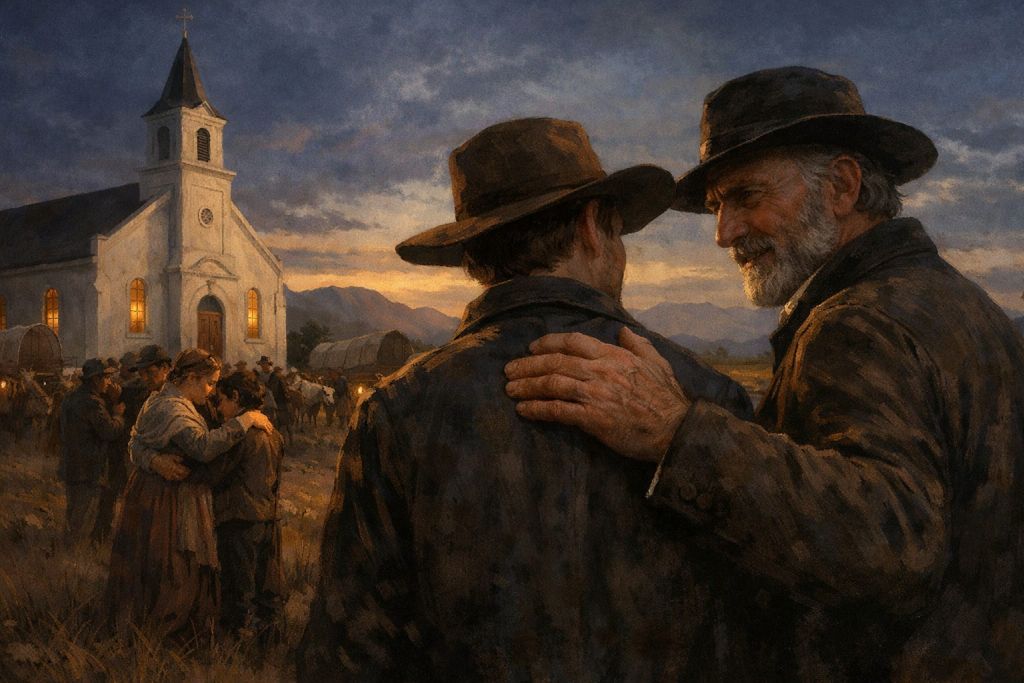
Since Pieter Jacobus (1868) had made his decision to join the Steyn family on the Dorsland Trek, fewer words had passed between him and his father.
They still worked the land side by side when necessary, and they still greeted one another in the mornings, but something had shifted. The easy rhythm of conversation was gone. In its place stood a silence neither of them knew how to cross.
His father did not forbid him to go, neither did he raise his voice or argue. He simply withdrew. Pieter felt it in the way his father avoided his eyes, in how conversations ended when he entered the room, and in the tightening of his father’s jaw whenever the Trek was mentioned. The decision had been made, but it had not yet been accepted.
On Sunday evening, 13 November 1892, families gathered in the church in Bethal. At the request of members of the congregations of Middelburg and Bethal who were preparing to depart, a farewell sermon was preached by Rev. Philippus Stephanus Snyman.
Among those present were the families of the fifth trek under Koos Hamman, who would leave in December 1892, and members of the Steyn group of the sixth trek, who would depart in January 1893.
The church was filled not only with those who were leaving, but also with fathers, mothers, brothers, sisters, and friends who had come to stand beside them one last time. This was more than a church service – it was a final goodbye.
Pieter and Cecilia sat among the departing families, surrounded by quiet whispers and the weight of unspoken words. Around them were those who would remain behind.
Pieter’s father was there, as were his brothers and sisters. Across the aisle, a few rows back, his father sat upright, his hands folded in his lap. Their eyes met once — only briefly — and then both men looked forward again.
In that crowded church, one presence was painfully missing. His mother was gone, having passed away just six months earlier. For the first time, Pieter felt her absence not as a gentle ache, but as a sharp, tangible space beside him — a space where her comforting presence should have been. He wondered what she might have said, what guidance she would have offered that evening. But there was only silence.
And then the minister began to speak.

He did not preach as on other Sundays. There was no long exposition, no carefully structured sermon. Instead, Rev. Snyman stood before them as a shepherd, sending part of his flock into the unknown.
“Farewell,” he said, and the word seemed to settle heavily over the congregation. It was a grievous word — made heavier by the thought that many who sat together that evening might never see one another again on this earth.
He spoke of fathers preparing wagons while their hearts lingered on the hour of separation. Of mothers who worked quietly, hiding their tears until they could weep alone before the Lord. Of daughters leaving the embrace of those they loved. Of brothers and sisters bound to the same soil, now torn apart.
To leave, he said, was like a tree uprooted from its own ground — its roots cut, its heart wounded.
He did not hide the fears that lay ahead: the long journey, the wilderness, isolation from church and sacrament, the graves of loved ones left behind. Many thoughts would return to those resting places, made sacred by tears.
Yet above every fear he placed a single promise, drawn from Isaiah:
“Fear not, for I am with thee; be not dismayed, for I am thy God.”
The same God who once led Israel by cloud and fire would go before them still. He would walk beside those who departed and remain with those who stayed behind.
Hold fast to the Word, he urged them. Watch over your children. Stand firm in faith. Do not forget God in the wilderness.
Then his voice softened.
“We must part; we must lose one another. And yet we do not truly lose one another. One Father remains over us all. In the Lord we are one.”
He commended them to God’s care — to the God of Abraham, Isaac, and Jacob — and prayed that one day they would be gathered again in the Father’s house, where there would be no more night of separation.
“The LORD bless thee and keep thee. The LORD make His face shine upon thee and be gracious unto thee. The LORD lift up His countenance upon thee and give thee peace. Amen.”
And with that, the blessing was spoken.
The full original farewell sermon, including the names of the departing members and their children, can be found here.
The final words of blessing still echoed through the church when the silence broke. For a moment, no one rose. It was as if standing would make the separation real. Then slowly, people turned toward one another — hands reaching, and voices trembling.
Pieter remained still. Around him, mothers embraced daughters, brothers held one another longer than usual, and children clung to skirts and coats, confused by the tears of grown men.
His eyes found his father again. This time neither looked away. They did not move at once. It was as though both understood that once they stepped forward, there would be no turning back. At last, as the crowd began to thin, his father walked toward him.
He stopped directly in front of Pieter and looked at him intensely. There was no anger, only a depth that pierced through the months of silence – a searching, a measuring, a final remembering of a son he would likely never see again on this earth.
Pieter opened his mouth, wanting to defend his choice to trek, to explain the pull of the far horizon, or perhaps to ask a final blessing. But before a word could form, his father raised his hand, silencing him.
Without another word, he stepped forward and drew Pieter into a firm embrace. It was not the brief, formal clasp of hands they had shared every Sabbath. It was not the reserved way Boer men showed affection, shaped by life on the veld and their faith – it was something else entirely. His father held him tightly, as though memorizing the weight of him, the breadth of his shoulders, and the rhythm of his breath before the dust of the Kalahari claimed them.
Pieter felt the strength in his father’s arms, the same arms that had lifted him onto his first horse and taught him to guide a plow through the stubborn Transvaal soil. For a moment, he was no longer a man preparing his wagons for the Dorsland Trek. He was simply a son.
After a long moment, his father’s voice came, low and steady against Pieter’s ear, carrying the weight of a final blessing: “It is well, my son. You are a strong man, and I know you will not bring shame to our name. Go then, with God – may He guide your wheels through the Thirst. I have faith in you.”
The words struck deeper than any argument ever had. Pieter swallowed hard. He had prepared himself for disapproval, for distance — not for this. For the first time since making his decision, he felt some relief.
Together they stepped out of the church. Under the darkening sky of Bethal, families gathered in small circles. Some wept openly, while others stood in silence – holding hands as if trying to hold back time itself.
Pieter turned first to his brothers and sisters. One by one, he embraced them, feeling the weight of each farewell. These were the faces of his childhood, the voices that had filled his home — soon, they would exist only in memory.
Beside him, Cecilia quietly stepped forward to say goodbye to Pieter’s family. She embraced each of them warmly, her eyes showing both sadness and strength. Pieter watched, grateful for her courage in this difficult moment.
Finally, he turned to his father, who had just completed his farewell to Cecilia. For a moment, they simply looked at one another — no more words were needed. Then his father gave him a small, steady smile. He stepped forward, placed a firm hand on Pieter’s shoulder, and gave it a strong, encouraging squeeze. Then he turned away.
Pieter stood still and watched his family move through the crowd. He watched until his father, brothers, and sisters disappeared into the darkness.
The sermon echoed in his mind: “Fear not, for I am with thee.”
The farewell had been spoken, tears had fallen, and blessings had been given. Now there was work to do.
In the weeks that followed, the departing families turned their attention to final preparations. Wagons were repaired, supplies gathered, and oxen strengthened for the long road ahead.
January would come quickly. The road north was no longer a distant idea — it was becoming real.
SOURCES:
Wikipedia – Dorsland Trek
Dr. Nicol Stassen – South African historian and publisher, considered the leading expert on the Dorsland Trek and the Afrikaners who traveled from the Transvaal to Angola in the late 19th century.
Farewell speech by Ds. Ph. S. Snyman


2 thoughts on “THE DORSLAND TREK – Part 2: Farewell at Bethal”