 11

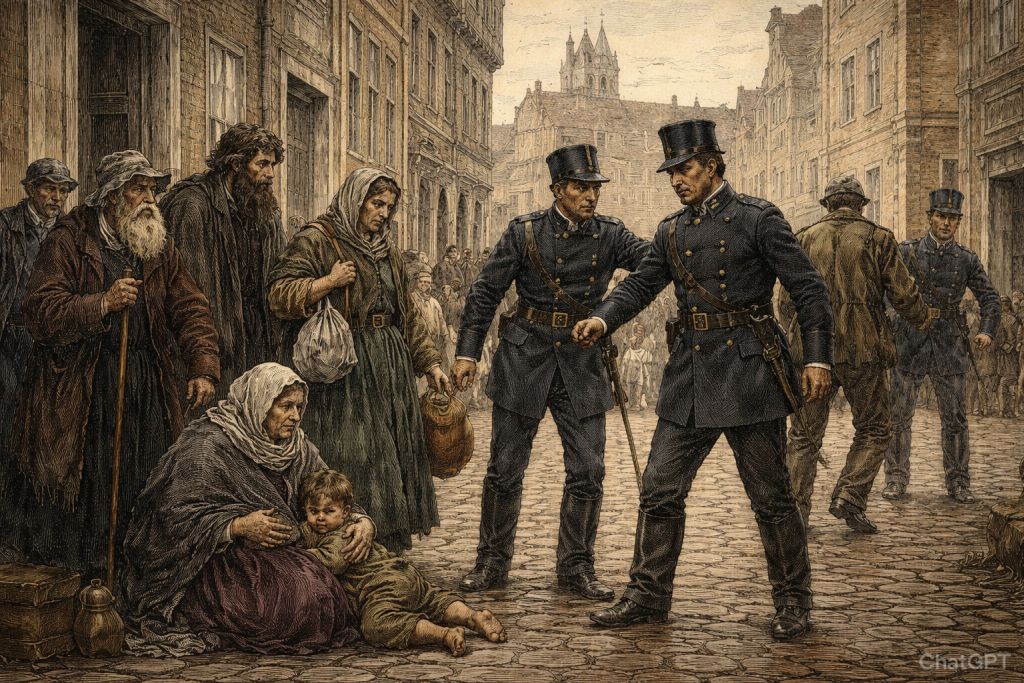
The Napoleonic Wars took place from 1803-1815, and in its aftermath, the economy stagnated, regional crops failed, and the population grew rapidly. That left many without stable employment or a secure income.
Poverty wasn’t merely a social problem – it was considered a threat to public order.
In that time, the Netherlands distinguished between “deserving” and “undeserving” poor. Widows, the elderly, and the disabled might receive local poor relief, while there was suspicion towards non-disabled people without work.
Poverty among those considered capable of labor was seen as economic failure, as well as moral deficiency. Society saw work as both an economic necessity and a civilizing force, and looked upon idleness as fostering disorder. It was within this framework that the state increasingly intervened.
The French period had deeply influenced the way the Netherlands treated poverty. While occupied by Napoleon, the Code Pénal was introduced (1811 in the Netherlands). After independence in 1813, much of this legislation remained in force.¹
The Code Pénal explicitly criminalized bedelarij (begging) and landloperij (vagrancy) in articles 269–282. It allowed people to be arrested, not for theft or violence, but for not having a home, a job, or any demonstrable means of subsistence. Poverty without visible support was seen as a danger to public order.²
The law did not require proof of malicious intent. Simply being “zonder vaste woon- of verblijfplaats” (without fixed residence) could justify detention. In effect, condition replaced conduct as the basis for criminalization, in other words, your situation weighed heavier than your actions.
The French administration had already established beggar depots in 1811. After Dutch independence, the government kept and adapted this system. Confinement, rather than relief alone, became a structural tool for managing visible poverty.³
Local authorities were well within their rights to remove individuals seen as beggars or vagrants from their jurisdictions. Courts could sentence them to labor institutions or correctional facilities. Those placements increasingly fell within a developing framework of state work institutions – rijkswerkinrichtingen.
The criminalization of landloperij reflected broader moral thinking. The Protestant ethics – it promoted working in the world to glorify God – influenced the thinking of Dutch reformers, who believed that discipline, rural labor, and supervision could transform the poor into productive citizens.
An unmarried mother without steady income, a seasonal worker between contracts, or a family migrating in search of employment could all fall under suspicion. Economic instability was often seen as a sign of moral weakness. Policymakers believed the solution lay in structured labor under supervision.
This principle remained embedded in Dutch legislation throughout the nineteenth century. Even after introducing the Dutch Criminal Code — the Wetboek van Strafrecht — begging and vagrancy remained punishable offenses.⁴
It wasn’t until the year 2000 that the Netherlands officially ended the laws making landloperij a crime.⁵
For us researching our family history, the above legal framework is essential for interpreting the documents we found in the archives. Terms such as landloper, bedelaar, zonder middelen van bestaan, or any references to administrative transfers weren’t just casual descriptions. All of those reflect a structural legal system that classified and regulated poverty.
When documents from the nineteenth century show institutional placement, the reason for it might not have been a serious crime, but rather economic vulnerability within a legal culture that saw poverty as a disorder.
The archives offer greater insight into the society that created them than into the individual’s character.
In our own family history, those laws shaped the lives of direct ancestors. The criminalization of begging and vagrancy was not an abstract legal theory. It determined where people were sent, how families were separated or confined, and how children were raised within institutional systems.
To understand what happened to those transferred under such classifications, we must turn to the institutions that received them.
That story follows in the next article.


2 thoughts on “BECOMING KUIPER – Part 2: A Crime Called Poverty”