 11

In January 1893, Pieter Jacobus Vorster and his wife, Cecilia Johanna Steyn, left their home in Bethal. They packed their entire lives into a single wooden wagon and joined what later became known as the Sixth Dorsland Trek.
The group was led by Cecilia’s brothers, Pieter and Johannes Steyn. Their goal was the high plateau of Humpata in Angola, a journey of nearly 3,000 kilometers that would take more than a year.
The families knew the dangers. They still remembered the terrible stories of Die Dors from the earlier treks of 1874 and 1877. Many had died in the sand, but the 1893 group believed they were better prepared. They were more organized and planned to follow known routes with mapped wells. Still, everyone understood that knowledge could not remove the shadow of danger.
The wagons first moved across the Highveld toward Pretoria to prepare for the long road ahead. They bought supplies in huge quantities: salt to preserve meat, gunpowder for hunting and protection, and coffee, flour, and tools. Every wagon was strengthened to survive thousands of kilometers of rocks and deep sand. They took everything they might need to survive, knowing that once they entered the desert, there would be no turning back.
The sun rises behind Bethal. Smoke curls from the chimneys of the homes they are leaving behind. In the distance, neighbors wave a final goodbye.
Cecilia stands by the wagon, clutching a bundle of blankets to her chest. Her eyes are wet with tears as she looks at the land she may never see again.
Pieter tightens the heavy ropes on the oxen. He glances at the empty horizon and swallows hard, feeling the weight of the journey ahead.
‘No looking back,’ he whispers to himself. ‘Only forward.’
From Pretoria the route turned northwest through Rustenburg and Zeerust toward the Crocodile River and the Marico region. Near the Marico River they joined the earlier Hamman group, which had left Bethal in December 1892. The trek grew larger. More wagons meant more protection, but also more mouths to feed and more animals that needed water.
The Limpopo and later the Notwane River near Kanye and Molepolole marked the last dependable water before the real sandveld of the Kalahari began. These rivers were not always wide or strong, but they were permanent enough to allow the trekkers to rest their oxen, fill barrels, and reorganize their wagons before facing the desert.
At the Limpopo, Pieter kneels by the water. He fills a small cup and drinks slowly. It tastes like life itself.
Cecilia dips her hand into the cool river. She watches the oxen drink until they are full. Nearby, the children splash and laugh in the water. For a moment, everyone is happy.
Pieter smiles, but only for a second. He looks at the dry horizon and his heart grows heavy. He knows that tomorrow, the sand will swallow them.
Soon, the sound of the river will be only a memory.
Beyond Kanye the land changed. The hard soil of the Transvaal disappeared and red sand began. Wagons that had moved steadily before now struggled. Wheels sank into the sand and oxen had to pull harder. From that point, survival was measured in days between wells. The stretch from Kanye to Lehututu could take three to four weeks. Sometimes wells lay sixty or more kilometers apart, which meant careful rationing of water.


By late August and September 1893 the trek entered the central Kalahari along what was known as the ‘Ghanzi route’. This route had been used by earlier trekkers and by traders, but it remained extremely dangerous.
The Kalahari is not a desert of high sand dunes like the Sahara. Instead, it is a vast, dry land where water is hard to find. There are no permanent rivers here. Water only exists in small pans and deep wells, but many of them are bone-dry during the heat of the year. Every mile was a gamble with life.
The suffering of ‘Die Dors’ began slowly. For the first two days, the oxen were still strong. The water barrels were still half-full. But by the third day, everything changed.
The water in the barrels turned warm and tasted like metal. The oxen stopped eating because their throats were too dry to swallow the rough grass. Without food or water, the animals began to fail. Silence fell over the wagons as the heat grew stronger.
After four days without water, crisis began.
The desert did not just break the people; it broke the animals that carried them. The oxen showed terrible signs of thirst. Their tongues swelled and turned black, hanging from their mouths like heavy stones. Their breathing became a ragged, desperate struggle for air.
In the middle of night, the desert was no longer silent. The normal sounds of the cattle changed into something far more terrifying. It was a deep, painful crying that many survivors later described as sounding almost human — like the cries of people in agony. Many survivors later described this ‘human’ crying of the dying oxen as the most haunting memory of the desert.
One by one, the animals collapsed into the burning sand. When they could no longer rise, they were left behind. Their hollow cries followed the families as they walked away, a sound that would echo in their minds for the rest of their lives.
When the water ran out, the trekkers turned to a horrifying last resort. They did not kill their dying animals for meat, but for the moisture hidden inside them. Historical records describe desperate men cutting open the stomachs of fallen oxen to find any liquid left. They would kneel in the sand beside the carcasses, using their hands to collect the bitter fluid from the stomach just to stay alive for a few more hours. It was a grisly, desperate act of survival in a land that offered nothing else.
While the desert was breaking the men and the animals, Cecilia was fighting a different battle.
Based on the baptism record of her daughter Sara Susanna in Humpata in July 1894, Cecilia likely became pregnant around October or November 1893. This was the exact moment the trek left the last reliable water. While her body was starting to support a new life, the world around her was becoming a land of death.
Historical records of the Dorsland Trek show how much women suffered during these months. Without fresh vegetables or fruit, her body prioritized the fetus, taking nutrients from her own bones and tissues.
Records suggest that women like Cecilia grew dangerously thin. Their arms became like skeletons and their faces grew hollow, leaving only their pregnant bellies as a sign of life.
Cecilia spent nearly fifteen hours a day inside the ox wagon. Historians note that these wagons had no springs to soften the ride. Every rock and sand-pit sent violent shocks through her body. Inside the canvas, the heat often rose above 40°C.
She sat in the burning dust for days, her body exhausted by the constant jolting and the growing weight of her child.
For Cecilia, the journey was more than a crossing of the desert. It became a road of silent pain, where every mile tested her faith and her body.
I watch Cecilia inside the wagon.
Her body trembles with every jolt of the heavy wheels. She is pale. Her hands clutch the edges of the canvas until her knuckles are white. Every step the oxen take throws her forward, then back. It is as if the wagon itself wants to throw her out into the burning sand.
I swallow hard, but I stay silent. I cannot tell her how terrified I am. She is carrying our child. Every mile through this burning sand feels like a knife in my heart. I count the distance to the next well, watching the shaky, tired legs of our oxen. I pray they do not collapse.
For a moment, her eyes meet mine. They are so full of trust, yet so full of fear. I tighten my jaw and look away toward the horizon. We will survive this. We have to.
The desert forced the trekkers to make choices that broke their hearts. To stay alive, they had to throw away their lives piece by piece. Heavy furniture was cast into the sand first, followed by tools and personal treasures. In the burning heat of the Kalahari, every extra pound was a step closer to death.
As the oxen died, the wagons became too heavy to move. Eventually, many families had no animals left at all. They were forced to walk away from everything they owned. Entire wagons were left behind, still standing in the silence, filled with clothes, family Bibles, and precious belongings that no one would ever touch again.
Because the desert air was so bone-dry, these wagons did not rot. They stood perfectly still for decades, like wooden skeletons haunting the dunes. Beside these wagons lay many unmarked graves — the final resting places of men, women, and children who lost their battle with the merciless sun.
When the next groups of trekkers passed years later, they found these ‘frozen’ caravans and silent graves exactly as they had been left. This haunting sight gave the route its name: the ‘Ghost Trek.’ These abandoned pieces of life served as a chilling warning that in the Dorsland, survival was never guaranteed.
That night, I cannot sleep.
The camp is silent, but it is not peace. It is exhaustion. Even the children have stopped crying. The oxen lie in the sand like fallen shadows.
I saw it today. Strong men from Bethal — men who once stood tall — were kneeling beside a dying ox. Their hands were shaking. Their faces were turned away from each other. They were not killing for meat. They were desperate for any drop of moisture inside the animal.
I never thought I would see such a thing.
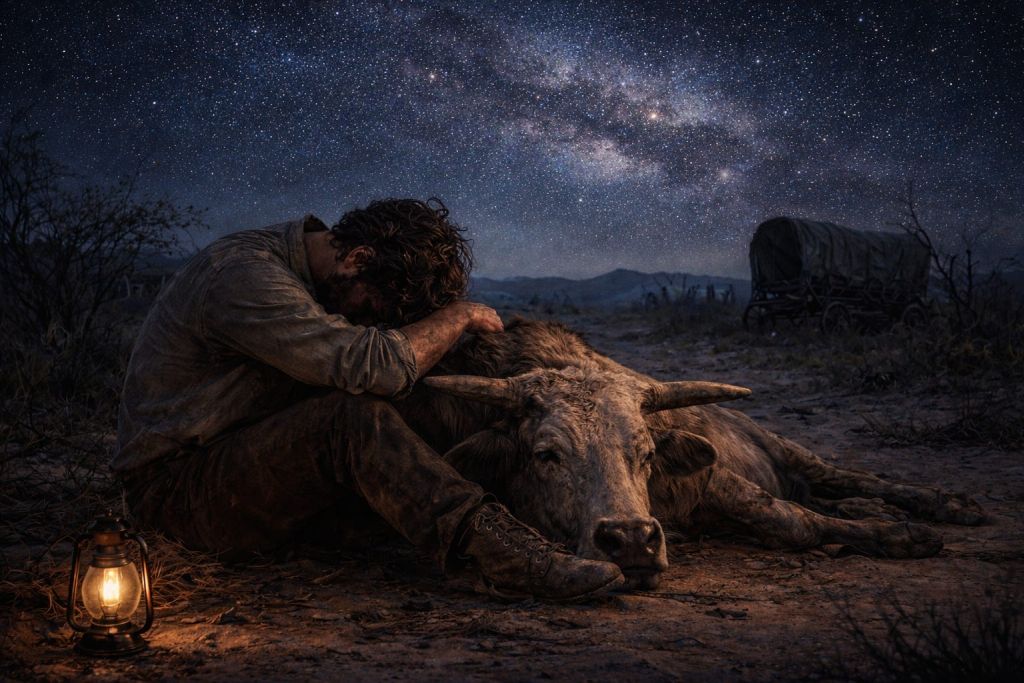
Now, one of my own oxen lies near our wagon. He has pulled us since the beginning. Through rivers, thorns, and deep sand.
I sit beside him. His skin burns under my hand. I speak softly to him, though I do not know why. Maybe because he has carried our home. Maybe because I do not want him to die alone.
‘Lord,’ I whisper into the dark, ‘is this Your will? Or did we only hear our own longing?’
The wind moves over the sand.
‘Cecilia is sleeping in the wagon. She carries our child. Have I led her into death? Have I asked too much of her faith?’
The ox struggles for breath.
‘I told her You would not abandon us. Was I wrong?’
His breathing slows. I feel it under my palm. Slower. Slower.
‘Please,’ I whisper, ‘if someone must fall, let it be me. Not her. Not our child.’
Then, he is still. The desert is silent.
Something inside me breaks. I bow my head against his neck and, for the first time since we left home, I cry. I do not cry as a leader or a husband. I cry as a man who is afraid.
In the morning, I will stand up again. But tonight, I do not know if this is faith—or foolishness.
During this part of the journey, the trekkers met the San people. The San were the oldest inhabitants of Southern Africa and the true masters of the Kalahari. They lived as hunters and gatherers, and they understood the desert better than anyone else.

The San showed the trekkers how to find life where there seemed to be none. They introduced them to the tsamma melon, a wild desert fruit that grows in the sand after the rains. These melons are bitter, but they are filled with water. In the middle of the Dorsland, these melons were often the only thing that kept both humans and oxen alive.
The San also taught the Boers how to find water hidden deep beneath dry riverbeds. They knew exactly where to dig to reach damp soil, letting water slowly seep into a hole. This required great patience and local knowledge that the trekkers did not have.
The relationship between the trekkers and the San was complex, but they often worked together to survive. In the heart of the desert, the San’s ability to read the land was the difference between life and death. Without their help, the migrating wagons might never have moved forward.
When the trek finally reached waterholes like Tlhabala or the small wells along the Ghanzi line, the relief quickly turned into a nightmare of disorder.
After days of burning thirst, the oxen could no longer be controlled. They smelled the moisture and rushed forward in a mad stampede, trampling the delicate springs into thick mud.
In an instant, the clear water was gone. The wells became a sickening soup of mud, sand, and dung. To survive, the trekkers had to scoop this mixture carefully, filtering the precious liquid through cloths. Every drop was like gold. Men had to stand guard with whips and guns to maintain discipline. Without it, a single thirsty animal could destroy an entire well in minutes, leaving the rest of the trek to die of thirst.
The road from Lehututu to Ghanzi was about 250 kilometers of deep sand. On a good day, the wagons moved only fifteen to twenty kilometers. But when the oxen grew weak, the daily distance became even shorter. This meant the journey took much longer. It could take ten days to reach a well, and for five of those days, the animals had no water at all. Every hour was a race against time. Every sunset brought them closer to death — or closer to the miracle of Ghanzi.
After weeks of death and dust, Ghanzi appeared. The endless sand finally gave way to green grass and limestone pans filled with cool, fresh water. It was a true oasis. Near the water stood the stone ruins of an old hunter’s house — a silent welcome for the weary. For the exhausted families, Ghanzi was the place where they could finally stop running from thirst and breathe again.
Some families saw a future in this land and chose to stay in Ghanzi forever. But for others, like Pieter Jacobus Vorster and the Steyn family, this was only a temporary refuge. Their hearts were still set on the high plains of Humpata in Angola.
I lifted Cecilia into my arms as gently as I could. Her body was heavy with exhaustion, and beneath my hands I felt the small life of our child beating beneath her heart. Her head rested against my shoulder. For the first time in weeks, her breathing was calm.
There was no more dust. No more shaking of the wagon. I set her down gently on the soft grass near the limestone well. Around us, the oxen finally drank their fill, and the other families began to unpack their thin blankets. For a moment, the world was silent and safe.
We would stay here for weeks to find our strength again. We told ourselves the ‘Dorsland’ was behind us, but the desert was only catching its breath.
The horizon toward Rietfontein still shimmered with a heat that looked like fire, and at night, the wind carried new sounds from the north – the heavy scent of wet earth and the distant, hungry shadows of the Kaokoveld.
The journey was far from finished. Beyond the sand, the air was changing. A strange, heavy mist was waiting for us near the waters of the Okavango, and the Kunene River was still a deep, dark line on our maps.
We had survived the thirst, but now the wilderness was watching us, waiting for its turn.
In Honor of the Oxen
The story of the Dorsland Trek is often told through the suffering of people, but the journey was only possible because of the oxen. Each wagon required sixteen to eighteen animals to pull through the deep sand.
During the first major treks between 1874 and 1881, historians estimate that 9,000 oxen perished in the Kalahari. In the worst moments, some families lost almost every animal they owned.
Many oxen collapsed from thirst, while others disappeared into the desert in a panicked search for water. When these animals died, families were stranded and their wagons were abandoned forever.
Their strength carried the trekkers forward. Their deaths showed the true cost of the desert.

SOURCES:
Wikipedia – Dorsland Trek
Dr. Nicol Stassen – South African historian and publisher, considered the leading expert on the Dorsland Trek and the Afrikaners who traveled from the Transvaal to Angola in the late 19th century.


2 thoughts on “THE DORSLAND TREK – Part 3: Die Dors”