 11

Continued from…
We move through the house without speaking. The choice has already been made. It is carved into our hearts by the horror of the last few days. There is nothing left to say. There is only movement—quiet, careful, and desperate. We move as if the walls have ears. We move as if the shadows themselves will turn against us if we breathe too loud.
I follow my brother, Guillaume, into the main room. The fire has burned down to a soft, pulsing glow. It casts long shadows that dance across the ceiling. The house feels smaller tonight, and colder, as if it is already mourning. It is no longer our shelter—it is only a memory.
Guillaume gathers what we can carry. His hands move fast, but his face is like stone. A piece of dry bread wrapped in cloth. A small flask of water. A heavy wool coat to shield us against the biting night air. He does not hesitate. In his eyes, I see the truth: there is no room for doubt anymore.
My eyes wander one last time. I see the table where we shared our meals. I see the chairs where we sat in the evenings, and the wooden beams that have held this roof over our heads for generations. Everything is still here, frozen in time, pretending that our world is not shattering. I place my hand on the table, feeling the rough wood beneath my fingers. I try to hold on to something familiar. But the wood feels cold. It already belongs to a life that no longer exists.
Guillaume stops. The family Bible lies on the table. Its leather cover is smooth from years of secret study. He looks at it for a long, silent moment. Then, he closes it with a gentle finality. He wraps it in cloth and hides it deep in his bag. It is our only treasure. It is the one thing we refuse to leave behind.
After the King signed the Edict of Fontainebleau in 1685, the world for Protestants in France turned upside down. It was a time where hope seemed to vanish overnight. The Reformed Church was not just discouraged—it was officially banned. Across the country, the sounds of hammers and falling stone filled the air as Protestant churches were torn down. Ministers were given a cruel choice: leave the country in two weeks or face even worse. This meant the leaders and the buildings that had guided the Du Toit family for generations were suddenly gone.
For ordinary people, the laws were even more trapped. Believers were forbidden from gathering anywhere, even in the privacy of their own homes. Anyone caught praying with neighbors or hiding a Bible could face terrible punishments. But, at the same time, the King made it a crime to leave France. He wanted to keep his best craftsmen and farmers to work for his kingdom, and he did not want their “rebel” ideas spreading to other lands. The Huguenots were prisoners in their own country, forced to choose between their secret faith and their safety. Despite the guards at the borders and the threat of the galleys, thousands chose to run.
For François and Guillaume du Toit, the only way to survive was to look north. They lived in Lille, which was very close to the border of the Spanish Netherlands and the Dutch Republic. While the distance was short, the journey was incredibly dangerous. Because Lille was a border city, the region was crawling with soldiers. Patrols watched every main road, every bridge, and every river crossing. Spies looked for anyone carrying bags or looking nervous.
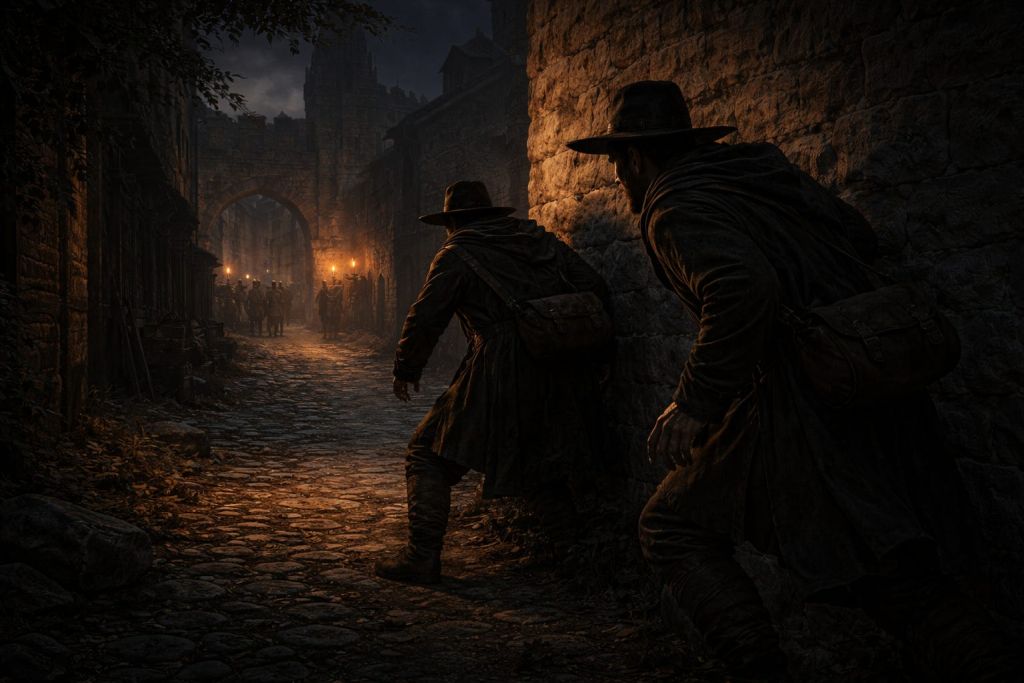
To escape, the brothers had to become shadows. Like most refugees, they likely traveled only at night, moving quietly through thick forests and muddy marshlands. They had to avoid the bright lanterns of the towns and the noise of the main roads. The journey required perfect timing and a lot of luck. They relied on “underground” networks—secret paths and kind strangers who offered a piece of bread or a hidden barn to sleep in during the day. Every snap of a twig or bark of a dog could mean they had been discovered. The trip, which should have taken a few days, could take weeks of hiding and waiting.
Behind us, the house is silent. But the silence is heavy with the horrors we just witnessed.
I can still see little Marie being dragged into that black carriage, her small hands reaching out for a mother she might never see again. I can still hear the terrible, ragged screams of Monsieur Joubert coming through the wall as the dragoons held him to the fire. Those sounds are burned into my mind—a warning that if we stay one minute longer, his screams will become our own.
Guillaume reaches for the door. He pauses, his hand pressing against the wood we have trusted for so long. He is listening. I hold my breath, my heart hammering against my ribs. Outside, Lille is alive with danger. In the distance, a horse moves. The sound of hooves is sharp and hollow. A shout rises far away, only to be cut short by a terrifying silence. They are no longer just watching us. They are taking us.
Guillaume opens the door. The cold air hits us instantly. It smells of damp stone and woodsmoke. It rushes into the house, pushing away the last traces of warmth. The street is dark. Only a thin line of moonlight cuts between the buildings. It is just enough to guide our steps, but not enough to make us feel safe.
This door is no longer a shield. It is a border. Once we cross it, there is no turning back.
I step out. The stone beneath my boots is icy. In the silence, every footstep feels dangerously loud. I wait, trembling, expecting a hand on my shoulder or a shout from the shadows. Nothing comes. Only the wind. Guillaume follows and quietly closes the door. As the door locks, I know our home is gone forever.
The streets of Lille are a maze of shadows. I have walked these paths a thousand times, but tonight, I am a stranger in a foreign land. We stick to the narrowest alleys, our shoulders brushing against the cold brick walls. We move like “shadow-people,” carrying our lives in small bundles. We are leaving our ancestors in the ground and walking toward a future we do not know.
We reach the edge of the city where the houses thin out. There are no walls here to hide us, only the vast, terrifying emptiness of the fields. I stop, staring into the blackness. I cannot see the end of the road. But as I look back at the silhouette of Lille, I know that our old life is dead.
Guillaume steps beside me. For a moment, we stand there together. Then he nods, just once. That is enough. We turn our backs on everything we have ever known and walk forward into the dark.
By the late 1680s, the dusty and tired refugees began to appear in the safe cities of the North. They arrived in places like Leiden, Haarlem, and Amsterdam, looking for a new start. The Dutch Republic had gained a reputation as a land of freedom, and the Dutch people opened their doors to these skilled workers.
In these cities, the Walloon Churches played a vital role. These were French-speaking Protestant communities that had been in the Netherlands for a long time. They became the heart of the refugee world. The church leaders carefully wrote down the names of everyone who arrived, noting where they came from and when they reached safety. These old, yellowed registers are where history suddenly becomes personal. By 1687, the names of François and Guillaume du Toit appear in the records of the Walloon Church in Middelburg. This proves that the brothers had successfully crossed the dangerous lines and reached a place where they could finally breathe freely.

The Du Toit brothers were part of a massive human wave.
Between 1685 and the early 1700s, nearly 200,000 Huguenots fled France, even though it was illegal. Tens of thousands of them settled in the Dutch Republic. They were welcomed because they brought valuable skills in weaving, farming, and trade. They were disciplined people who were eager to work and rebuild what they had lost.
While many stayed in the busy Dutch cities, others felt the pull of an even greater horizon. They moved on to England, Germany, or Switzerland. But for some, even Europe felt too small or too close to the King’s reach. They began to look toward the distant colonies across the ocean.
The journey north was not the end of the story for François and Guillaume, but it was the most important turning point of their lives. They had left behind their house, their friends, and the graves of their parents. They chose the unknown over a life of hiding. From the crowded streets of Lille to the cold canals of Middelburg, they carried their name, their skills, and a burning desire for a place to call home. And from the docks of the Netherlands, an even longer journey across the sea was waiting for them.
The road out of Lille was more than a path through the dirt. It was a journey between two worlds. Behind Francois and Guillaume lay the ashes of their past and the anger of a King. Ahead lay a dangerous border and a future that was not yet written. They were no longer citizens of France. They were refugees, walking toward a safe place they had only heard of in their prayers.
Continued here…


2 thoughts on “BLOOD OF THE HUGUENOT – Part 8: Into the Night”