 11

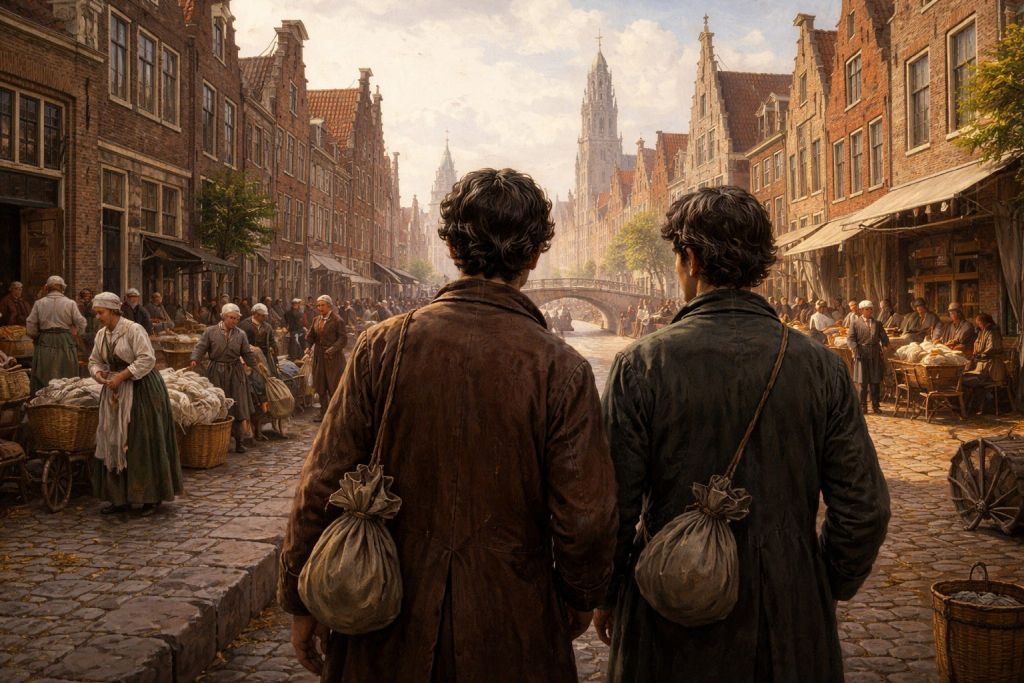
The door is heavy.
As I push it open, warm air flows toward us, carrying soft voices, quiet prayers, and the gentle sound of wooden benches shifting. The moment we step inside, I feel the difference between this place and the world outside. It feels calmer, almost protected, as if the fear we carried with us has been left at the door.
For a moment, I hesitate and remain where I am, taking in the room before me.
The room is full of people, but no one speaks out loud. Men and women sit close together. Some bow their heads in prayer; others whisper softly. A few just stare ahead, lost in thought. Even though no one says it out loud, it is clear that they all carry the same burden we do.
We have all lost something.
At the front, a man stands behind a simple wooden table. There is nothing of wealth or decoration around him, only a worn Bible and a large open book, ready to receive new names.
Guillaume places a hand on my arm, gently pushing me forward.
“Come,” he says quietly. His voice is calm, but I can feel the weight in his words.
I nod and follow him deeper into the room.
We join a small line of people who are waiting near the front. No one speaks, and no one needs to explain why they are here. We all understand that this is a place where we must be seen, where we must be known, and where we hope to belong again.
When it is our turn, the man behind the table looks up at us. His eyes are calm, but they study us carefully, as if he is trying to understand more than what we say.
“Your names?” he asks.
“Guillaume du Toit,” my brother answers.
“François du Toit,” I say.
My voice is softer than I expected, but the man nods without comment and dips his pen into ink.
“You came from France?” he asks.
“Yes,” Guillaume replies.
The man pauses for a moment and looks at us more closely.
“And your faith?”
The question lingers in the air, and for a moment I feel myself pulled back to Lille, to the darkness, to the closed doors and whispered prayers where every word carried danger.
My chest tightens as the memory hits me. But this isn’t Lille. There are no soldiers here, no boots on the stones, and no fear in the shadows. Still, the words are hard to say. They carry the weight of everything we’ve been through.
Guillaume answers first.
“We did not abandon it,” he says steadily. “Not at home, and not on the road.”
The man then turns his eyes toward me, waiting.
I swallow before answering. “We kept it quiet,” I say, “but we did not abandon it.”
For a moment, the room feels completely still. Then the man gives a small nod and begins to write. Slowly and carefully, he writes our names into the book before him.
The sound of the pen moving across the paper is soft, but to me it feels louder than anything else in the room. For the first time in a long time, our names are no longer hidden or spoken in whispers. They are written down, openly and without fear.
I hear Guillaume let out a slow breath beside me, and only then do I realize that I have been holding mine as well.
We are no longer hiding. As I look around the room again, I finally understand something. We are safe here, but we are surrounded by people who have walked the same road. They have all left behind homes, families, and entire lives.
We are not alone in our loss.
Before the Dutch Republic became a place of refuge, it was a land marked by conflict, fear, and long years of war.
In the sixteenth century, these regions were part of the Spanish Netherlands. They were ruled by King Philip II of Spain, a strict Catholic ruler who did not allow Protestant belief. People who followed the Reformed faith lived under constant pressure. Many were punished, imprisoned, or even executed. Faith was not a private matter. It was something that could cost a person their life.
This created deep unrest among the people.
Over time, that tension grew into open resistance. In 1568, the Eighty Years’ War began. It was a long and difficult struggle that lasted until 1648. It was a fight for land and power, but also for something more personal—the right to believe differently and to live without fear because of it.
In 1579, several northern provinces joined together in the Union of Utrecht. This became the foundation of what would later be known as the Dutch Republic. After many years of war, their independence was finally recognized in 1648 with the Peace of Westphalia.
Out of struggle, a new nation had been formed.


By the late seventeenth century, the Dutch Republic had gained a reputation for something rare in Europe. It had a level of religious tolerance that many other countries did not offer.
The Dutch Reformed Church was the main church, but other Protestant groups were often allowed to live and worship, especially in the cities. People could begin again. They could build a life without hiding who they were.
This became especially important after the year 1685.
In that year, King Louis XIV of France revoked the Edict of Nantes. For many years, this edict had offered protection to Protestants in France. With one decision, that protection disappeared.
Churches were closed and pastors were forced to leave. Families were pressured to convert. Soldiers entered homes, and daily life became filled with fear and uncertainty.
For the Huguenots, there was no future left in France.
Thousands fled. Many traveled in secret, often at great risk. They left behind homes, land, and family. Some never saw their loved ones again.
Many of them found their way to the Dutch Republic.
Cities such as Leiden and Middelburg became important places for these refugees.
In these cities, Huguenots could worship openly again. This was something that had become impossible in France. The Walloon Church, also known as the Église Wallonne, played an important role in this. It was a church created especially for French-speaking Protestants.
These churches were more than places of worship. They were places where people could be seen, where their faith could be confirmed, and where they could become part of a new community.
But safety did not mean comfort. The cities quickly became crowded as more refugees arrived. Work was not always easy to find. Many families had to begin again from nothing.
Leiden became known for its large textile industry. It was one of the most important in Europe at the time. Many refugees found work there as weavers, bakers, and craftsmen. Among them were also earlier generations of the Du Toit family. Their names appear in records in Leiden as early as the beginning of the seventeenth century.
Over time, however, the city became too full. Work became harder to find, and life remained uncertain.
Some families began to move again.
Many Huguenots moved south to Middelburg.
Middelburg was smaller than Leiden, but it was a powerful port city. Ships left its harbor for distant parts of the world, including Africa and Asia. It was a place of movement, trade, and opportunity.


In 1687, the names François du Toit and Guillaume du Toit appear in the records of the Walloon Church in Middelburg. At first, it is only a simple entry – names written in ink on paper. But behind those names lies a much longer story. A story shaped by loss, movement, and survival.
The Dutch Republic offered safety, but life remained uncertain. Many families were still searching for something more stable. Something lasting. It was during this time that a new possibility began to take shape.
Middelburg was not only a place of refuge. It was also a center of global trade, where the influence of the Dutch East India Company could be felt everywhere.
The VOC had been founded in 1602 by wealthy merchants together with the Dutch government. Over time, it became one of the most powerful organizations in the world.
It was not an ordinary company.
It had the right to mint its own coins. It could build forts in distant lands. It had its own army and navy. It could even wage war when needed. Through its network of ships, it connected Europe to Africa and Asia.
By the 1680s, the VOC was at the height of its power. But one of its most important stations, the Cape of Good Hope, was struggling.
The Cape had been created as a refreshment station. Ships traveling to Asia stopped there to rest and take on fresh food and water. But the station could not produce enough to support the growing number of ships.
This became a serious problem.
Behind the great ships and distant settlements of the Dutch East India Company stood a group of men known as the Heeren XVII. Their name means “The Seventeen Gentlemen.” They were the directors of the VOC, chosen from different cities in the Dutch Republic. From their meeting rooms, they made decisions that affected trade, travel, and life across the world.
They decided where ships would sail, what goods would be traded, and how distant places like the Cape of Good Hope would be managed.
It was this group that saw the growing problem at the Cape, where ships needed more food and supplies. They understood that the Cape needed more than short-term help. It needed permanent settlers. People who could farm the land, grow food, and build a stable community.
They were not looking for soldiers or adventurers. They were looking for families.
At the same time, thousands of Huguenots were trying to rebuild their lives in the Dutch Republic. Many had skills, discipline, and strong values, but they lived in crowded cities with little certainty. For the VOC, this created an opportunity.
In 1687, the Company began offering contracts to refugees like François and Guillaume du Toit.
They offered land at the Cape. Each settler would receive a large piece of land, enough to build a farm and support a family. For people who had lost everything, this meant something they had not known in a long time. It meant the possibility of a future. The Company also paid for the journey, which made the offer possible. The voyage was long and dangerous, and most refugees could not afford it on their own.
But the offer came with conditions. Settlers had to swear loyalty to the Dutch Republic and to the VOC. They had to agree to stay at the Cape for at least five years. In reality, the distance made return almost impossible. For most, this decision was permanent.
They were also given tools, seeds, and sometimes livestock. These were provided on credit. This meant they arrived with debt and had to work hard to repay it.
For many families, this was a difficult choice. For François and Guillaume, it was even more personal. Their parents, Pierre du Toit and Marie Rouselle, remained behind in France. Accepting the offer meant leaving them behind forever. This was not only a decision about land or work. It was a moment that would change everything.
The Heeren XVII never saw the land themselves. They never walked the soil or faced the dangers of the frontier. But their decisions shaped everything that followed.

The ship that would carry François and Guillaume away from Europe was called the Vrijheit.
It was a vessel of the Dutch East India Company, built in 1666 in Amsterdam. It was a strong and fast ship, known as a pinnace, designed for long journeys across dangerous seas.
By the time they prepared to board, the ship had already been in service for more than twenty years. It had crossed oceans many times, carrying goods, supplies, and people between continents.
The ship was large, about 170 feet long and 39 feet wide. It could carry heavy cargo, up to around 1210 tons. But it was not built for comfort. On board were between 240 and 300 men. Sailors, soldiers, officers, and workers all lived and worked in tight spaces.
Most of the ship was filled with cargo. Barrels of water, food supplies, tools, and trade goods took up much of the space. Passengers had little room. Life on board was crowded, dark, and difficult.

The journey to the Cape could take between three and five months. The sea was never predictable. Storms could rise without warning. Illness could spread quickly. Every day brought new uncertainty.
Ships often traveled together for safety. Others, like the Voorschoten and the Oosterland, made similar journeys during this time.
For the VOC, the purpose was clear: they needed food production at the Cape. But for François and Guillaume, the meaning was different. The Vrijheit was more than a ship. It was the line between everything they had known and everything that lay ahead. Once they stepped on board, Europe would begin to disappear behind them and the sea would carry them forward.
There was no turning back.
The harbor is alive long before the sun has fully risen.
As we walk through the streets of Middelburg, the quiet of the early morning slowly gives way to movement, to voices, to the sound of work already beginning. The closer we come to the water, the more the air changes. It smells of salt, tar, wet wood, and something else I cannot name, something that belongs to the sea.
People move in every direction. Sailors shout to one another as they carry ropes and barrels across the docks. Workers push carts filled with supplies, their wheels grinding over the wooden planks. Crates are lifted, dragged, and stacked. Everywhere there is motion, urgency, and purpose.
And above it all, the ships rise.
I slow my steps without meaning to.
They are larger than I imagined. Dark shapes against the pale morning sky, their masts reaching upward like tall, silent trees and their ropes hanging like webs. The hulls are heavy and worn, marked by journeys I cannot even begin to understand.
Somewhere among them is our ship.
“The Vrijheit,” Guillaume says quietly, as if he can read my thoughts.
I follow his gaze, and then I see it.
It stands close to the far side of the dock, its dark wooden body resting deep in the water. Men move along its deck, preparing for departure.
For a moment, I stop walking. Everything inside me tightens.
This is no longer a road we can turn away from. This is not like leaving Lille in the night, when the darkness still held a way back if we had chosen it. This feels final in a way I cannot ignore.
I look at the ship, and then at the water beyond it. It stretches further than I can see.
“Guillaume…” I begin, but the words do not come easily. “What if we are wrong?”
He does not answer immediately. Instead, he steps closer to me and follows my gaze toward the ship. For a moment, he says nothing, as if he is weighing the same thought, feeling the same doubt.
Then he looks at me.
“We have already lost everything once,” he says quietly. “If we stay, we lose it again. If we go…” He pauses, just for a moment. “Then we build something new.”
I shake my head slightly, still looking at the water. “We do not even know what waits for us there.”
“No,” he says. “We do not.” There is no fear in his voice. Only certainty. “But we will make it right,” he continues. “Whatever we find there, we will make it right.”
For a moment, I stand in silence. The noise of the harbor continues around us, but it feels distant now, as if I am standing between two worlds, not fully belonging to either of them. Behind me lies everything I have known. Before me lies everything I do not.
I take a slow breath. Then I nod.
We begin to walk again, this time without hesitation.
The dock feels different beneath my feet now, heavier, more real. With every step, the distance between who we were and who we are becoming grows larger.
When we reach the ship, a narrow wooden plank stretches from the dock to the deck. Men move past us, some climbing aboard, others shouting instructions. No one stops us. No one asks us to explain ourselves.
Guillaume steps forward first. He places his foot on the plank and moves upward without looking back.
For a moment, I remain where I am. I turn my head slightly, just enough to see the harbor one last time. The city, the water, the life that continues without us.
Then I look forward again. And I follow him.
The deck creaks as the men step aboard the Vrijheit. Around them, the harbor of Middelburg is still in motion, but the focus has now shifted to the ship.
This is the final stage before departure. Ropes are checked, cargo is secured, and the vessel prepares to leave the dock.
Slowly, the ship begins to move away from the shore. The connection to the city breaks, and the journey toward the Cape of Good Hope officially begins.


One thought on “BLOOD OF THE HUGUENOT – Part 9: Between Two Worlds”