 11

Continued from…
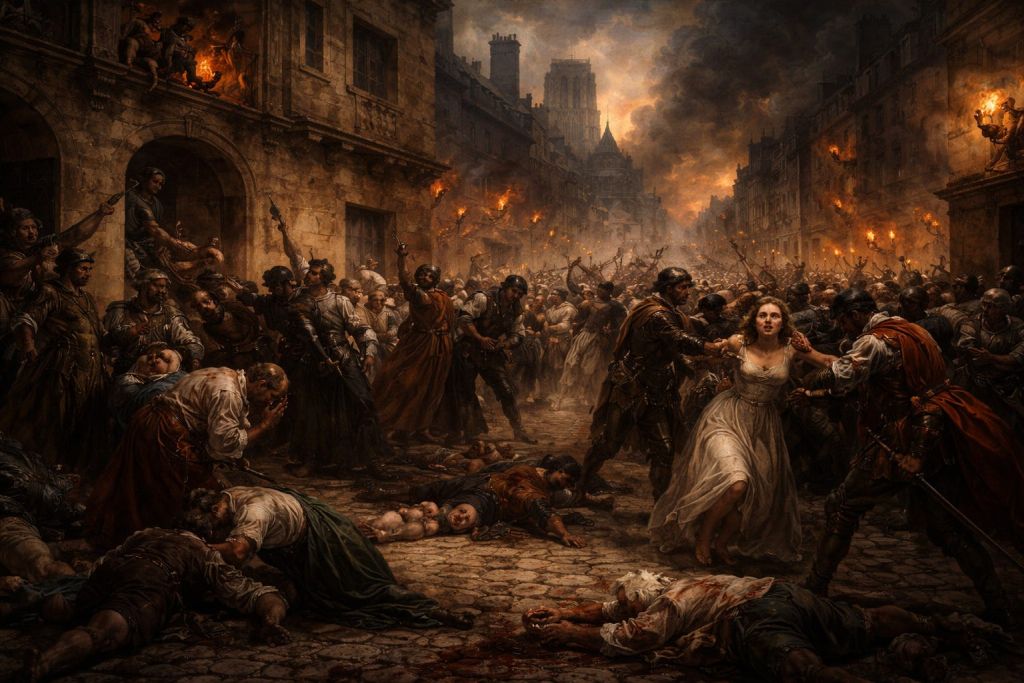
In the heavy heat of August 1572, the old city of Paris lay under a dark and suffocating silence. It was the early hours of the morning, and most people were still asleep in their beds. The narrow, twisted streets were quiet, and the warm summer air hung still above the rooftops. To anyone looking out of a window, the city seemed to be at peace. But it was a false peace, hiding a trap that was about to snap shut.
Suddenly, the silence was shattered. The deep, heavy tolling of a single church bell rang out from Saint-Germain-l’Auxerrois. The sound moved like a wave through the dark streets, hitting the stone walls and waking the sleeping city. It was not a call to prayer; it was a signal for murder.
Within moments, doors were thrown open. Men stepped out into the shadows, clutching swords and daggers. The faint light of lanterns caught the cold glint of their weapons. Something terrible had begun. Before the sun could rise, the gutters of Paris would run red with blood in what history would call the St. Bartholomew’s Day Massacre.
Only a few days earlier, Paris had been a place of music and laughter. People had gathered to celebrate a grand royal wedding. This marriage between the Protestant prince, Henry of Navarre, and the Catholic princess, Margaret of Valois, was supposed to be the end of the wars. Because of this promise of peace, the most important Huguenot leaders had traveled from all over France to be there.
Among them was Admiral Gaspard de Coligny, a brave and respected man. He truly believed that this wedding would finally bring Catholics and Protestants together as one people. But even during the feasts, there was a poisonous feeling in the air. Catholic citizens watched the Protestant visitors with hatred, and dark rumors began to crawl through the busy markets.

The fragile hope for peace died when an assassin hid in the shadows and fired at Admiral Coligny. Two bullets hit him—one tore off a finger and the other shattered his elbow. He survived the shot, but the attack sparked a wild panic. The King’s advisors, gripped by fear that the Huguenots would seek revenge, made a desperate and bloody choice. They decided to kill the Huguenot leaders before they could strike back.
Late on the night of August 23, royal guards burst into Coligny’s home. They found the wounded man in his bed and murdered him without mercy. They threw his broken body out of the window, down into the street below. This was the spark that lit the fire. Protestant homes had already been secretly marked with white crosses so that the mobs could find them in the dark.
What followed was a nightmare that lasted for days. The violence spread through the city like a wild forest fire. The “pure horror” of those hours is hard to describe. Men were dragged from their beds and killed in front of their families. Women and children tried to scramble across the steep rooftops or hide in damp cellars, but there was nowhere to run.
The air was filled with the sound of breaking doors, the clatter of steel, and the screams of those trapped in the narrow alleys. The violence was so great that thousands of bodies were thrown into the Seine River. The water became so thick and dark with blood that people could no longer use it. When the news reached other cities, the killing spread across France. The Huguenots felt a deep sense of betrayal that would scar their families for generations.


I wake up in the pitch dark. My head is spinning, and I don’t know what time it is. A terrifying sound is cutting through the air, shaking the very walls of my small room. It is the great bell of the Saint-Germain-l’Auxerrois, but it is ringing much too fast. It does not sound like a call to prayer – it sounds like a scream made of iron.
I crawl out of bed, my heart turning cold in my chest. Only yesterday, the streets of Paris were filled with flowers for the royal wedding. We saw the smiles. We saw the dancing. We truly thought we were safe. We thought the years of killing were finally over.
We were wrong.
I creep toward the window, my bare feet silent on the cold floorboards. I move slowly, hiding my face in the shadows. I pull the curtain back just an inch to look outside. The street below is not dark anymore. It is a bright, angry orange. Hundreds of torches are moving through the night like a river of fire.
I see men moving in the shadows, wearing white bands around their arms to mark themselves as the killers. In their hands, they carry long blades that catch the firelight as they walk. These are the same faces I see every day at the market—the baker, the smith, the neighbor. But tonight, their eyes are wide and empty. They are filled with a cold, mindless hate.
Suddenly, the first door across the street is kicked open. The wood splinters with a loud crack. Then, the first body is thrown from a high window. It falls through the air like a broken bird and hits the stones with a heavy sound. I watch, frozen, as the water in the gutter begins to turn a thick, dark red. It flows like a small river of blood.
Then, my own front door is smashed open. It hits the wall with a bang that shakes the whole house. Heavy boots thunder up the stairs. Men burst into my room. They do not speak. They do not explain. They grab my hair and my arms with rough hands. They drag me out of my bed and down the stairs, my feet scraping painfully against the cold stone steps.
The street is cold, and the air is thick with the smell of smoke. Above, the church tower stands dark against an orange sky. The great bell continues to swing, moving back and forth in a frantic rhythm. The sound begins to fade, growing quieter as the world seems to pull away.
A sudden, sharp pain stabs through my chest. I try to breathe, but the air will not come.
The red sky is visible one last time before the ringing stops completely. Everything becomes silent. The world goes cold, and then, everything goes dark.
While Paris was burning with chaos, the Du Toit family lived further north in the city of Lille (Rijsel). At that time, Lille was ruled by the Spanish Inquisition, and the atmosphere was different but just as terrifying.
In Lille, the danger was not a sudden fight. It was a cold, planned way to make people afraid. The authorities used public executions to send a message. Watching a neighbor being led to the flames or seeing a family’s home being taken away was part of daily life. When the news of the massacre in Paris reached Lille, the Du Toits realized that no roof was strong enough to protect them.
The family learned to survive by living two lives. In public, they showed total obedience to the rules. But behind closed doors, they whispered their prayers and held onto their faith. They lived with constant, gnawing fear. They knew that one wrong word, one suspicious look from a neighbor, or one small mistake could bring the Inquisition to their door and destroy everything they loved.
Historical Note
King Charles IX, pushed by his mother Catherine de’ Medici, ordered the initial hit on the leaders. However, they lost control of the city. What started as a political strike turned into a slaughter by ordinary citizens against their neighbors.
For the Du Toits in Lille, the pressure was even more calculated. The Spanish Inquisition meant that every day was a test of survival, where keeping your faith secret was the only way to stay alive.


The blood in the streets of Paris showed the world one thing: the Huguenots were no longer safe in their own country. As the fires in the city died down, a new and cold power was rising in the north. In the city of Lille, a different kind of terror was waiting for them.
Continued here…


2 thoughts on “BLOOD OF THE HUGUENOT – Part 5: The Red Wedding”