 11

Continued from…
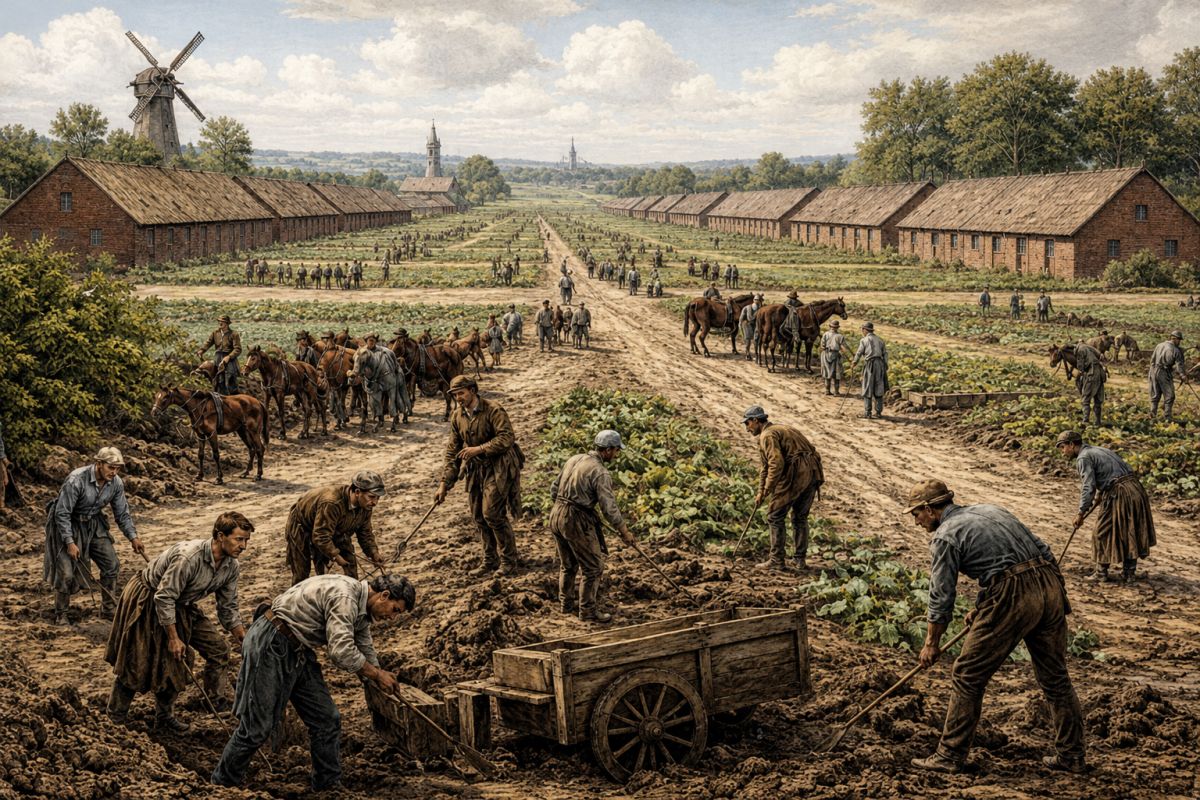
In 1818, General Johannes van den Bosch founded the Maatschappij van Weldadigheid (Society of Benevolence), an idea which came from the Enlightenment optimism. His ambition was bold: to combat poverty by relocating the urban poor to agricultural colonies in the rural north of the Netherlands.
He believed by providing land, structure, and supervision, poor families could become self-sufficient farmers. Work, discipline, and moral education would break the cycle of dependency.
The Society – Maatschappij van Weldadigheid – established several settlements in Drenthe and Overijssel. Some, such as Frederiksoord, were “free colonies”, where families voluntarily settled under supervision.
Others, however, functioned differently.
Ommerschans and later Veenhuizen became “unfree colonies.” Individuals sent there were often classified as beggars, vagrants, or socially disruptive. Placement could follow arrest under vagrancy laws. Residents were not free to leave.
The distinction between benevolence and punishment blurred quickly. Agricultural labor was compulsory. Discipline was strict. They separated families. Children had to work at a young age, contributing to the colony’s productivity.
The penal colonies served several functions:
Authorities believed that forced structure would instill work ethic and obedience. However, in reality, conditions were often harsh. Mortality rates in certain periods were high. For many inmates, the colonies represented confinement rather than opportunity.
Children were not exempt from this system. Once physically capable, they had tasks — agricultural work, spinning, weaving, or other forms of labor. Records sometimes note earnings or “verdiensten” for children as young as five or six. This was not exceptional; it was systemic.
In 1874, the Kinderwetje van Van Houten restricted factory labor for young children, but agricultural child labor remained common for decades. Within the colonies, children’s productivity formed part of the economic model.
The policies described above were not abstract. They shaped real families.
Archival records show that on 14 June 1832, a mother named Grietje Alberts Kuiper arrived at Ommerschans with her two-year-old son, Marten Kuiper. The boy’s father, Christiaan Geerts Swaak, was also present in the colony, though the parents weren’t married.


Their direct placement in a penal colony suggests classification under vagrancy or related regulations. Unmarried status, poverty, lack of stable residence, or prior judicial involvement could all have been the reason for their confinement in Ommerschans.
By the time Marten was five years old, records already noted earnings attributed to him — a small but telling sign of how fully the system absorbed even its youngest residents.

Marten was a toddler when he arrived at Ommerschans in June 1832, together with his mother. In November 1835, they were both transferred to Veenhuizen, where they were discharged in April 1839. By then, Marten was a nine-year-old boy who had already seen and experienced far too much in his short life.
Their story illustrates how quickly nineteenth-century poverty could translate into institutionalization. What began as a philanthropic experiment developed into a national mechanism for regulating the poor. Did that make those with a roof over their heads and food on their tables feel better about themselves? That they had locked away the poor, under the guise of helping them?
General Johannes van den Bosch founded the Society of Benevolence with the stated goal of uplift and reform. The system promised structure, work, and moral improvement.
For those who lived within its boundaries, however, the experience was often one of discipline, separation, and limited freedom.
The colonies reveal a tension that runs throughout nineteenth-century social policy: the desire to improve society, and the willingness to confine those who did not fit within it.
For Grietje and Marten, this tension was not theoretical. It shaped the first years of a child’s life and the course of a mother’s survival. In a next article, we will look more closely at what that meant in practice.
Continued here…


2 thoughts on “BECOMING KUIPER – Part 3: The Society of Benevolence”