 11

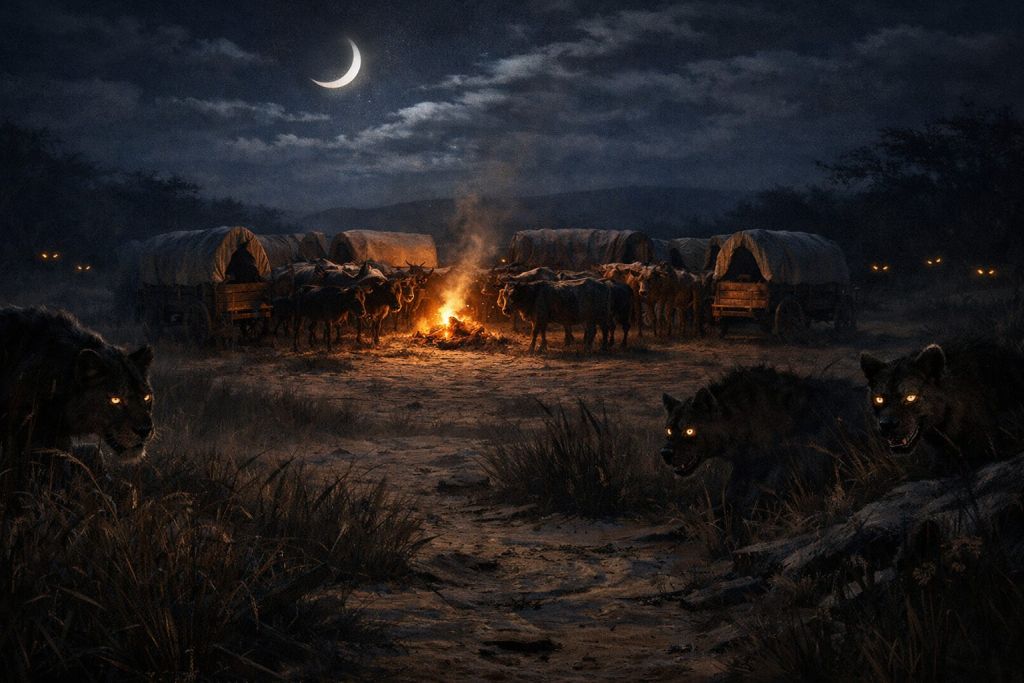
The camp was quiet, the wagons huddled close together in a rough circle. Night had fallen, and the fire flickered weakly against the darkness.
The oxen were restless. They stamped and lowed, their hooves scraping the dry earth. I sat up, straining to hear over the snorts and groans. Something was wrong.
A rustle in the grass caught my ear. Soft, almost invisible, but deliberate. I reached for my rifle, feeling its weight in my hands. Around me, the other men stirred, alert. One by one, they grabbed their guns and joined me in the center of the wagon circle. We pressed our backs together, eyes on the dark edge of the camp, each man scanning the shadows.
Suddenly, a massive shape burst from the shadows. A lion, silent and fast, sank its teeth into the neck of an ox at the edge of the circle. The ox bellowed and struggled, trying to escape.
A shot fired. The lion let go, falling to the ground. Another shot followed. The beast lay still, its yellow eyes dim in the firelight. The ox, shaken and bleeding, stumbled back toward the safety of the circle.
Silence returned, but it was tense and uneasy. The men whispered, checking the edges of the camp. The fire crackled. The oxen stamped nervously, still trembling from the attack.
I lowered my rifle, my hands shaking, and walked over to the ox. It was badly wounded.
One final shot ended its suffering.

After the trek survived the fevers of the Okavango, the families entered the Kaokoveld, a land of red rocks, deep canyons, and narrow passes. Here, they faced two of Africa’s most powerful animals: the lion and the elephant.
The lions of the Kaokoveld were known as the “Kings” of the mountains. Larger and bolder than lions from the south, they did not wait for the weakened animals — they hunted.
Because the wagons moved slowly over the jagged rocks, lions could follow the trek for days. They hid near the few remaining water holes, waiting in complete silence. When a lion struck, it often jumped onto the lead ox, and if that ox fell, the entire wagon became trapped in what the survivors called a ‘killing zone.’
At night, the roar of the lions could shake the wooden floors of the wagons. The sound was enough to break the leather riems of the oxen, sending the terrified animals running into the dark, straight into the mouths of the waiting pride.

The elephants, called the “Grey Giants”, were dangerous in their own way. Their huge size and strength made them unstoppable. On the narrow, rocky mountain paths, there was no way to move aside. Herds moving toward water would not stop for anything. A five-ton elephant could flip a wagon like a toy, crushing wheels and tearing canvas covers just to reach a water hole or clear the path. All the trekkers could do was step aside and pray the giants did not destroy their wagons.

To survive, the men kept watch every night. They built high laagers, circling the wagons tightly, and kept large fires burning. If a fire went out, lions came. If the path was blocked, elephants could charge. For months, the trek was a journey of sleepless nights, where every shadow in the Kaokoveld could hide a deadly predator.

After months of travel, the families reached the banks of the Kunene River. This was Swartbooisdrift. This river forms the border between modern-day Namibia and Angola. For the trekkers, this was one of the final major obstacles before reaching their new home.
The Kunene was wide, deep, and had a very strong current. To cross it, the men had to lead the heavy wagons into the rushing water. The riverbed was covered in slippery, green stones, making it difficult for the exhausted oxen to find a grip. Men had to stand chest-deep in the water to keep the wagons steady. If a wagon tipped over, the family would lose all their food and supplies to the river.
The Kunene River is home to one of the largest populations of Nile crocodiles in Southern Africa. These predators are very aggressive and can grow up to five meters long. Historical records show that the crocodiles were a constant threat to the livestock. While the wagons crossed, armed men had to stand guard on the banks and on top of the wagons. They watched the water closely, ready to shoot if a crocodile tried to attack the oxen or the people in the water.

Crossing the Kunene was a deep emotional moment. On the northern bank lay Angola, a land ruled by Portugal. By crossing this river, the families were officially leaving their homeland behind, leaving the influence of the British forever. Once the wagons reached the other side, the trekkers knew they would never return to the land where they were born.
The water of the Kunene was cold against my chest, but the fire in my heart was dying. We stood at Swartbooisdrift, at the edge of the world. Behind us lay the dust of our home, and before us stretched a land of strangers.
I climbed onto the northern bank and looked back across the river. My clothes were soaked, and my hands were shaking. I looked at the southern shore — the last piece of the land where I was born.
I thought of my father. It had been months since we said farewell at Bethal. Yet in that moment, I could see him so clearly in my mind. I could still feel the strength and love of our last embrace. I could hear his voice just as clearly in my head, the final words of his blessing:
“It is well, my son. You are a strong man, and I know you will not bring shame to our name. Go then, with God — may He guide your wheels through the Thirst. I have faith in you,” he had said.
Now a whole desert lay between us. A desert filled with the graves of our friends and the bones of our oxen.
It was then that I realized I would never see him again. I would never walk the hills of my childhood or hear the wind in the trees of our farm. The river was a wall of water and teeth, and I had just locked the door behind me.
I knelt in the mud of the northern bank. I picked up a handful of the red earth, but it did not feel like mine. I was a man without a country, a son without a father. I leaned my head against the wooden wheel and wept. The sound of my grief was swallowed by the roar of the Kunene.


After crossing the Kunene, the families faced their final and hardest challenge: the Chela Mountains. A massive wall of rock rose hundreds of meters above them, hiding the high plateau of Humpata at its summit.
There were no roads, only narrow paths filled with loose stones and sheer cliffs. The oxen were weak from the long journey, and they could not pull the heavy wagons up the steep slopes alone.
Families had to work together to survive. Men linked thirty or forty oxen to a single wagon, struggling to drag it upward. On the steepest parts, they used thick ropes and pulleys, hauling the wagons bit by bit.
Every meter was dangerous. If a rope snapped, the wagon—along with all the family’s food and memories—could tumble into the canyon below. To make the wagons lighter, women and children walked beside them on the rocks, carrying what they could in their arms.
When the first wagons finally reached the top, the world changed. The burning heat of the river valley was gone. A cool breeze replaced the dust and thorns, and green valleys and clear streams stretched out before them. Many fell to their knees, overcome by relief.
They had traveled three thousand kilometers and lost their homes, their cattle, and many loved ones along the way. But here, nearly two thousand meters above the sea, they found a healthy place where the malaria mosquitoes could not live.
They had finally reached the end of the Dorsland Trek.

The last few meters were the hardest. I put my arm around Cecilia, holding her weight as we stumbled over the final rocks of the Chela. My legs felt like lead and my lungs burned, but I did not stop. With one last, gasping breath, we reached the edge.
And then, we saw it.
Humpata. The plateau stretched out before us, a sea of soft green grass and cool, clear streams. The air was different here—it was thin, fresh, and sweet. There was no more dust.
My strength simply vanished. I let go of Cecilia and felt my knees hit the cool, thick grass. I collapsed forward, my face pressed against the green earth. Cecilia sank down beside me, her hands resting on her heavily pregnant belly.
She was exhausted, but she had done the impossible. She had carried our unborn daughter across the desert, through the fever, over the Kunene, and up the Chela on foot.
In the distance, I saw movement. Men and women were running toward us from the stone houses of the settlement. As they got closer, they slowed down. I saw the shock in their eyes.
They saw us for what we were: ghosts. We were skin and bones, our clothes were rags, and our faces were yellow from the fever. In our hollow eyes, they saw a mirror of their own suffering from years ago. They stood in a stunned silence, looking at the skeletons who had crawled out of the wilderness.
I didn’t care. I rolled onto my back and let my body sink into the deep grass. I stared up at the sky — a perfect, endless blue. No more lions. No more thirst. No more fear. I closed my eyes and let the mountain breeze wash over me.
We were home.
The Victory of Cecilia
The birth of Susara Susanna Vorster on July 15, 1894, shows the incredible strength of the women on the trek. Records show that Cecilia Johanna Vorster climbed the steep Chela Mountains while she was nine months pregnant.
She reached the top just in time. Only weeks after the wagons were pulled up the cliffs, her daughter was born in the cool air of Humpata, far above the deadly fever of the swamps.
On September 30, 1894, Susara Susanna was baptized in Humpata by Rev. C.J.H. Vorster. She was one of many children born during the long trek, when the families had traveled for months without a minister. In total, about 60 to 70 children were baptized in Humpata during September 1894.

This tribute is for all the families of the legendary Dorsland Trek. They left their homes, their land, and sometimes even loved ones they would never see again. They risked everything for the dream of a better life for their children, carrying hope across deserts, swamps, and rivers.
The wagons are gone. The dust has settled. The rivers have washed away the footprints of those who came before. Yet under the wide African sky, their courage, their tears, and their dreams remain.
Some found freedom at the end of the long road. Others found their final resting place along the way. Together, their stories will live on — a journey of fire and water, of loss and hope, that changed them forever.
In the descendants of our own ancestors, Pieter Jacobus Vorster and Cecilia Johanna Vorster (Steyn), their courage, strength, and perseverance still live on. Their bravery shaped the generations that came after them, and their spirit was passed down through our family.
We carry that legacy with us today.
And when life asks for courage, we hope we will be as brave as they were on the long, hard roads of the Dorsland Trek.
SOURCES:
Wikipedia – Dorsland Trek
Dr. Nicol Stassen – South African historian and publisher, considered the leading expert on the Dorsland Trek and the Afrikaners who traveled from the Transvaal to Angola in the late 19th century.


One thought on “THE DORSLAND TREK – Part 5: Into the Wild”