 11

Continued from…
In the mid-seventeenth century, the worst violence of the past seemed like a distant memory. But in families like the Du Toits, the stories of terror were never truly forgotten. They were whispered at night as warnings, not just as history. The time of the “Iron Duke” had passed, but it remained alive in their minds—a constant reminder of how quickly a peaceful life could turn into a nightmare.
For a few decades, there had been a fragile peace. In 1598, King Henry IV had signed the Edict of Nantes. This law gave the Huguenots the right to practice their faith, run their own schools, and live with some protection. It allowed families to rebuild. For nearly eighty years, Huguenot communities thrived. Farmers tended their vines, craftsmen worked their trades, and children learned to read the Bible in their own language. It was a time of relief, but the shadow was already moving again.


When Louis XIV, the famous “Sun King,” took control of Lille in 1667, everything began to change. Louis XIV wanted absolute power. His vision for France was simple and dangerous: “One King, One Law, One Faith.” He believed that having different religions made his kingdom weak.
The pressure did not come all at once. It was like a slow tide rising until everyone was underwater. First, the King took away their place in society. Huguenots were banned from being lawyers, doctors, or government workers. For Protestant families, this meant their world became smaller every year.
Then came the attack on their souls.
Protestant churches were torn down, one by one, often using small legal excuses. Without their churches, families had to worship in secret. Baptisms and weddings were held in the middle of the night, in whispers. Even mourning the dead became dangerous, as if crying for a loved one was a crime against the King.
As the 1680s began, the King’s cruelty reached into the very heart of the home. New laws allowed the state to take Protestant children away from their parents. If a child as young as seven was said to “want” to be Catholic, they were snatched away and placed in convents or Catholic schools.
Many parents never saw their children again. This created a constant, shivering fear in every household. Every time there was a knock at the door, parents wondered if it was the end of their family.
To force people to convert, Louis XIV introduced a terrifying new weapon: the Dragonnades. He sent his toughest soldiers, known as dragoons, to live inside Protestant homes. These men were not there to protect; they were there to destroy.
The dragoons would eat the family’s food, drink their wine, and break their furniture. They used sleep deprivation as a tool of torture, keeping families awake for days with loud noise and shouting. They tied people near hot fires or beat them until they collapsed. Women were humiliated, and everything of value was stolen. The goal was to exhaust the Huguenots until they “converted” just to make the nightmare stop. The home, once a place of safety, had become a prison.
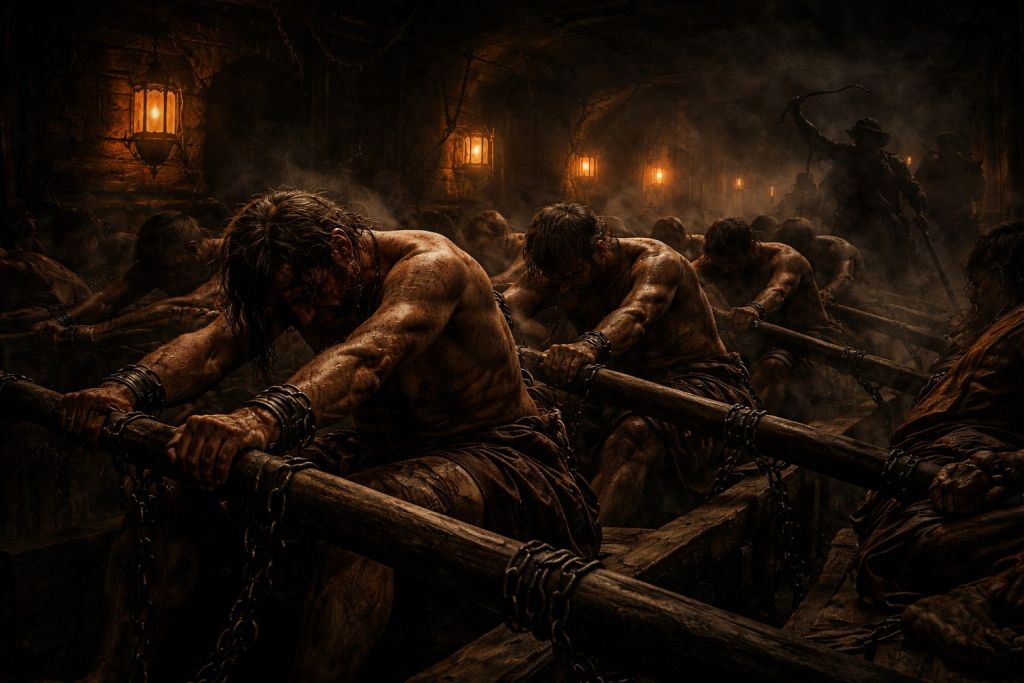
For those who resisted or tried to flee, the punishment was the galleys. Men were chained to the benches of giant warships, forced to row until they died of exhaustion or disease. Many did not survive. This punishment was known as a “living death.”
For Protestants, even in death, there was no peace. Those who refused the Catholic rituals were often denied a burial. Their bodies were sometimes dragged through the streets and thrown away like trash.

The walls of our house feel as thin as paper tonight.
I sit on the kitchen floor with my back against the cold stone. I try to block out the sounds from next door, but the screams find their way through every crack.
Three days ago, the King’s dragoons moved into the home of our neighbors. Four soldiers in a small house with a family of five. Through the wall, I hear the heavy banging of copper pots. The soldiers strike them together, right next to the ears of the children. They haven’t let the family sleep for sixty hours. Every time Monsieur Joubert’s eyes close, he is kicked or a soldier screams in his face.
Then, I hear a chair scrape across the floor. A roar of pain follows that makes my blood run cold. I hear the fire crackling in the hearth. The soldiers laugh while they force him to choose: give up his faith or keep burning.
The smell reaches me through the chimney—the sickly scent of burnt hair and scorched skin. Monsieur Joubert screams now, a high and thin sound. I can picture it, the soldiers holding his bare feet closer and closer to the red-hot coals. They do not want to kill him—they want to break him. They want him to give up his soul just to stop the pain.
I hear a loud smack—the sound of a hand hitting a face—and then the neighbors go silent. I pull my knees to my chest and cover my ears. I can still feel the vibration of the heavy army boots through the floorboards. Our neighbors’ home has become a torture chamber, and we are forced to listen.
The final blow came in October 1685. Louis XIV signed the Edict of Fontainebleau, which officially cancelled the Edict of Nantes. Protestantism was now illegal. Faith was forbidden. Ministers were given two weeks to leave the country, but for everyone else, the borders were closed. Leaving was a crime.
In Lille, the streets were filled with a heavy silence. No one trusted their neighbor. People lived in constant caution, pretending to be Catholic during the day while secretly praying at night. The past had returned, but this time it was more controlled and harder to escape.


Across France, people began to disappear into the night. Small groups moved quietly through forests, avoiding the main roads and the King’s soldiers. They carried almost nothing, leaving behind their homes, their money, and the graves of their ancestors.
Among those moving through the shadows were two brothers from Lille.
Guillaume and François du Toit
Their journey began in silence and fear, but it would take them far beyond the borders of France. They were looking for a place where the King’s shadow could not reach them.
The street is too quiet. It is not a normal silence. It feels heavy and wrong, making the hair on my arms stand up. I stand behind our thick oak door, holding it open just a tiny crack. A thin line of light falls into the dark hallway where I hide. Behind me, I can hear my brother Guillaume breathing fast. His hand grips my shoulder.
“Don’t move, François,” he whispers. His voice is so low it is barely a sound. “Stay in the shadows.”
I peek through the small opening. A black carriage is already waiting in the middle of the street. It sits there in the dark like a giant, ugly bug. It does not move. It just waits. The horses are restless. Their hooves strike the stones—clack, clack, clack. The sound is sharp and loud in the empty street. It feels like a clock counting down to something terrible.
The carriage is parked right in front of our neighbors’ house across the street. The family living there, the Durands, are just like us. They pray quietly. They hide their books. They are careful with every word they speak. They have a daughter, Marie. She is only seven years old.
Suddenly, the carriage door swings open. A priest steps out with two soldiers. They do not knock. They kick the door so hard that the wood breaks. A moment later, I hear a scream. It is a high, sharp sound that cuts through the night.
I watch as they drag Marie into the street. She kicks and cries, her small shoes scraping over the stones. Her mother falls to her knees in the dirt. She grabs the priest’s robe and begs for her child. But the priest does not look at her. His face is like cold stone. “The law of the King is the law of God,” he says. “She is seven. She has ‘expressed a wish’ to be a Catholic. She belongs to the Church now.”
They throw Marie into the dark carriage. The door slams shut with a heavy sound. It sounds like a coffin closing.
I step back into the dark hallway. My heart is beating so fast it hurts. I look at my brother, Guillaume.
“We are next,” I whisper. “They will come for us too.”
Guillaume looks at the door, then at me. His eyes are hard.
“Not if we leave,” he says. “Tonight, we go north. We follow the stars until we find a place where the King cannot find us.”
I look at our home one last time. It is no longer a safe place. It is a trap.
“Tonight,” I whisper back.
With one stroke of his pen, the King destroyed the last hope for peace. Every Huguenot was now a criminal in their own land. In the deep silence of the night, Guillaume and François packed their bags to leave everything behind. They were beginning a journey that would take them to the very edge of the world.
Continued here…


2 thoughts on “BLOOD OF THE HUGUENOT – Part 7: The Sun King’s Shadow”