 11

On 3 November 1835, after being in Ommerschans for three years, four months and twenty days, Grietje Alberts Kuiper (number 94) and Marten Kuiper (number 118) were transferred to Veenhuizen. Christiaan Geerts Swaak stayed in Ommerschans.


When Johannes van den Bosch had the three asylums built in Veenhuizen, his idea was to fill them with orphans. However, orphanages across the country resisted sending the children.
In the meantime, the beggar’s asylum at Ommerschans was overflowing, and the Society of Benevolence needed money, which meant the asylums in Veenhuizen had to be filled. Municipalities across the Netherlands could send beggars to the penal colonies at a fixed rate per year. Sometimes even families sent ‘problem members’ and paid for them.
Johannes van den Bosch decided to designate the second asylum at Veenhuizen for beggars. However, everyone – beggars and colonists from the free colonies who were punished for any kind of wrongdoing – first had to go to Ommerschans before being transferred to the newest asylums.
While in Ommerschans, Grietje and Marten stayed together in the women’s ward, but a shock awaited them at Veenhuizen. There, entire families were pulled apart, with men staying on the one side of the asylum, women on the other and children in the middle, in the children’s ward.
Marten, then five years and nine months old, had to live separated from his mother for the duration of their stay, and saw her only on Sundays.
Mostly, the hall supervisors were a colonist family, and the children had to call them ‘mother’ and ‘father’. This, at least, was daily practice in the orphanage asylum, and it’s not a long stretch to think that it went the same in the beggar’s asylum.
The psychological impact of this separation on the children is almost unimaginable.
The thought arose: Could it be that they separated mothers and children so the mothers could earn their living? Even so, there’s cruelty in that separation.
Sometimes once, sometimes twice and sometimes several times a year, the management of the beggars’ asylums reported on the number of disabled and half-disabled people.
Anyone who was too old to work appeared on the list of disabled people, while those who could still do some work, but not to their full capacity, were mentioned to be ‘half-disabled’. Sometimes a person would appear on the last list, and then disappear from any list following that, as they’d healed from whatever ailment they had and could fully work again.
We found a document from early 1836 in which Grietje was mentioned. Apparently, she had ended up on a list of ‘half-disabled’ people, and this document served as a correction.


Since Grietje mainly worked in the factory in Ommerschans, we can assume she did the same at Veenhuizen, which meant she either worked at the spinning mill or helped to make clothing for her fellow inmates.
Just like in Ommerschans, the asylums in Veenhuizen consisted of large, square buildings, and in the middle, a courtyard. Beggars lived on the inside of the building, while guards and families who voluntarily came to the colonies lived on the outside.
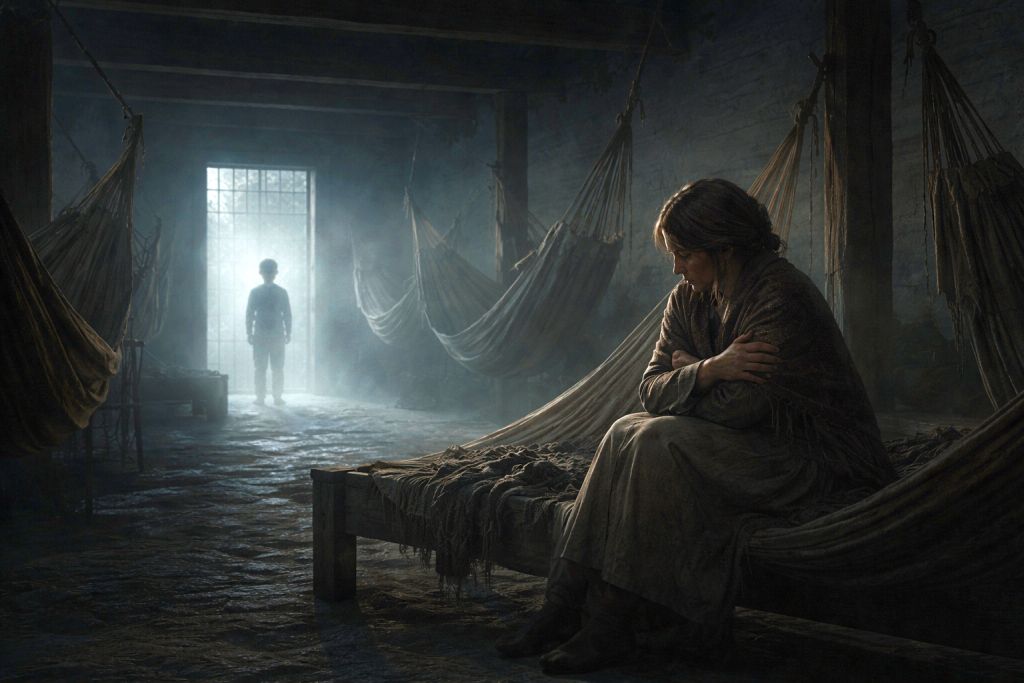
Men, women and children lived separately, crammed into a single ward with 80 people, where they ate during the day and slept at night. There were simple wooden benches and tables, and hammocks hung from the ceiling. Everyone had a small locker to store personal belongings. Despite working hard, food portions were small, leaving many people sick and weak, and death occurred frequently.
Every night, as they hoisted her hammock up and lights went out for the night, Grietje hugged herself, and pressed her mouth against her forearms, stifling the sobs threatening to escape.
What had they done with her child? Why had they taken him away from her? Would she ever see him again?
Her tummy rumbled after yet another insufficient day of eating, and her body ached from sitting hunched over mending clothes in poor lighting. Thankfully, from pure exhaustion, she drifted off to sleep.
At first, she didn’t know what had awoken her. Then she heard it. The scratching. It seemed to come from all around her – so many of the women in her ward suffered from the terrible itch. Some had open sores on their legs and arms because they couldn’t stop scratching.
Grietje kept clear from everyone, afraid she might be infected too.
Trying to ignore the sounds, but failing to do so, her thoughts travelled back to Marten. Did the children also have it? The scabies? What if Marten got it? Would they take good care of him? Would they get the ointment from the doctor to treat the itch?
Panic took hold of her. She couldn’t bear the thought of her child being sick. He was everything she had, now Christiaan was so far away.
Once more, as tears filled her eyes and threatened to spill, she wrapped her arms around herself again, and tried to rock herself to sleep.
Because of the crammed and unhealthy conditions, one condition which circulated constantly was scabies. In later years, after Grietje and Marten had already left, there was a cholera epidemic, and what was called the ‘Veenhuizen eye disease’, which left many people blind.
We found much information online, documents telling the stories of our ancestors, but one book has been absolutely invaluable. T.L. Hoff was a former beggar-colonist who shared information about life in the penal colonies. His words are in Dutch but gave insight into the separation of the children from their parents, the quality of the food and how little money they earned.
No one was allowed to earn more than three guilders a week, depending on the work he or she did, and of those three guilders, they only received 42 cents. Of that, 14 cents were added to their pocket notebooks towards the fund they had to build up to be discharged, and 28 cents were given to the person in the form of tickets, which they could use to buy food at the colony store.
Please find the book here.
While Grietje and Marten left Ommerschans in November 1835, Christiaan remained in this penal colony until May 1836. Just a month before that, a request was made for his release.

On 7 May 1836, Christiaan Geerts Swaak left Ommerschans, but before 1 January 1837, he returned to the colonies. He volunteered for the second asylum in Veenhuizen.
Why?
Was it because he wanted to be close to Grietje and Marten? Was it because, like so many before him, he couldn’t settle down outside the walls of the colonies? No one was prepared for the outside world, and because of their stay in the colonies, others looked upon them as ‘low-life’ and ‘scum’. Sad, but true.

Christiaan never left the second asylum. We know he worked in the bakery at Ommerschans before his discharge there. He even made it to foreman of the bakery, so the assumption that he also ended up in the bakery at Veenhuizen.
On the morning of 12 March 1855, he passed away in the second asylum.
The only curious thing is that on his death certificate, it mentioned that he was the widower of Catrina Wynands. As it stands now, we cannot find anything to explain who she was, but we will continue to investigate.

Three years, five months and twelve days after arriving, Grietje Alberts Kuiper was discharged from the second asylum in Veenhuizen on 5 April 1839 (see first document shared above).
Thankfully, Marten Kuiper, now nine-years-old, left with her.
Just a year earlier, on 14 May 1838, they refused to discharge Grietje because of her ‘unsatisfactory behavior’.

Johannes van den Bosch, the founder of the Society of Benevolence in 1818 with the first colony in Frederiksoord, was appointed as Commissioner-General in the Dutch East Indies in 1827. From 1830 to 1833 he was the Governor-General in the Dutch East Indies where he introduced the Cultivation System to fill the treasury. He returned to the Netherlands in May 1834, and in the same month, he was appointed Minister of Colonies.
Shortly after his appointment, he was confronted with a damning report regarding the management of the asylums in Ommerschans and Veenhuizen. The Society of Benevolence had a debt of 3.5 million and was effectively bankrupt. The problem was that once a poor person arrived in Veenhuizen, they could not leave. Many indeed left, but returned, simply because they could not make it in the outside world.
To promote flow of people, the board decided that seven years in Veenhuizen would henceforth be the maximum. Since Grietje and Marten were still in the second asylum during these years, we can assume that they automatically became eligible for discharge in 1839 due to the set maximum period. They did leave just two months short of completing the seventh year.
Either that, or Grietje had improved her behavior so much, that less than eleven months after they had refused her discharge, they finally granted it.
By the time Grietje and Marten left Veenhuizen, she was forty-five years old. We have no idea where she went when she left the colony, but the assumption is that family took her in. Unlike what so many people experienced when they returned to society, Grietje found a place to stay.
One thing is certain: Grietje never returned to the colonies.
On her knees in the kitchen, Grietje leaned hard on the brush.
Scrub. Scrub. Scrub.
With each stroke, her thoughts travelled to her time inside the walls of the asylum. She remembered the moment she could wrap her arms around Marten again. She’d hugged him close to her and had sworn she would never let him go again. That was the one thing she’d promised her son, and the other was that they would never end up in the same situation they’d been in the past seven years.
While she was inside, she’d seen many of her peers leave with the same promise on their lips, only to return within a year after having been discharged. It had hurt her heart to see the despair in their eyes, the pain because they couldn’t make it on the outside. Maybe that was why she’d been better prepared; why she’d made sure there would be a support network out there.
Scrub. Scrub. Scrub.
Despite her age, and the work being physically hard, Grietje refused to stop working. She was terrified of being sent back to the colony, even though she knew Marten would never allow it.
Grateful tears mixed with the scrub water when she thought of her son, and how proud she was of him. Despite the start he had in life, he had transcended his past, and the future lay in his hands.
She sniffed, quickly wiped her eyes with her apron.
“Come now, enough of this foolishness, old woman,” she scolded herself, with a slight smile playing around her lips.
Before 7 July 1863, Grietje appeared in the population register of Roden, Drenthe, together with several people with the surname ‘Alberts’, the same as the patronym Grietje carried.
Somewhere during our research, we came across the note that Grietje went to live with a widower upon her release from the colonies. However, we couldn’t find a name for this person.

Below Grietje’s name is the name Wietske Remmelts van der Lande. Looking for more information, we found she was a maid for a man called Louwe Hummel and she later formed a family with Lèoe Hummel, pronounced ‘Louwe’. Lèoe Hummel had been married, but his wife passed away in 1828, less than two years after the birth of their sixth child. He later had three more children with Wietkse, but they never married, which was why their three children carried ‘van der Lande’ as their surname.
Maybe Grietje knew the Hummel family, and they took her and Marten in when they left the colony, or maybe this was the family that offered her a job as maid, the same position Wietske had before she and her employer formed a family.
This was not the only time we came across the surname ‘Hummel’.
In the above population register, it said that Grietje left Roden on 7 July 1863. Next, we find her in the register of Leek, Groningen. Marten Kuiper had married Lutske Tel in May 1856, and in April 1857 their son, Jan, was born. The register shows the four of them, together with Koene Harms Hummel, all living in the same house.

The Society of Benevolence boasted that those discharges from the colonies were very much in demand in the world outside its walls. The men were said to be the best diggers, the women the best maids. We believe that Grietje earned her money cleaning for others or running errands. Marten probably also worked, as was common in those times. After all, it was only in 1874 that it was forbidden by law for children under 12-years-old to work.
On 19 January 1869, Grietje Alberts Kuiper passed away in Leek, Groningen. The notification of her death was done by two acquaintances – Jannes Pater (66-years-old) and Albert Alberts (47-years-old).

During our research, we came across the genealogical website of the surname Pater, the one surname mentioned on Grietje’s death certificate.
Grietje Alberts Kuiper, Christiaan Geerts Swaak and Marten Kuiper all appear on the Pater website, as does Jannes Pater, Albert Alberts, Wietske Remmelts van der Lande, and Koene Harms Hummel.
All of them are linked to the same family tree, called Pater Westerkwartier.
Even though none of them are in any way related to each other within fifteen generations – a check we did on the website – we can safely assume they all knew each other in some or other way.
She rebuilt her life, likely through work that was just as demanding, but this time on her own terms. She earned her keep, found her place, and raised her son outside the walls that had once confined them. In the years that followed, he would go on to ‘right’ some of the ‘wrongs’ of earlier generations.
It is tempting to think that her strength ended with Grietje, but lives like hers rarely do. The need to work hard, to be careful with money, to keep going no matter what – these are not just habits.
They are legacies.
Passed on quietly. Unspoken. Sometimes unrecognized.
Traces of that resilience may still be found in the generations that followed.
Perhaps it is no coincidence that, even in death, her father’s name stands beside hers — a reminder that every story begins somewhere.


2 thoughts on “BECOMING KUIPER – Part 8: Between Separation and Survival”