 11

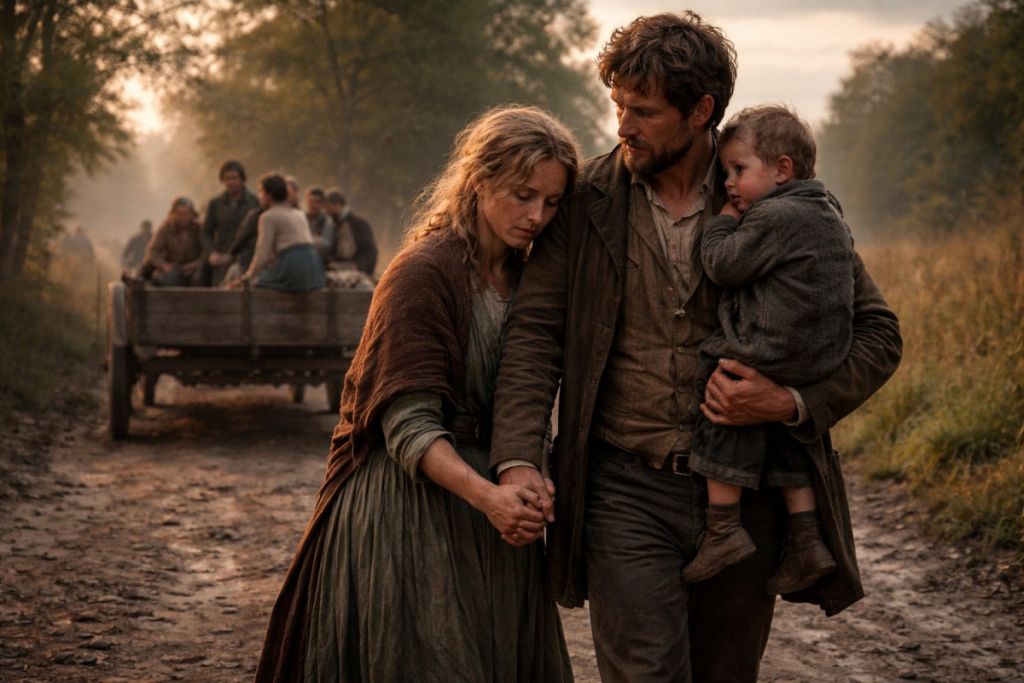
Grietje Alberts Kuiper, her partner Christiaan Geerts Swaak and their son Marten ended up in the penal colony of Ommerschans.
Their crime? They were poor.
On 14 June 1832, the names of Grietje Alberts Kuiper, Marten Kuiper, and Christiaan Geerts Swaak were recorded in the register of Ommerschans. We don’t know whether they had been taken there by authorities or whether they arrived there voluntarily. What we do know is that the journey wasn’t an easy one. At least, not if they had to get to De Schans the same way the other beggars did.
His Majesty issued a decree on August 14, 1819, whereby the Ommerschans was granted to the Society in usufruct. However, it would take until November 1820 before the first detainees arrived. By then, Johannes van den Bosch had already instructed the building of a two-story building. The building was an immense square with a courtyard in the middle. There were no windows on the outer wall, only on the inner.
In later years, they added an infirmary, as well as one building which they used as a school and a church. Around the large building, on the outside of the penal colony, were several smallholdings where free colonists lived. The plan was to build fifty of those smallholdings, but this was never realized.
The first colonists who were sentenced to be detained arrived in November 1820. Quite quickly, Johannes van den Bosch realized they would never be able to fill Ommerschans only with colonists who needed punishment, and that led to a Royal Decree on 13 March 1822 that all beggars who could work had to go to Ommerschans, upon which this location was effectively declared a national asylum for beggars.
The Society of Benevolence provided a reward for every beggar brought to Ommerschans and reimbursed travel expenses at a fixed rate per distance traveled.
As with everything in life, someone had to pay. The Society of Benevolence recovered the travel cost as well as the cost of a beggar’s stay in the penal colonies – Ommerschans and Veenhuizen – on their local authority. That meant the town in which they were born. Obtaining money from them was a lengthy process, and sometimes it took months to determine where a beggar came from.
No matter where the beggars came from, they all had to walk most of the way. Any place there weren’t towboats they walked. Only sometimes there would be a cart for women with children. If both Christiaan and Grietje had to walk from the city of Groningen or from where we know they once resided – Leek, Groningen – to Ommerschans, that would have been around 80 kilometers.
Grietje scooped Marten up in her arms, hugging him to her while he cried on her shoulder. He had just stumbled and fell, after walking for some distance. Too far for a toddler. Her own feet burned with exhaustion but moved as if of their own accord.
Christiaan walked at the front of the flat cart but now stopped and saw Grietje and Marten getting behind. He walked toward them, then took Marten into his strong arms. Holding the child on one arm, he offered his hand to the woman he considered his wife.
No, they weren’t married.
There were reasons for that. One reason, actually. The same reason that saw them walking here on their way to Ommerschans. Money. They didn’t have it. Didn’t have the money to marry, nor to feed themselves. Begging for the help of others had put them in this position.
Grietje took his hand, and it was as if she found a second breath. Together they sped up until they reached the front of the cart. Grietje briefly glanced at a woman with a baby sitting on the flat cart, wishing she could get up there too. But except for the one woman, there were others. Some pregnant, some disabled. Men too, of the latter degree.
She’d offered to walk, and now she regretted it. Grietje shook her head, tightened her grip on Christiaan’s hand and just did what she’d been doing for many kilometers already: just put one foot in front of the other. Repeat.
Even if Grietje and Marten could ride along on a cart, Christiaan still had to walk. If they had to walk the full distance, with no access to a towboat, it would’ve taken them weeks to reach their destination.
Men lived on one side of the institute, women and children on the other. Contrary to earlier findings, it seems that mothers and their children weren’t separated in Ommerschans. Married couples, however, were.
The courtyard had a double fence running from one to the other end, splitting it in half, and with guards walking between the two fences. This was to keep the men and women apart, but it didn’t prevent the occasional pregnancy.
In February 1826 they decided to allow married people to stay together, which also saved them money, but since Grietje and Christiaan weren’t married, they would have stayed separate at Ommerschans. Authorities didn’t look kindly upon unmarried women with children.
All beggars had to work for their food, except mothers with small children. Since Marten was only two-and-a-half years old when they arrived in Ommerschans, chances are that Grietje didn’t have to work for a year or two, but Christiaan had.
Many beggars were placed with the free colonists on the smallholdings on the outside of the main building. Those beggars worked for the colonist families as their slaves.
Except for the sick, everyone started working the day after their arrival. There were three types of work: field work, factory work, and miscellaneous work. Factory work comprised all activities in the spinning mill or the weaving mill, and the miscellaneous category included all tasks assigned by the hall supervisor, such as sweeping the hall.
For every kind of work the inhabitants of Ommerschans performed, they were paid. That wasn’t a daily wage but piecework, in other words, they were paid according to the amount produced. Everyone received their pay at the end of each day’s work, but not in money. They received steel ‘tickets’ of five, one or half cents.
Every Sunday morning the hall supervisor received every person’s wage. He checked whether a beggar had earned at least 91 cents, as that was what they had to earn each week to cover the cost of their living.
The 91 cents were made up of:
Those who didn’t have the required 91 cents earnings at the end of the week had a problem. Firstly, they had a debt in their pocket notebooks, and secondly, they only got half a portion of the daily warm meal.
Those with earnings of over 91 cents received extra steel tickets and could buy food for the evening meal, while those who earned exactly 91 cents had to rely on just the one meal a day.
Even though beggars paid 6 cents a day for their warm meal, Johannes van den Bosch had determined it wasn’t to cost more than 4,5 cents. The 1,5 cents they paid extra also went into the administrative fund and was used to supplement any earnings under 91 cents a week.
On Tuesday, Thursday and Sunday, the beggars ate soup with meat, pearl barley and potatoes. The rest of the week they didn’t get meat, but it was compensated by adding melted fat to the meal. On Monday they had potatoes with carrots, on Wednesday potatoes with tubers and on Saturday potatoes with cabbage. On Friday they had only potatoes. Salt and pepper were added to all meals.
In summer, when there were no potatoes, they replaced that with other homegrown vegetables.
Throughout the colonies, whether free or penal, school was compulsory for children from six to twelve years old. This started in 1819. Since Marten Kuiper was only two-and-a-half years old when they arrived, and they went to Veenhuizen two months before he turned six, he never received any schooling in Ommerschans.
Despite the beautiful reports in the monthly magazine of the Society of Benevolence – De Star – travelers who visited Ommerschans in 1823/4 reported that only thirty of the three hundred children there received schooling.
Everyone in Ommerschans was under strict supervision of those in authority, whether the hall supervisors inside or the rural constables out in the fields. Enough people deserted from De Schans, and those who returned were punished. A corporal from Luxembourg, Ignatius Seijl was heavy-handed and had the dubious honor of executing such punishment, using a whip.
She didn’t want to go. Didn’t want to see yet another punishment. They were too brutal.
Grietje shuffled towards the exit of the hall with the other women. A hall supervisor was watching over the children, so thankfully they – at least the little ones – didn’t have to lay their eyes on the inhumane act.
Once in the courtyard, Grietje stayed at the back of the group of women, hoping their bodies would block her view. It wasn’t that she could just turn her head away, because guards walked around them, forcing them to look. The belief was that seeing the punishment would ensure they didn’t do the same wrong.
A guard led the condemned into the courtyard, between the women looking on from one side, and the men from the other. Corporal Ignatius Seijl followed, a whip in his hand.
Grietje shivered, and briefly her eyes wandered, looking for Christiaan between the men. Before she could find him, a guard approached and she quickly turned her head back to where they were supposed to be.
A shiver ran through her when the corporal raised his arm, and the whip sang through the air. A low groan escaped the man on the whipping block. As the whip whistled several times more, the groans turned to cries, to begging.
When it finally stopped, Grietje quickly wiped tears from her cheeks. She wasn’t the only one. Before they turned to go back to the women’s quarters, she finally found Christiaan in the men’s crowd. He gave her an apologetic smile, as if he’d performed the punishment, but she knew what that smile meant: he was sorry she had to witness it.
She smiled back, nodded once and turned away.
Punishments happened publicly in the courtyard, in the hope that the onlookers wouldn’t perform the same ‘crime’ as the people punished. That, however, didn’t stop people from attempting escape.
The vision of Johannes van den Bosch when he founded the Society of Benevolence was to help the impoverished working class of the Netherlands by ‘providing work, education, and sustenance, and raising them to a higher civilization, enlightenment, and benevolence’.
In other words, he wanted to re-educate them so they could be better citizens.
In the colonies, he wanted to demonstrate that by working and earning money, they could provide for their own needs. Beggars had to build up a savings fund, and they only became eligible for discharge from the colony when that fund had reached a predetermined level. The statutes of the Society of Benevolence stated that a beggar had to stay in Ommerschans for at least a year and have a savings fund of at least 25 guilders before discharge could be requested.
Nationwide in the Netherlands they had this ‘motto’: He who does not work shall not eat.
Re-education, however, wasn’t only about teaching the beggars to work for their food. They also looked at the spiritual side of things, and all children who weren’t baptized, had to be.
We have searched – and are still in contact with a church – for Grietje’s baptism record, but we know Marten was baptized only six months after their arrival in Ommerschans.

Christiaan Swaak stayed at Ommerschans until May 1836, after which he voluntarily reported at the Second Asylum in Veenhuizen, and stayed until his death.
Grietje Alberts Kuiper and Marten Kuiper were transferred from Ommerschans to Veenhuizen on 5 November 1835. They had been at ‘De Schans’ for almost 3 years and five months, and would eventually stay in Veenhuizen just as long.


3 thoughts on “BECOMING KUIPER – Part 7: Behind The Walls”