 11

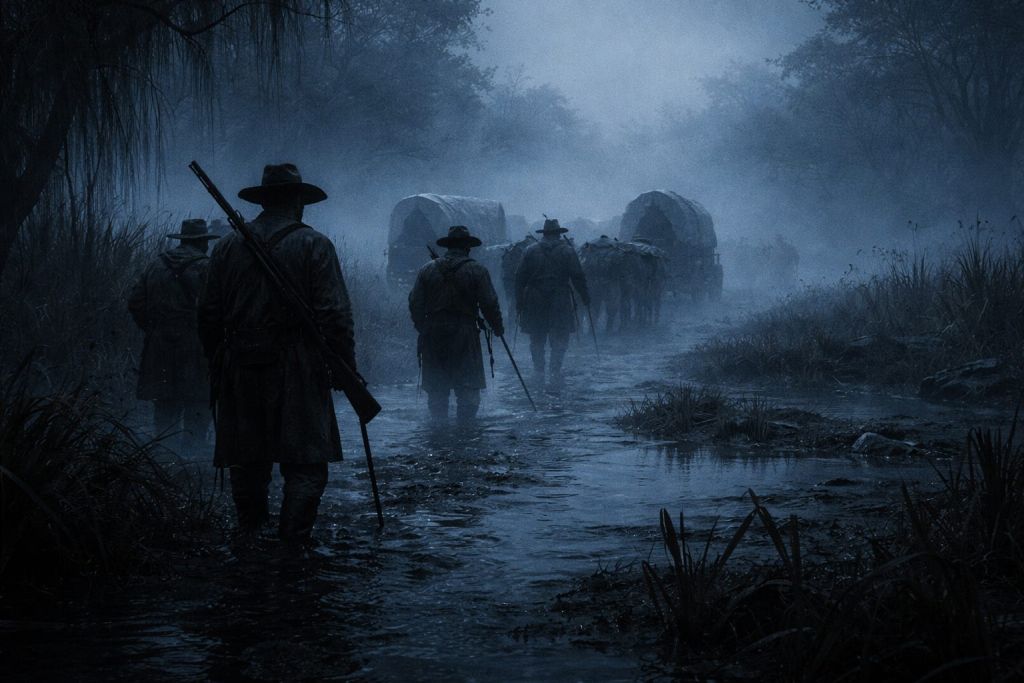
The fires in Ghanzi were dying out. For a few short weeks, the limestone wells had given us rest. Our oxen had drunk deeply, and the children had slept without crying from thirst.
But every man knew this peace would not last. Ahead lay the long road to Rietfontein — a road even drier and more cruel than the desert we had already crossed.
The wind blew hot across the sand that morning. It carried no promise of rain, only dust and the bitter scent of the ‘Dorsland’ waiting for us.
The men began to yoke the oxen again. Before us stretched the long road to Rietfontein — a road of deep sand and burning sun. Even the strongest oxen feared it.
By day the desert looked empty. But when night came, strange sounds followed the wagons. Sometimes it was only the wind moving through the thorn bushes. Sometimes it was something else — a hungry cry that carried through the night.
I looked at Cecilia, resting in the shade of the wagon. She looked peaceful, but her face had grown thin, and the child inside her was a heavy burden on her tired body. We had survived the burning sun of the first desert, but the next part of the ‘Dors’ was waiting for us.
The first wagon creaked as it began to move. One by one the others followed, their wooden wheels groaning in the sand.
The Ghost Trek was waking again.
By late 1893, the brief peace at the wells of Ghanzi came to an end. When the wagons finally pulled away, the heat returned like an old enemy. Ahead lay the long road to Rietfontein — one of the harshest stretches of the Dorsland.
Although the oxen had drunk their fill, their bodies were already weakened by the long weeks in the desert. The road to Rietfontein was not only deep sand and burning sun. For many animals it became a graveyard of strength.
Historical accounts describe a frightening behavior among the cattle during this stage of the trek. At the faint scent of water carried on the wind, exhausted oxen sometimes became frantic with desperation after weeks of thirst.
The animals could suddenly bolt in blind panic. They lunged forward with such force that the heavy wooden disselbooms (wagon poles) sometimes snapped like small twigs. In the chaos, wagons overturned and precious supplies were spilled into the sand. Men had to react quickly, cutting the animals loose to prevent the wagons from being completely destroyed.
In some cases the situation became so desperate that the trekkers released the oxen entirely, hoping the animals’ instincts might lead them to hidden water. Many of these panicked oxen disappeared into the desert, their cries fading as they ran toward what was often nothing more than a mirage.
But the desert did not remain silent for long. The smell of the exhausted and dying cattle carried far across the sand, acting like a dinner bell for the wilderness.
It started just after sunset. At first it was a low, moaning sound, almost like the wind. But then came the laughter. A raw, human-sounding cry that made my blood run cold.
I looked back at the wagon. Cecilia was sitting inside, her hands pressed tightly over her stomach, protecting our child.
I gripped my rifle and stared past the light of the campfire. There, low to the ground, I saw the first eyes — dozens of yellow lights floating in the darkness.
The hyenas had found us.

Between Ghanzi and Rietfontein, the desert changed. The thirst remained, but now a new danger followed the wagons. Spotted hyenas began to track the trek. These scavengers were the ‘cleanup crew’ of the Kalahari, able to smell death from miles away.
The oxen were already exhausted from the long journey through the deep sand. The hyenas sensed this weakness. They did not attack the strong animals – they waited for the weak to collapse.
Survivors of earlier treks described how bold the hyenas could become. At night they sometimes crawled beneath the wagons, chewing on the riems (leather straps) and licking the grease from the wagon wheels while the families tried to sleep.
The most heartbreaking part of these stories concerns how the hyenas treated the dead. Because the ground toward Rietfontein was often as hard as iron, the trekkers could not dig deep graves. They buried their loved ones — often small children — under piles of stones and thick, thorny branches.
Trekkers later wrote about the pain of looking back as the wagons moved away. From a distance they could see dust rising as the hyenas began to dig. The ‘laughter’ of the hyenas was the last sound many mothers heard as they left the graves of their children behind.
For many families, the predators were not only feeding on the dead – they became a haunting memory of the terrible road through the Dorsland.

After the nightmare of the deep sand, the families finally reached Rietfontein, a famous water source on the border of what is now Namibia. For the trekkers of 1893, Rietfontein was not just a stop – it was a ‘waiting room’ in the wilderness, a place where they could pause and gather their strength for the journey ahead.
When later trek groups arrived, the sight was haunting. The ground was scattered with the bones of oxen and the broken wood of wagons left behind by earlier treks, and many graves were marked with simple stones. Rietfontein was a place of life because of its water, but it was also a place heavy with sorrow.
The families did not leave quickly. Most groups remained at Rietfontein for several months, and some stayed as long as two years. The surviving oxen were skeletons, and they needed months of grazing on the green grass near the springs to regain the strength to pull the heavy wagons again.
The trekkers also had to wait for the right time to move north. Leaving too early would bring more drought, and traveling during the rains would make the malaria of the Okavango even more deadly. During this long stay, Rietfontein transformed into a small village of wagons, a temporary home in the heart of the desert.
The families were deeply religious. Church services were held under the large trees, and babies born during the journey were baptized with the water of the springs.
Because so many cattle had been lost, the families could not afford to slaughter their own oxen for meat, so the men spent their days hunting wild animals such as eland and gemsbok to feed their families. It was also a time to repair the broken disselbooms and torn canvas covers of the wagons, using wood and hides found in the bush.
While the families rested, the leaders sent verkenners, or scouts, ahead to find the safest path north toward the Kunene River. These men returned with reports of the great thirst that still waited in the Kaokoveld and ‘the fever’ that lingered in the waters of the Okavango.
When the groups finally pulled their wagons out of Rietfontein, they were stronger, but they were also afraid. They knew the trek was moving into its most dangerous chapter: the land of predators and invisible sickness.
The sun was high over Rietfontein, but to me the air felt cold and thin. We had been here for over a month, waiting for our oxen to grow strong, yet my soul felt as hollow and fragile as the animals we depended on.
It was Sunday. We gathered under the shade of a large camelthorn tree for the church service, but the sight made my heart ache. Here, life and death walked side by side.
In front of the minister, three mothers held their newborns, dipping them into the spring to baptize them. Soft cries rose from the infants, mingling with the psalms. It should have been a moment of joy, but all I felt was the weight of the graves around us.
Cecilia stood beside me, her hand resting gently on her own growing belly. Her voice was clear and steady, her faith solid as a rock. But I could no longer find the faith to sing. I could not even pray. How could I? How could I sing when death had already taken so many from us, when the desert swallowed life and innocence without caring?
I turned my eyes toward the edge of the camp. There, a small group of men worked in silence, lifting heavy stones to cover a fresh grave. A young woman, taken just last night, lay beneath them. She had been pregnant, just like Cecilia. The earth had claimed her and her child before they could reach the safety of Humpata.
I looked from the babies in their mothers’ arms to the graves in the sand. How could God give life with one hand and allow the desert to snatch it away with the other?
Cecilia squeezed my hand. “We are almost there, Pieter,” she whispered.
Her soft voice should have helped, but it only made the weight in my chest heavier – hope fighting against the fear I could not shake.
I gazed north, thinking of the swamps and the fever waiting there. I wanted to believe her, to trust in God’s plan. But seeing the rows of graves at Rietfontein, I feared we were heading straight into a larger cemetery, stretching all the way to Angola.

As the trek moved north toward Lake Ngami and the Okavango, the dry, baking heat of the desert gave way to a heavy, wet mist. The air was thick, clinging to skin and clothing, carrying the scent of rotting plants and stagnant water. It seemed harmless at first, but the families quickly learned that this mist hid a deadly enemy.
These were the ‘invisible killers’, the mosquitoes that carried a sickness they would come to know as ‘the fever’ — malaria. The name comes from the Italian words mal aria, which mean ‘bad air.’
The trekkers did not understand how the disease spread. They believed the heavy, foul air itself poisoned their blood, and they feared each breath might be their last.
Mothers wrapped their children tightly, while men tried to protect the oxen and wagons from the spreading swamp. But no strategy could stop ‘the fever’. It crept silently, striking the strongest and the weakest alike.
By morning, a person might appear healthy, but by sunset, their body would shake uncontrollably. The cold bites of fever left them trembling, teeth chattering even under the blazing sun. Then came the burning heat, when skin reddened, eyes glazed, and the mind began to wander. Some spoke to shadows that weren’t there, while others cried out in confusion or delirium. Families watched helplessly as husbands, children, and neighbors weakened day by day, their bodies turning pale or yellow from the sickness.
The toll was immense. Nearly every family lost someone along the swamps of the Okavango, and many wagons carried more grief than goods. Mothers who had survived the desert now found themselves burying their own children. Men who had fought lions and elephants were powerless against the tiny, relentless mosquitoes that carried ‘the fever’.
While the people fought malaria, the oxen battled another enemy: the tsetse fly. The small insects carried a sickness called Nagana, which slowly wasted the animals’ strength. The name Nagana comes from a Zulu word meaning ‘to be low in spirit.’ It perfectly described how the animals lost their spark. Day by day, the oxen grew weaker, until they could no longer pull the wagons.
Every day was a fight not just to survive, but to keep hope alive. ‘The fever’ was invisible, unstoppable, and struck anyone. The trekkers of 1893 learned that the greatest danger was not the sand — it was the sickness they could not see or fight, and that killed faster than any predator.
By the time the wagons reached firmer ground, ‘the fever’ had taken its toll. Bodies were thin, faces hollow, and spirits weak.
Many families would never be the same.
The grave was shallow. The ground near the water was softer than the hard desert, but it still demanded every ounce of our strength.
We covered him with sand and stones. No words were spoken. The fever was still here. It could still take another one of us. Every man could feel it.
We stumbled back to the wagons, where a weak fire flickered against the darkness of the night. We sat down by it, our bodies aching, sweat and mist clinging to our skin. The silence was heavy. Only the fire crackled.
Sudden fear gripped me, pressing on my chest, making it hard to breathe.
“Lord, please do not leave us here, not in this dark land. Watch over Cecilia. Watch over our child. Keep us alive. Keep our hearts beating. Do not let the fever take us all. Please Lord. Do not leave us behind. Not here. Not tonight.”
Historical Note:
Between 200 and 300 people died on the Dorsland Trek from the Transvaal to Angola. About 80% of them died from malaria, which the trekkers called ‘the fever.’ The rest were lost to the desert heat, wild animals, or the rivers.
By the end of this stage of the journey, the trekkers had already crossed deserts, buried loved ones, and survived the deadly swamps of the Okavango. The dream of a new life in the north had come at a terrible cost.
Yet the road did not end here.
Beyond the swamps lay the harsh lands of the Kaokoveld, the crossing of the Kunene River, and the long climb into the mountains of southern Angola.
The families who continued the trek would soon face the final stage of their long journey toward Humpata.
SOURCES:
Wikipedia – Dorsland Trek
Dr. Nicol Stassen – South African historian and publisher, considered the leading expert on the Dorsland Trek and the Afrikaners who traveled from the Transvaal to Angola in the late 19th century.


2 thoughts on “THE DORSLAND TREK – Part 4: Trails of Sorrow”