 11

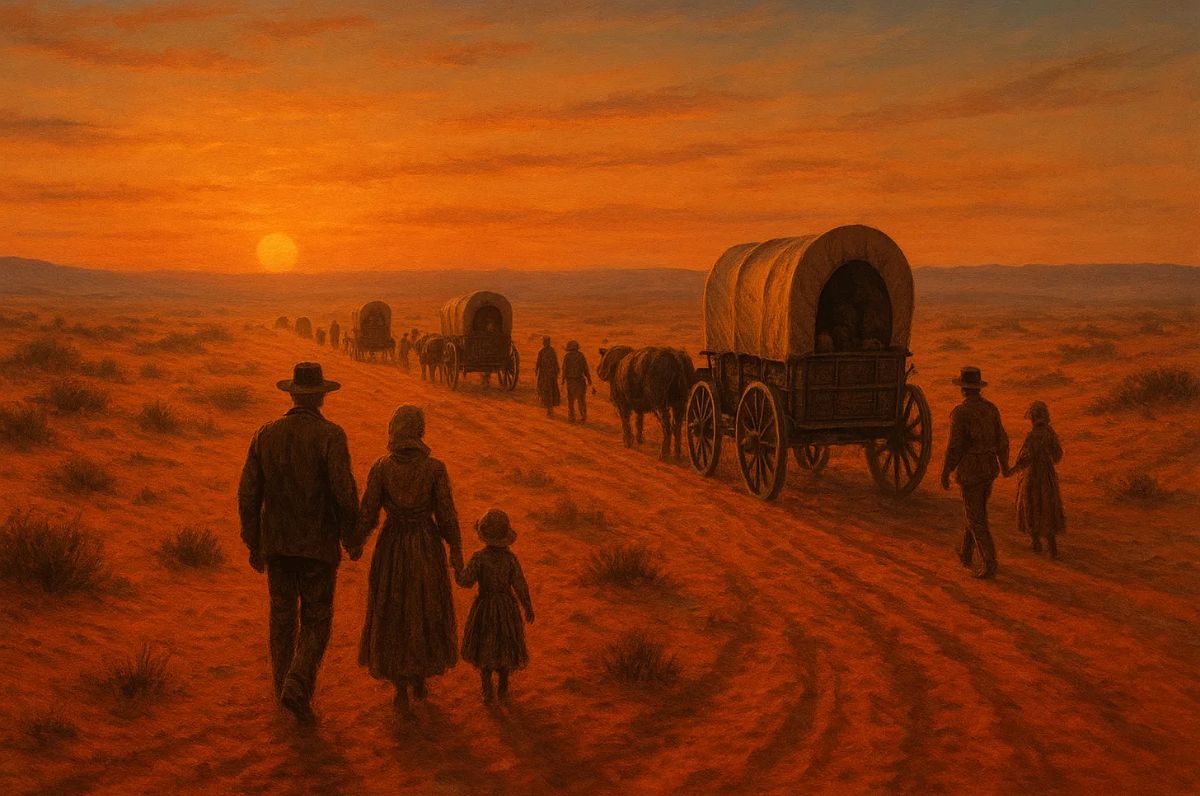
The story of the Vorster family begins long ago, in the 1800s, in the dusty lands of South Africa. In 1845, a baby boy named Barend Johannes Marthinus Vorster was born in Colesberg, in the old Cape Colony. He grew up with strong sunshine, wide open land, and the sound of cattle bells in the distance. Like many people of that time, he learned to live from the land and to travel far when life demanded it.
A few years later, in 1849, Aletta Johanna Steyn was born in Swartruggens, further north. When she grew up, she met Barend, and they married. They farmed in the Rustenburg district of the Transvaal and raised their children there. Their first little boy, Barend Johannes Marthinus Vorster (1867 – 1873), sadly died at the age of five or six, Pieter Jacobus Vorster was born in 1868, Cecilia Johanna Vorster in 1871, and the younger Barend Johannes Marthinus Vorster in 1874.
Life on the highveld was not easy. Droughts came often, sickness spread through the families, and disagreements with the government made life even harder. Many farmers dreamed of moving north, to find land where they could live freely and raise their children in peace. The call of the open road was strong.
In 1874, the family joined the great Dorsland Trek. Pieter Jacobus was only six years old, Cecilia was three, and the youngest Barend was just a few months old. The journey began in the Transvaal, a land of wide open spaces, small farms, dirt roads, and long stretches of silence. For the families, leaving felt like packing their entire lives onto one ox-wagon. The oxen were yoked, the wheels checked, and everyone took one last look at the home they were leaving behind. The mornings in Transvaal were cool, but by midday the sun was sharp and hot. The first days were slow as everyone got into the rhythm of the trek – waking before sunrise, taking down the camp, preparing the wagons, and moving forward again.

The route passed through Marico, a region of low hills, thornbush, and red dust that rose behind the wagons in drifting clouds. Here they still travelled through known land. They sometimes met people they knew and it still felt safe, but everyone understood that once they left Marico behind, the true wilderness would begin. The oxen needed special care here. They were the heart of the trek. Without strong oxen, the wagons could not move. Sometimes a wheel broke or an ox stumbled. When that happened, it slowed down the whole group.
Eventually they reached the Limpopo River. It was wide, slow-moving, and sometimes dangerous. For many families, crossing it was frightening. Wagons had to be made lighter. Heavy things were taken out and carried separately. Long lines of oxen, sometimes 16 or more, were put in front of each wagon. Some parts of the river were shallow, but other places were deep and muddy. People stood in the water up to their waists. Children sat high on the wagons, holding onto the sides. If everything went well, the wagons came out safely on the other side. If not, a wagon could tip, or an ox could drown. Once they crossed, they were truly on their own.

The Kalahari Desert was the most dangerous and exhausting part of the trek. The sand was red and burning hot and the air shimmered from the heat. But at night the temperature dropped, and the cold could bite you just as hard. There was almost no water. Families had to know exactly where the next waterhole was, because a mistake could cost lives. The road north was not empty, it was alive. Sometimes quietly, sometimes terrifyingly, with everything the wilderness could offer. The sand dunes moved like living creatures. A single gust of wind could move a whole hill of sand and cover the wagon tracks in just minutes. Sometimes a wagon sank so suddenly that the back end tilted and everything inside slid forward. Men shoved their shoulders against the wood, women steadied the children, and the oxen strained until the yokes creaked like old bones. The land was thick with thornbush, dry and sharp as broken glass. It clung to skirts, tore shirts open, scratched ankles until they bled, and hooked onto anything that hung loose on the wagons.
At night, the world changed. The fires lit up only a small space around them, and just beyond them was darkness. And endless, breathing darkness filled with eyes. Lions walked quietly through the bushes. You could see their dark shapes moving. There were hyenas, bold and restless, pacing just out of sight. Their strange, broken laughter rose unexpectedly, startling the oxen and sending cold shivers through the camp. Sometimes they came so close that the trekkers could see their pale shapes flickering between the shadows. Farther out were jackals, screaming thin and sharp into the night, as if warning each other, or warning the trekkers that the land belonged to them. Every family slept lightly, and mothers kept their children close. The men sat close to the fire’s last glow with their rifles resting on their knees.
In the morning when the sky turned soft and grey, the world fell quiet again. There were no signs of the night’s visitors, only pawprints around the camp and the memory of glowing eyes just beyond the firelight. In the long days that followed, everything around them was very quiet. No birds singing, no rivers, only the slow, steady sound of the oxen’s hooves and the distant sigh of the wind moving across the dunes. It was a silence that could make a person feel very small.
People got tired and some became sick along the way. The heat of the Kalahari desert weakened everyone. Small children and older people suffered the most. Sometimes a family had to stop because someone was ill or because animals were too weak to go on. Other groups moved ahead, and some families became separated. Still they kept going, step by step, wagon by wagon, crossing the great emptiness toward Angola.

After months in the desert, the land began to change. The air felt more humid, the grass grew greener. In Portuguese-controlled Angola, there were new trees, new smells, and unfamiliar mountains. Humpata sat high on a plateau, with cooler air and better soil. For many trekkers, reaching it felt like finally being able to breathe again. But they were exhausted, the animals were worn down and many wagons were damaged. Some family members were missing, and some had died along the way.
Among them was Barend and Alleta’s young daughter, Cecilia (1871). There are no records of when she died, but it is possible she went missing and did not survive the journey. The journey had taken a great toll, but it had also shaped them.
Here in Humpata they began again, building homes, planting fields and trying to build a future in a new land. The Vorster family settled in Que, a small settlement within the Humpata district, where they built their farms and lived among other Boers in the Angolan highlands. There, young Pieter grew up and became a strong man. He learned to plough, herd cattle and live close to nature. The settlers built small houses of clay and stone, planted crops, and a church – a congregation of the Nederduitsch Hervormde Kerk (NHK) was founded in Humpata on May 31, 1910 by the Rev. Pieter van Drimmelen. They sang the same hymns their parents had sung back in the Transvaal.
Around 1890, Pieter met a young woman named Cecilia Johanna Steyn, born in 1872. They married and began a family. Their first child, Susara Susanna, was born in 1894 in Que. Over the next twenty years, more children followed, all born in Angola. Johannes Hermanus (1898), Aletta Johanna (1900), Pieter Jacobus (1903), Hermanus Johannes (1906), Paul (1908), Cecilia Johanna (1910), and Cornelia Katrina Adriana (1916).
Life in Angola was beautiful but not easy. The people worked hard to grow wheat, maize, and vegetables. They traded with local Africans and shared the land as best they could. But there were also long dry seasons, sickness, and sometimes attacks from raiders or bandit-groups taking advantage of the remote frontier. The families were far from any government help, they had only each other.
Among the children, Aletta Johanna remains a mystery. She was married, but she never had children, and no records of her death have been found. Because women of that time usually married and began families at a young age, it is likely – though not certain – that she died quite early, possibly while still in Angola. The same uncertainty surrounds her younger sisters, Cecilia Johanna and Cornelia Katrina Adriana. With no surviving documents to show their adult lives or places of death, it is most likely that they, too, passed away young – either in Angola or during the difficult trek back toward Namibia.
Frontier Dangers in Humpata, Angola
Life on the Humpata plateau carried a quiet tension beneath its beauty. The region was remote, and colonial law enforcement reached it only weakly, leaving the settlers exposed on the far edges of the frontier. In this isolation, different groups of raiders began moving through the area – local bandits, cattle rustlers, and small armed gangs who took advantage of the vast, unpoliced landscape. These groups targeted isolated farms, appearing suddenly from the bush to steal cattle or supplies. Sometimes they threatened families or tried to intimidate the small settlements that dotted the plateau. Because help from authorities was rarely available, the Boers were often forced to defend themselves. Many households kept rifles close at hand, and communities organised simple local militias to patrol the grazing lands. For the settlers, these dangers shaped everyday life. Families learned to secure their livestock carefully, reinforce their homes, and remain alert even during peaceful seasons. Though most days passed quietly, everyone understood that the frontier could change in an instant. The presence of bandits left a lasting mark on the Boer experience in Angola, adding another layer of hardship to an already challenging life.
Sources: https://en.wikipedia.org/wiki/Dorsland_Trek
By the early 1880s, life in Angola had grown increasingly difficult. Droughts were frequent, sickness spread easily, and the settlers faced ongoing challenges in maintaining their farms and cattle. Around 1884, Aletta Johanna Vorster (Steyn) and her husband, Barend Johannes Marthinus Vorster, made the difficult decision to return south to the Transvaal. They were accompanied by their younger children, Cornelia Catharina Adriana (born 1878 during the trek, or after arriving in Angola)and Hermanus Johannes (1882).The older sons, Pieter Jacobus (1868) and the younger Barend (1874), remained in Angola to continue caring for the cattle and tending the farms they had established.
No letters or records tell us exactly how they said goodbye, but we can imagine that moment. The wagons were packed again, oxen waiting, the younger children beside them, and Pieter Jacobus and his younger brother, Barend, standing by the gate, watching their family leave.
The journey back was long and challenging, filled with the same hardships they had faced on the way north years earlier. Dust and heat, scarce water, and the endless horizon made every day a test of endurance. Yet Aletta and Barend pressed on, carrying their hope and responsibility for the younger children with them. Once they reached the Transvaal, life slowly began to stabilize. Paul Philippus was born there in January 1886, marking a new chapter for the family after years of frontier struggle. Though they had left part of the family behind in Angola, Aletta and Barend found safety and support among relatives in the Transvaal, ensuring the youngest children could grow up under more secure conditions.
In 1892, Aletta Johanna Steyn Vorster passed away in Middelburg. She died far from the red plains of Humpata, yet back within reach of the country where her life had begun. Her grave lies quietly there, the resting place of a woman who crossed the desert twice. Once chasing a future, and once finding her way home.
Many years later, in 1927, Barend Johannes Marthinus Vorster died in Lydenburg. He lived to see the world change around him, carrying with him the long memory of the trek, the hardships of Angola, and the journey back to the south.
Why Families Left Angola in 1884
By 1884 many Boer families in Angola began to realise that life in Humpata was becoming too hard to maintain. Over the years the problems had grown heavier instead of lighter, and several issues pushed families to make the difficult decision to return south.
Environmental struggles – Repeated droughts damaged crops and dried up grazing lands. Sicknesses, especially fevers, spread easily in the dry season. Many families lost cattle and oxen, making farming impossible.
Economic Hardship – With failing crops and dying livestock, families struggled to survive. Trade was unreliable, leaving many without basic supplies. Some settlers were unable to rebuild after several years of losses.
Safety Concerns – Bandits and cattle raiders made the region dangerous. The killing of leaders like William Worthington Jordan created fear and uncertainty. Families felt the region was no longer safe for their children.
Growing Portuguese Control – Portuguese authorities increased control over land, taxes, and movement. Settlers felt their independence tightening more each year. Some feared they would eventually lose the freedoms they came for.
Family Reasons – Many families had relatives in the Transvaal or Cape who could help them. Some returned south to give their children a safer life or proper schooling. Other families split temporarily – some members stayed in Angola while others returned.
Source: W. G. Clarence-Smith, The Thirstland Trekkers in Angola: Some Reflections on a Frontier Society (University of London, 1976), which comments that “in 1884 roughly half the trekkers moved off again. A few returned to the Transvaal, but the majority set up the Republic of Upingtonia” near northern Namibia.
In 1918, sorrow came to the Vorster family. That year, Cecilia Johanna Vorster (1872), the mother of the family, became sick and died in Que, leaving Pieter a widower with several young children. There are no written records of exactly how she died, but 1918 was the year when the great influenza pandemic reached southern Angola, sweeping through the small farming communities of Humpata and Que. People grew ill very suddenly. Within days, strong men and women were gone. The timing of her death suggests that Cecilia may have been one of its many victims.
The same sickness also took the husband of a woman named Hilletje Levina Labuschagne (1874). She had seven children of her own. Both families were hurt by loss, and in time they found comfort in each other – two people who had each buried a part of themselves that year. In that same year, Pieter and Heiletje married. They did not have more children together, but they raised all the children as one big family. Their home was filled with hard work, prayer, and the quiet courage of people who had seen much sorrow but still believed in tomorrow.
The Spanish Flu (1918–1920)
The Spanish Flu reached Southern Africa, including Angola, in 1918. It was a global pandemic that killed millions worldwide in just a few months. Small, isolated communities, like the Dorsland Trekkers in Humpata and Que, were hit hard. Families often lost multiple members in a short time because there were no medicines, vaccines, or hospitals nearby. Missionary and colonial records describe a “great fever that took many within days,” showing how vulnerable these small, isolated settlements were.
Sources: Historical records on the Dorsland Trek https://en.wikipedia.org/wiki/Dorsland_Trek and general histories of the Spanish Flu in Southern Africa.
By the late 1920s, the settlers of Humpata knew their time in Angola was coming to an end. Droughts had returned, and Portuguese taxes increased. Trade became difficult. Many families had buried loved ones there, and the land no longer felt safe or free. When the decision was made to leave Angola, the families packed their wagons once more and headed south. The air on the Humpata Plateau was cool, but as the wagons rolled down toward the south, the climate grew hotter and drier. Everyone knew the hardest part was still ahead.
The journey began through the Angolan highlands, a region of red soil, small villages, and deep valleys. The roads were rough, and wagons often got stuck. Oxen strained against the heavy yokes, their hooves slipping on the rocky ground. Sometimes they passed Portuguese outposts, and sometimes they passed nothing at all – days and days of empty road. People were cautious. They camped close together at night, forming a tight circle of wagons for safety.
As they moved south toward the Kunene River, the land became harsher. The air grew hotter, the grass shorter, and water more difficult to find. The sky sometimes turned a deep, angry red as dust storms rolled across the plains, swallowing everything in their path. Days could pass without a single cloud, the land so dry that every drop of water had to be shared with careful hands. Around the rare waterholes, clouds of flies and mosquitoes swarmed so thick that people had to cover their faces just to fill a cup.
Along the wagon line the oxen stumbled forward, the heat pressing down on them like a weight. When one grew too weak to stand, the trek had to halt. Families gathered in silence, knowing what came next. The animal was slaughtered where it fell, and each time it happened, the wagons moved a little slower, the journey becoming heavier with every step.
After weeks – sometimes months – of walking through heat, dust, and endless dry plains, the settlers finally reached the Kunene. For a moment, the sight of the wide, dark river felt like relief. It meant they were close to South West Africa at last. But the feeling shifted quickly, replaced by a quiet fear. The Kunene was beautiful, but it was dangerous. The current churned fast and strong, pulling at anything that touched it. Crocodiles lay hidden in the shadows along the banks, their eyes just above the surface. A single mistake could mean a wagon tipped, swept away, or smashed against the rocks.
The men worked for days to prepare the crossing. They cut branches and reeds to build rafts. They tied barrels and empty wooden casks under the wagons to help them float. Before anything else could move, the oxen had to be driven across. Men shouted, splashed, and waved sticks to keep crocodiles at a distance. Children waited on the shore, clutching the few belongings that could not get wet. Mothers hushed them gently, whispering prayers while the water moved like a dark, living thing before them.
And then, one wagon at a time, the crossing began. Wheels creaked, ropes strained, and voices echoed across the river. Slow step by slow step, they moved forward, holding their breath until each wagon reached the far bank. At last, when the final family stood safely on the southern side, they looked back across the water. Behind them lay almost fifty years of history in Angola. Hope, hardship, and everything in between. Ahead of them waited the land their ancestors had once left behind, calling them home again.
Among them was Pieter Jacobus Vorster (born 1903), the son of the elder Pieter. He had grown up in Que and married Maria Magdalena Opperman, also born there in 1902. In 1928, they also joined the great return trek. Once again, their wagons rolled across the dry plains. The journey was long, hot, and full of danger. Their son, also called Pieter Jacobus, was born that year, but tragedy struck. Maria died in 1929, while they were still travelling. It’s possible that she died due to complications after child birth. The baby either died during birth or soon after. They were buried somewhere between the highlands of Angola and the dry Namib. No grave markers, only memory.

The young Pieter continued the journey with a heavy heart. By 1930, he reached Outjo, in South West Africa, and started again from nothing. Later, he married Anna Johanna Dorothea Nel, who had been born in Sacangimba, Angola, in 1911. Together they built a new home and began to farm. Their six children were born between 1930 and 1941. Petrus Johannes Vorster (1930), Cecilia Johanna Vorster (1934), Anna Johanna Vorster (1936), Pieter Jacobus Vorster (1937), Barend Johannes Vorster (1940), and Willem Johannes Vorster (1941). For a time, it seemed that peace had finally come. The family worked the land, tended cattle, and became part of the Outjo community.
During the war, around 1941, Pieter Jacobus Vorster had likely joined the Noord Afrika Korps, serving far from home with courage and discipline. When he returned, he found life had changed in his absence. His wife, Anna Johanna Dorothea Nel, had fallen in love with another man. She wished to build a new life with him. Pieter faced a difficult choice. With a heavy heart, he decided to divorce, putting the well-being of his children first.
And so, in 1946, the Vorster family packed their things once more. They left Outjo and crossed the border back into South Africa, returning to the land their great-grandparents had left seventy years before, in Bronkhorstspruit. For the first time in almost a century, the Vorster family was home again. This marked the end of the Dorsland Trek story.
In 1949, Pieter Jacobus Vorster, born in 1868, passed away at the age of eighty-one. He had witnessed three generations travel deserts, build new farms, lose loved ones, and create homes in faraway lands. He carried with him the memory of the Dorsland Trek – a legacy shaped by hardship, hope, and the quiet strength that had guided his family across a continent.
The wagons are gone now, and the tracks in the sand have faded. Yet the story lives on – in the land, in the names, and in the hearts of those who came after. We, his descendants, will carry their memory forward. We will tell our children of the journey they made – from Colesberg to Rustenburg, across the Kalahari, through Humpata, and finally to Outjo.
The Vorster story is shaped by fame or fortune. It is a story of people who never gave up, who kept moving forward, and who traveled a long road that finally led them home.


