 11

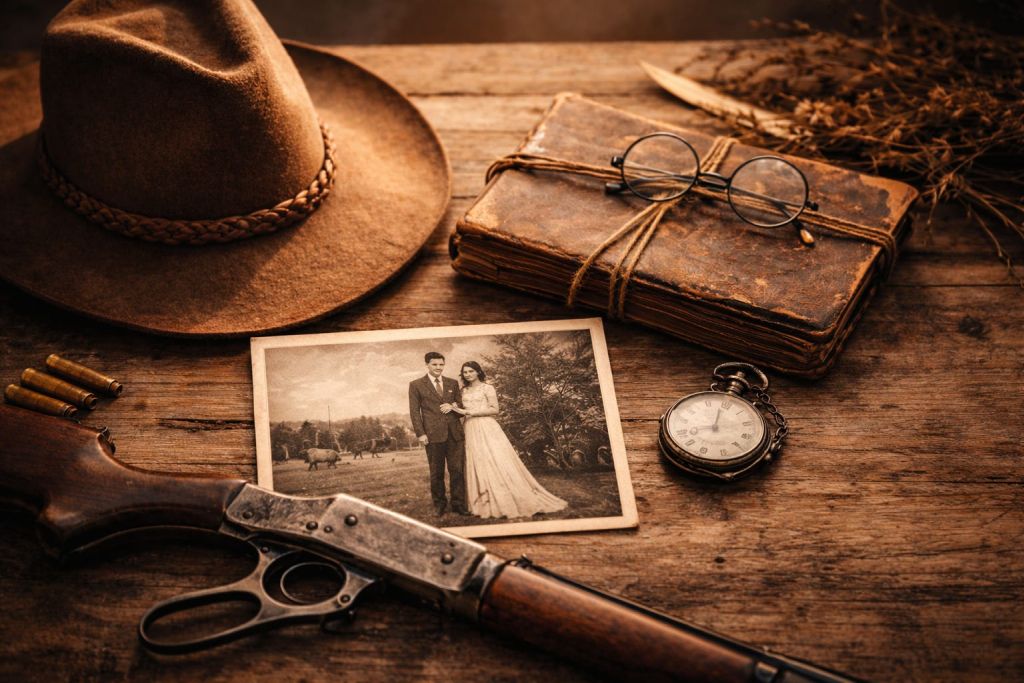
The valley below simmered with the heat of midday, where Pieter Jacobus Vorster stood looking out over it. He was oblivious to the beauty, simultaneously thinking of his birthday the previous month and his upcoming wedding next month. He had turned twenty on 9 December 1923 and would marry his beautiful Maria on 25 February 1924.
“Do you, Maria Magdalena Johanna Opperman, take Pieter Jacobus Vorster as your lawfully wedded husband?”
He could hardly wait to hear those words spoken; hardly wait to wholeheartedly say ‘yes’ when asked if he wanted to have Maria as his wife.
The moo of a cow drew his attention back to the cattle behind him. It was time to move on and find shelter for the night. He needed to keep the animals safe from wild animals. Pieter whistled for the herders to get up from where they lay in the grass. He walked out in front, rifle at the ready, while the men made sure all the cattle followed.
They found a large enough space close to some trees and started setting up camp – a corral for the cattle, and picking relatively safe spots to sleep under the stars. Once the guard duties for the night had been determined, they sat down to eat. Tonight they didn’t have to hunt, as they still had leftover meat from the day before. In about ten days they would be back in Mombolo.
After a few days’ rest, Pieter would go on one more trip with the cattle – north this time – then his next trip would be to Humpata, to marry Maria.
Pieter Jacobus Vorster, born 9 December 1903, married Maria Magdalena Johanna Opperman, born 12 February 1902 in Humpata, Angola on 25 February 1924. On 11 October 1928, they became the proud parents of a son, who they named after his grandfather, which just happened to also be his father’s name. Sadly, their son passed away at barely a month old. On 25 November 1928, they departed from Mombolo, Angola to trek to South West Africa, documented to be in group M/58. Had their son been part of the trek, his name would also have been on the list.


Pieter’s heart ached. He had to leave his beloved Maria behind. She had fallen ill on the trek from Mombolo, and even before they reached South West Africa, he had to give her back to the earth.
Ashes to ashes, dust to dust…
How could God be so cruel, to take his love and his child from him? What had he done wrong to be dealt such a fierce blow? Or maybe he did nothing wrong? Didn’t the Bible say that God would punish the sins of the father to the third and fourth generations?
Once again it was the mooing of a cow that drew him out of his reverie. Since he had no family, the South West African government hadn’t awarded him a farm when they arrived here. He had, however, found work on farm 388. It was still not clear what the actual name of the farm was, but he was grateful to have found something to keep his mind busy.
Pieter allowed himself a faint smile when he thought of the girl on the farm 382, Helm – Anna Nel. He had met her when he went to Helm to buy a cow, as one of theirs had died, leaving them short on milk.
He still felt the acute sadness of losing Maria, but maybe God is showing him a new way. Maybe there could be happiness after all? Anna intrigued him. She was shy, soft-spoken, and kind. He would like to get to know her better, and after all, it’s about time he started a family.

On 12 August 1929, Pieter Jacobus Vorster, married Anna Johanna Dorothea Nel, born 11 June 1911. In the twelve years after that, they had seven children:

Pieter worked hard. They had moved around quite a bit and had finally settled in Outjo on the farm Leghorn. They didn’t own it, but at least they earned enough money to keep everyone clothed and fed. Just.
When they learned of the Second World War, Pieter was 36 years old. Because he was a farmer, he was exempt from being called up for military service. Farmers were needed to supply the country and the troops with food. Even so, Pieter frequently needed to check in with the National Reserve on the farm Oopval, in the Grootfontein region. He knew the possibility was there, but hoped he would never be called up for military duty.
It was about two years after the birth of their youngest, Willie, that Pieter noticed the change in Anna. She seemed distant; quieter than usual. He wanted to talk to her, but coming home bone-tired from the fields every day had him asleep not long after they had their dinner. After all, even before the sun rose the next day, he had to be out and about again.
It wasn’t only the hard work that kept him from talking to her. No, it was also his nerves and his health. He had a cough for some time now, and it seemed to get worse when he had a hard day of work in the fields, especially when they did some ploughing. The cough left him more tired, but his nerves blocked all words from forming. He knew something was wrong, knew he had to talk to Anna, but at the same time he didn’t want to know.
She was a good, strong woman. A good mother to her children. He had sensed her restlessness, but thought with time that would settle down.
It was when he returned home one day in 1943 that he knew how wrong he’d been. He’d heard the rumours. His wife and that fellow, Schoeman. A drunkard.
Anna was gone.
Cielie, only nine-years-old, stood at the stove, trying to cook them some dinner. Her sister, Anna, sat on the floor, soothing the crying Willie. Pieter was shocked. Where was Anna? He had asked the children, but they didn’t know. Somehow Pieter knew he would never see her again.
Once again, life had dealt him a blow. That night, for the first time in years, he got down on his knees and prayed. He pleaded with God to bring Anna back to him; said he would forgive all her transgressions if only she would come back. Not for him, but for her children.
Anna Johanna Dorothea Vorster, born Nel in 1911, never returned to Pieter Jacobus Vorster, 1903.
Two years after her disappearance, and two years of caring for the children by himself, with some help from his sister, the call to duty came.
It was in the first months of 1945 that Private P.J. Vorster received his orders to report for duty in Voortrekkerhoogte, Pretoria. He arrived there in April, after arranging for his children to stay with his younger sister, Cecilia Johanna Vorster, born in 1910. By now she was married to Hendrik Johannes Vermaak, born in 1892.
Pieter might have hoped his brother, Paul Vorster, born in 1908, would share the responsibility with his sister, but sadly, Paul wanted nothing to do with the children because their parents were divorced.
Shortly after his arrival in Pretoria, Pieter was admitted to the military hospital in Voortrekkerhoogte. Once discharged, he was granted leave without pay (LWOP), only to be hospitalized again. After several hospitalizations because of his lungs – he had never gotten rid of that cough – the army decided that his medical situation was serious enough for a medical board. He was finally discharged from the army in May 1946.


Pieter breathed in deeply, grateful that it was at least possible after his recent stay in hospital. Just over a year ago, he had reported for duty, and here he was, medically boarded. He’d been in hospital so many times, sometimes for months. Asthma, they’d said, but he’d heard them whisper about underlying conditions.
At least, the most recent cure made him feel stronger. He briefly glanced up at the blue sky above, sending a prayer of thanks to the Almighty.
Maybe, just maybe, happiness was in his future. During one of the many times he’d been discharged and granted weeks of sick leave, he met Anna.
No, not the Anna who left him, but a divorcee who captured his attention on one of his first of few nights out. They’d fallen in love, and he wanted to make her his wife. To do that, he would first have to request a divorce from Anna Nel.
Pieter headed to Pretoria, to where he’d arranged for board and lodging, near to where Anna lived. He’d promised her to take care of his ‘little problem’ and to marry her as soon as he could. He intended to do so before returning to South West Africa, where his children still lived with his sister.
Pieter Jacobus Vorster, 1903, was discharged from military service in Voortrekkerhoogte, Pretoria on 4 May 1946. He consulted an attorney almost immediately, as on 16 May 1946, a letter was sent to Anna Johanna Dorothea Nel, 1911, to appear in court on 18 July 1946. She didn’t, whereupon the judge granted the divorce and the care of their six children to Pieter.

A month after that, Pieter Jacobus Vorster, 1903 married Anna Catharina Jooste, born Wolff, date of birth 15 February 1915. Their union took place on 21 August 1946 in Pretoria. From here they moved to South West Africa, and eventually lived in Tsumeb, where their twins were born on 23 July 1947 – a boy, Josua Johannes Filiphus and a girl, Maria Magdalena Gertruida.

Pieter sat on the veranda, looking out over the scorched earth of the back garden, and cringed when he heard Anna’s voice.
“You can sweep the kitchen again!” she yelled. “Just look at this, crumbs everywhere! And when you’re done, go make the beds.”
Pieter knew it was Cielie whom Anna was speaking to. No, not speaking, yelling. Ever since the birth of the twins, Anna had changed. Not that she was overly friendly with his children before that, but now she openly used the two girls to do the housework and the cooking. Somehow, she seemed to like Cielie less than Anna. He’d talked to her about her treatment of the children so many times, but nothing ever changed. Not for long, that was.
She treated the younger boys just as badly. Ouboet, their oldest sibling, hadn’t moved to the Transvaal with them. It was 1948, and he was eighteen already, working in South West Africa, and close to the girl he loved. But Koos, Ben and Willie had to sweep the yard, pull out the weeds and tend to the chickens. Anything so Anna can give all her love and attention to the twins. That was when she wasn’t taking a nap, and the two girls would have to tend to the babies.
It was towards the end of 1948 that Pieter once again questioned God. What had he done wrong? Why was his life so difficult? What was he being punished for?
Anna, his wife, had been such a sweet woman when he got to know here in Pretoria. When had she changed? Why had she changed?
He sat under a tree in the garden, mulling over Anna’s words. She wanted his children to go to an orphanage. There was no place for them in their home anymore. He thought about how she treated the girls. Maybe it would be better for them to go to an orphanage? They were fifteen and thirteen years old, and wouldn’t have to stay there for too long. It might also help them with some job opportunities.
The more Pieter thought about it, the more he thought he would do the girls a favor to send them to the orphanage. They would be away from their stepmother; have more peace than they had now. It would also give all of them more food, since there was so little to go around. Anna wanted the five kids to leave, but he would put his foot down. Only the girls.
At the beginning of 1949, Cielie and Anna went to the orphanage, President Kruger Children’s Home in Pretoria. It broke them. He could see it in their eyes. Throughout the year, his wife prodded him to send the boys too. Pieter, not being well, and only getting sicker – still his lungs – finally relented. At the beginning of 1950, Koos, Ben and Willie went to the same orphanage, but in Johannesburg.
Twice a year, the children returned home for the longer holidays. Because Pieter couldn’t work and his health was getting worse, the boys caught fish and birds, which they ate with mieliepap. He heard the rumbling of their tummies when they went to bed at night, and saw the pain in their eyes when they had to return to the orphanage at the end of the holidays.
The five children who had to go to the orphanage despite both their parents still being alive had suffered lifelong consequences because of it. Not only they but also most of their children, because unwittingly their trauma had influenced the way they parented.
The sins of the fathers…
Pieter Jacobus Vorster, born on 9 December 1903, died at the age of only 51 on 28 August 1955 and the cause of death was recorded as ‘Congestive Cardiac Failure (Asthma)’.

Pieter felt his life force draining out of him. He knew it wouldn’t be long. Next to his bed sat his wife, and in the distance he heard Josua and Maria. They were only eight years old, far too young to lose their father. That made him think of his other children. Cielie, Anna and Koos had all left the orphanage at the end of the year they’d turned sixteen. Ben would leave at the end of the next year, while Willie had to stay until the end of 1957.
Had he done well by his children to send them to the orphanage? To get them out from the tyranny of his wife? Had their lives been better? He knew the orphanage had provided them with clothes and food, but what about love? Had they known enough love?
Did they know he loved them with all his heart? That all he ever wanted was the best for them? Could they forgive him for not being strong enough to stand up to those who had harmed them? Their mother? Their stepmother?
Pieter’s breathing hitched and a coughing fit racked his frail body. He saw the concern on his wife’s face. When his coughing didn’t subside, his wife rushed out of the room. She returned shortly after, two pillows in her hand. She pushed it behind his back, while saying: “I’ve called the doctor.”
He tried to smile, wanted to reassure her he would be okay, even though he knew he wouldn’t. Minutes later, there was a knock at the front door and Anna jumped up to let the doctor in. That was when Pieter stopped holding on, and allowed life to leave his body.
He was finally at peace.


