 11

Continued from…
In our previous look at the history of the Du Toit family, we saw the Huguenots as people who valued education, hard work, and the Bible. But to understand why they were later forced to leave everything behind, we must look at how the peaceful fields of France slowly changed. It became a land filled with fear and deep division.
For many years, Huguenot families were a vital part of French life. They were skilled farmers who knew the rhythm of the soil and talented craftsmen whose work kept the local economy strong. In many towns, Catholic and Protestant neighbors lived side by side. They walked the same narrow streets, traded at the same markets, and watched their children play together. On the surface, life seemed calm and stable.
But beneath this calm, a storm was building. As the Protestant movement grew, tension began to rise across the kingdom like dark clouds on the horizon.
In the sixteenth century, religion was never just a private matter. It was tied to politics, power, and loyalty to the King. The Catholic Church had held power over Europe for centuries. The French Kings believed that for a country to be strong, it had to be united under one God and one King.
To the rulers in their grand palaces, the growing number of Huguenots was a serious threat. They feared that a divided church would lead to a divided nation. They worried that people who chose their own way to pray might also choose their own way to live, ignoring the King’s commands.
While the powerful worried in their castles, the ideas of the Reformation continued to spread. Forbidden books were printed in Switzerland and the Netherlands and smuggled into France in the bottom of merchant wagons. Traveling preachers moved quietly from house to house, speaking to anyone who would listen. What started as a simple wish to read the Bible in French was turning into a dangerous struggle for the soul of the nation.
The country split into two camps. On one side was the House of Guise, a wealthy Catholic family who swore to defend the old faith. On the other side were powerful Protestant nobles who became the protectors of the Huguenots. As these leaders fought for power, trust between ordinary people began to vanish. Neighbors who once greeted each other warmly now looked away with suspicion. In the marketplace, quiet conversations were replaced by doubt and fear.
The sun is setting over the fields of France, painting the sky in shades of deep red and gold. Usually, this is my favorite time of day. It is the time when the men return from the grapevines and the smell of fresh bread fills the air. But lately, the evening air feels different. It feels heavy, as if a storm is coming that no one can stop.
I am sitting on the low stone wall outside our house, watching our neighbor, Monsieur Bernard, walk past. For as long as I can remember, he has been a friend to my father. They used to stand here for hours, laughing and talking about the harvest or the weather.
But today, Monsieur Bernard does not stop. He does not even look at me. He pulls his hat lower over his eyes and walks faster. I see him cross the street to avoid our door. My mother says it is because he goes to the old church and we do not. She says people are becoming afraid of their own shadows.
Inside, I hear my father speaking in a low voice to my uncle. They are not talking about the crops today. They are talking about the news from the city—news of soldiers, of closed gates, and of a town called Vassy where people who pray like us were hurt. My father’s voice sounds hard and dry. He only speaks like this when he is worried.
“We must keep the shutters closed tonight,” my mother whispers as she pulls me inside. She doesn’t light the big candles anymore. We sit in the dim light of a single small flame.
I look at my hands and wonder how a prayer can make a neighbor turn away. We still live under the same red roofs. We still drink the same water from the village well. But a wall has grown between us, a wall made of silence and suspicion.
As I lie in bed, I listen to the sounds of the night. Every bark of a dog or hoofbeat on the road makes my heart race. I used to feel safe under our sturdy roof, but now I realize that even the strongest stones cannot keep out the fear that is spreading through France.
By the year 1562, the tension finally snapped.
In the small town of Vassy, Catholic soldiers attacked a group of unarmed Protestants who had gathered to pray. Many men and women were killed where they stood. This act of violence started the French Wars of Religion. It was a long, painful conflict that would last for decades and tear families apart.
During these dark years, the country was broken. Armies marched across the countryside, leaving behind burned crops and ruined villages. Great cities were surrounded by soldiers, causing hunger and misery for the people inside. War was no longer something that happened far away on a battlefield. It entered the homes of ordinary families who had never chosen to fight.
For Huguenot communities, every day was uncertain. They never knew if their town was safe or if a change in power would bring soldiers to their door at midnight. Even during short times of peace, the fear never really left. Many Catholics wanted the Protestant faith gone forever, and the Huguenots knew that any promise of safety could be broken without warning.
Families learned to live very carefully. They spoke in whispers about their beliefs. They often traveled through thick forests at night to meet in secret places for worship. Life became a delicate balance between hope and fear.
By the early 1570s, France reached a turning point. The leaders of both sides hoped that a royal marriage could finally bring peace. They planned a wedding between a Protestant prince, Henry of Navarre, and a Catholic princess, Margaret of Valois. This union was supposed to end the years of blood and create a future where both faiths could live together.

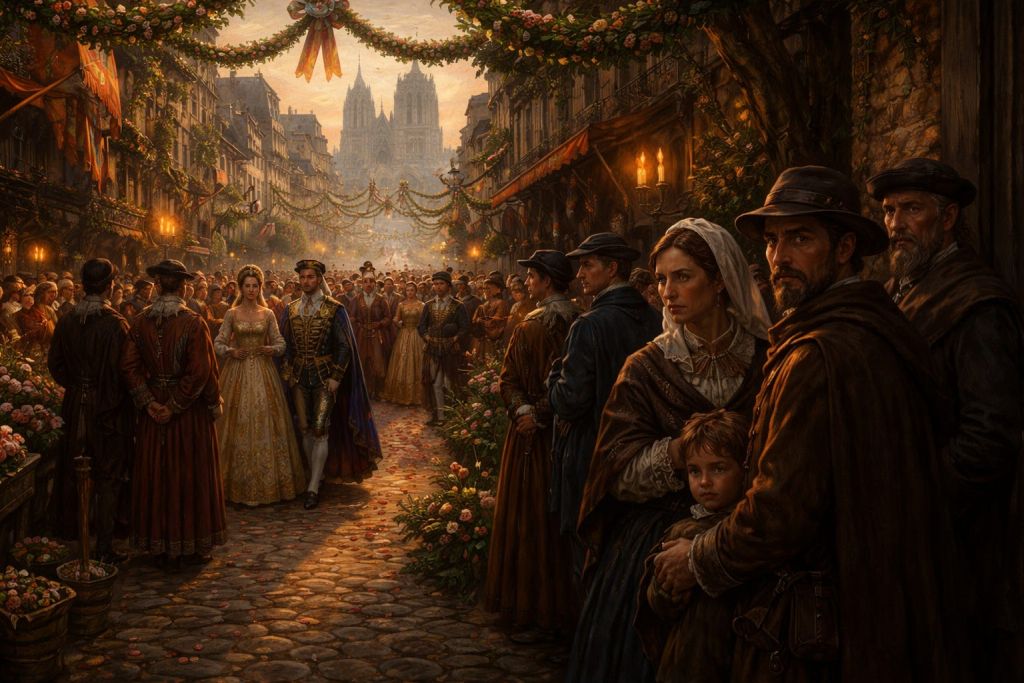
In the warm August days of 1572, the city of Paris was packed. Nobles, soldiers, and religious leaders came from all over the country to see the wedding. For a short time, the streets were filled with music, bright colors, and laughter. Many people truly believed that a new chapter of peace was beginning.
But beneath the celebration, something dark was moving. In the shadowed alleys of Paris, plans were being made in secret. These plans would soon turn the wedding bells into a signal for horror. It would lead to a night of violence so shocking that it would forever change the history of the Huguenots—and the future of families like the Du Toits.
As neighbors turned into enemies, a grand wedding offered a final hope for peace. The streets of Paris were filled with music and laughter. But behind the palace walls, a trap was being set. One of history’s most terrifying nights was about to begin.
Continued here…


2 thoughts on “BLOOD OF THE HUGUENOT – Part 4: Clouds of Fear”