 11

Discovering documents of my maternal ancestors, learning they’d been in the penal colonies of the nineteenth century, and discovering an almost hidden part of Dutch history, prompted me to visit Drenthe and Groningen. I didn’t have to go there to discover more of our family history, as many old documents had already been digitalized and can be downloaded.
I went, because I wanted to stand where they had stood.
For five days, we stayed at the hotel in Frederiksoord – Logement Frederiksoord – which is the place where General Johannes van den Bosch created the first free colony. Many of the original buildings still stand, now protected as UNESCO World Heritage.
A guided tour took us through the grounds of the first ever horticultural school in the Netherlands, the Gerard Adriaan van Swieten Tuinbouwschool founded in 1884. What fascinated me more was the spot next to the monumental school building, where volunteers had laid out tiles in a rectangle, with sticks wedged upright between them. This was right across from the hotel, and marked the location of the very first colonial house. As I stood there, I felt a quiet sadness. Our ancestors would never have lived here. This place was not meant for people like them.

From the documents we found, we knew everything in the colonies were recorded – every movement, every misdemeanor, but also good behavior. On the entrance road, two white houses faced each other like watchful eyes. This was where movements were recorded — arrivals, departures, misdemeanors, good behavior. Nothing went unnoticed. To put extra weight to this task, there was a supervisor’s house right across the entry road.


The house where the doctor lived in colonial times, is where the doctor of Frederiksoord lives today. On our side of the road, a low column bore the face of Johannes van den Bosch, and two inscriptions. The top one: KVW 1818 (Kolonie van Weldadigheid 1818 – Society of Benevolence 1818). The bottom one read: Welkom in de kolonie – Welcome to the colony. These columns marked the borders of the colonies.


We had planned two museum visits – one to Museum De Proefkolonie (Museum The Experimental Colony) and the other to The National Prison Museum in Veenhuizen.
As the doors to our first museum experience opened, we were right in the better part of Amsterdam, only to round the corner. Here we were amid the dark side of the nineteenth century. Filthy streets, rats, poverty. People begging. People telling their stories and Johannes van den Bosch sharing his ideas for the colonies.
The belief was simple: give people a home, clean clothes, work — and dignity would follow. It sounded almost modern. Almost like the beginnings of the Dutch welfare state.
Even though the colonists were given those things, they had to repay it. They had to stay and work in the colonies for sixteen years to pay off that debt.
In one display, a letter described a woman too sick to work after childbirth. Instead of punishing her, Johannes van den Bosch advised patience. Support her until she recovers.
It struck me how radical that must have been — the idea that poverty was not always moral failure.
The idea originated that all colonists had to pay a tiny amount to help support those who got sick, and this was over 100 years before the Netherlands introduced the first health insurance funds. Another thing that happened in the colonies long before the law dictated it was that children had to go to school.
It was tremendously interesting to learn more about the colonies – more than I’d read about it up to then. I needed to see this to understand the idea behind the colonies, to prepare for the moment I would stand where my ancestors had.
The last room of the museum showed the timeline of the creation of the different colonies – free and penal. What fascinated me here were the notebooks and coins, the clothes the people wore, the old school desks.
Every bit of money the colonists earned was recorded, but also when they owed money for damaged clothes or received a fine for whatever reason. Since people were free to come and go as they wanted in the experimental colony, many of them went to drink in town. Alcohol became a problem, which was why they created a coin that could only be spent in the colony. Since alcohol wasn’t available there, people couldn’t become drunk anymore. Or at least, that was the reasoning.


Just before we left, my eye caught a stand with twenty-five wooden blocks listing misdemeanors and punishments. The words on one block read: unmarried woman with a child.
I thought of Grietje.
Her punishment?
To be sent to a penal colony.
That fact colored the way I looked at the colony house, which was part of the museum, but about 600 meters from the main building.
As I walked towards it, I noticed how large it was from the outside. Part of it was white, part of it black, with a thatched roof. I was actually shocked to see the inside – 5×4 meters / 20 square meters. Here the families had to live, to cook, to eat. Adjacent to this space were three box beds. I peeked inside and couldn’t imagine sleeping there. There was no way someone could stretch their legs – remember, the entire house is five meters wide, and the three box beds stretch across those five meters.


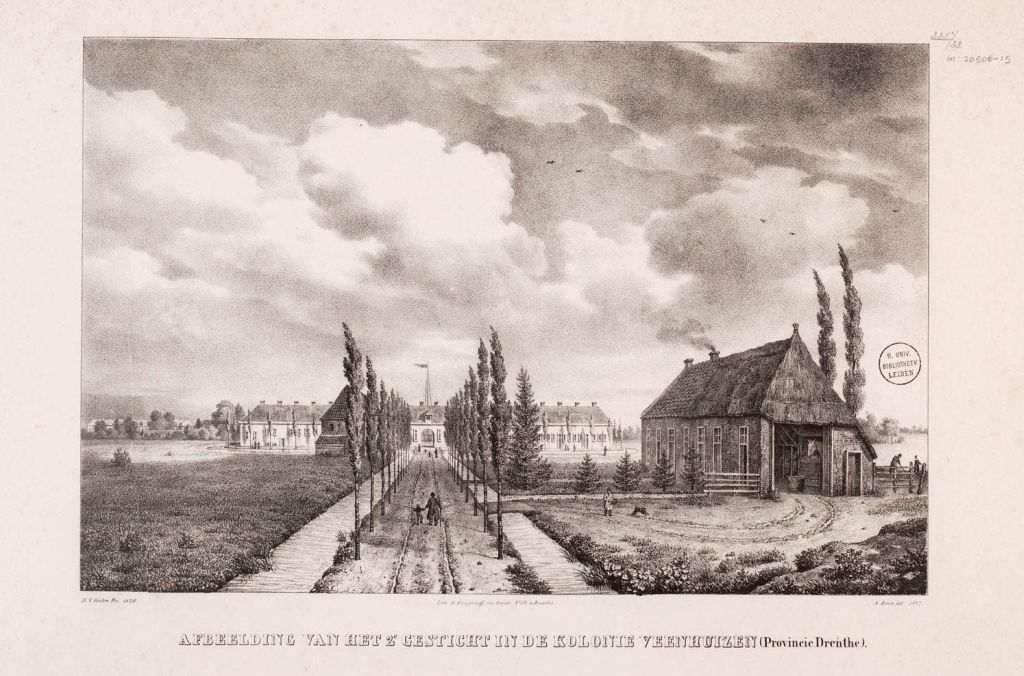
Our next museum visit was to the National Prison Museum in Veenhuizen, housed in what was called Het Tweede Gesticht (The Second Asylum) back in colonial times.
At the entrance to this museum, a plaque explained that this was the Second Asylum, built in 1823 and designed by Johannes van den Bosch. Orphans on the inside rooms. ‘Exemplary families’ in outer rooms. Later, a labour facility. Since 2005, a prison museum.
This was where they had been.
Standing there, reading the words on the plaque, and knowing from research that Grietje Alberts Kuiper (1794), Marten Kuiper (1830) and Christiaan Geerts Swaak (1792) arrived in Ommerschans in 1832, and were then sent to Veenhuizen in 1835, gave me pause.
I almost felt as if I was about to tread on holy ground.

The first and third asylums were where the orphans were sent, but this, the Second Asylum, was where our ancestors breathed the air, and one of them – Christiaan – died in 1855. He was discharged from Veenhuizen in 1836, but returned as a volunteer in 1837 and stayed there until he passed away.

Even though this building was once a penal colony and part of the Society of Benevolence, 75% of the museum is about the prison, not the orphans, beggars or vagrants that had been confined between its walls.
We walked past cells, ancient torture instruments and read about notorious criminals and the punishments they received. We were about a quarter way through the museum when we found the first mention of the Society of Benevolence.


One of the pictures mentions Veenhuizen I, II and III – the three asylums. There it said that the first asylum quickly housed 1000 children, but because there was a lot of protest, less children than expected came to Veenhuizen. That was why Veenhuizen II was designated as a beggars asylum.
The goal of the asylums – for orphans, beggars and vagrants – was to train the poor and needy for a working life. Work, education, religion, and discipline were central. Sadly, I don’t think many of the children actually received education, as despite Marten Kuiper being in Veenhuizen until he was nine years old, he had never learned to write, as was evident on his marriage certificate in 1856, when he married Lutske Tel (1832).
In the next room, coarse linen hammocks hung from the ceiling. Once orphans and beggars had to go to sleep in those hammocks, higher up in the air. Once they had to go to sleep, the hammocks were hoisted up in the air by a pulley, and there was no getting out of it until the hall supervisor let them down again the next morning. There were also sleeping cages, a steel construction of 1 by 2 metre with a hammock inside, and these were locked at night.


Deeply impressed, we walked on through the rest of the museum, where you followed the crimes, trials and punishment of five inmates. Interesting, but not why we were there. In the last large hall was an exposition that revolved around the release of once secret documentation, and how family members dealt with the guilt and shame of Dutch people who collaborated with the Germans.
In the past, this hall also housed an exposition where you could check whether your ancestors were in the colonies, but sadly, as it is with most expositions, it was a temporary one. I’d been told that you could search for names on a computer and then they would get out the actual books where notes had been made.
I didn’t want to see those books because we needed the documents, as we already have all of those – found on allekolonisten.nl – but I think seeing the actual books would’ve added to the experience of walking where my ancestors had.
However, exiting the museum after a calming cup of coffee and strawberry cake, I turned around to look at the building, and a totally unknown feeling took hold of me. Something I hadn’t felt in Frederiksoord, simply because Grietje, Marten and Christiaan had never set foot there.

I looked at the stone set in the wall above the entrance and tried to imagine myself in Grietje and Christiaan’s shoes, who came to the Second Asylum almost 200 years ago with hope in their hearts.
Hope for a better life. For food. A place to sleep.
I wondered what it must have felt like to be so poor that you were locked up.
Marten clasped his mother’s hand tightly, looking up at her, wondering why she stopped, while others around them approached the entrance of their new lodgings.
Grietje felt his eyes on her, and her heart broke a bit more. She didn’t think that was even possible. All she wanted was for her son to survive. She’d already lost one only a few days after his birth.
Maybe it would be better here in Veenhuizen? Maybe here she could save more money than she could in Ommerschans. Would their food portions be a bit bigger here, so they wouldn’t have to go hungry all the time? Maybe here they would allow her to stay with her son? Or would they be separated again?
She finally looked down at him, her almost-six-year-old son. He was wise beyond his years. How she wished she could take him away from here, keep him safe, warm and fed without the help of the Society of Benevolence.
She scooped him up in her arms, and hugged him tight to her.
“No worries, my son, it wi…”
Before she could finish her reassurance, a guard dragged him out of her arms.
“Children to this side, and you…” he shoved Grietje to a line of women shuffling towards the entrance, “… move!”
We will never know how they felt standing there in November 1835, or what really happened when they arrived in Veenhuizen from Ommerschans.
But in the registers of the colonies, in the fines, the earnings lists and the discharge notes, traces remain.
It is from those traces that we can reconstruct a tiny part of their lives.


3 thoughts on “BECOMING KUIPER – Part 4: The Second Asylum”