 11

In 1811, during the French occupation of the Netherlands, Napoleon Bonaparte introduced regulations requiring people to register a fixed family name. However, the transition from patronymics and other naming practices to fixed surnames was not immediate or consistent. In November 1825, King William I issued a Royal Decree ordering those who did not yet have a registered family name to choose and register one, with penalties for those who failed to comply.
What complicates genealogical research from before 1811, or even before 1825, is the use of patronyms. Let’s look at Grietje. When she was born, she was called Grietje Alberts – Grietje, daughter of Albert. But she wouldn’t have been the only girl named Grietje who had been born in Zevenhuizen and who had a father named Albert.
Can you see now, when we investigated those historical documents, how confusing it could be?
We had to make assumptions, had to assume the people we had found were the correct ones, as we mentioned towards the end of the previous part about Albert Martens Kuiper.
It’s almost time to go back one more generation, and maybe even another, but before that, there is one other thing to look at.
In the eighteenth-and nineteenth centuries, there were (often strict) customs for parents when they named their newborns.
As early as the Middle Ages, naming after their grandparents was a widespread custom, not a universal rule. This was done to honor and keep their ancestors alive in their own children.
Where applicable, female names were changed to a male form (Geertruida = Geert) and vice versa (Albert = Albertina).
The common naming patterns for boys were:
The common naming patterns for girls were:
For sons, the father’s family generally took precedence; for daughters, the mother’s family.
However, when a relative had passed away, newborns often received their names, regardless of whose side of the family that person was on. It could happen that if a grandfather had passed away, and a daughter was born, the girl could receive the feminine form of the deceased’s name. For example, Cornelis became Cornelia. The reverse applied to boys.
In Groningen, the first son received the name of the mother’s father if he had already passed away. Otherwise, he was named after the father’s father.
In Drenthe, the naming followed a different pattern. There, the first four children received the names of their four grandparents, and then the next eight children got the names of their great-grandparents.
It is common for children from the same family to have the same first names. There are two reasons this might be the case. Either an earlier child with the same name had passed away, and because they still wanted to honor the ancestor, they gave the next daughter or son the same name again. The other reason was that the grandparents from both sides had the same name.
With all the above in mind, it’s time to dive deeper into our family history.
Before we share our findings about Geertje Martens, we first want to say:
So let us take you on the journey.
With the naming pattern above in mind, we can now reasonably assume that Grietje (b.1794) was named after her grandmother, Geertje Martens, mother of Albert Martens. Maybe Grietje’s official name was Geertje, but in daily life she she was called Grietje, just like another Geertje, born in 1947, was first known as Géke and later as Gé.
Back to Geertje Martens…
Her parents were Marten Jans and Trijntje Martens, and she was baptized in Bourtange, Groningen on 20 December 1728.

Fort Bourtange was built in 1593 during the Dutch Revolt and was used until 1851. The Eighty Years’ War, or the Dutch Revolt, was an armed conflict between the Spanish government and disparate groups of rebels, and the causes included the Reformation, centralization, excessive taxation, and the rights and privileges of the Dutch nobility and cities.
Between 1967 and 1992, the star fort of Bourtange was restored to its mid-eighteenth-century state, and it is now an open-air museum.


On 21 November 1747, Geertje Martens married Bartholomeus Davids, a soldier in the Company of Major Alberda van Menkema. At the time of their marriage, Geertje was only nineteen years old and needed permission to marry. By then her father had already passed away, and an uncle – Pieter Jan Alpherts (Alberts) – stepped in as her guardian.

Geertje Martens and Bartholomeus Davids had three children:


Bartholomeus Davids, husband of Geertje Martens, passed away somewhere between the birth of Marten in 1755 and December 1762. We have discovered a document in which every item in Geertje’s meager estate was recorded.
Documents like this served to safeguard the inheritance rights of minor children when a surviving parent remarried. The children’s share of their deceased parent’s estate was recorded so that it could be identified and protected, even after their surviving parent entered into a new marriage.


We are fairly confident that this document was drawn up in connection with Geertje Martens’ marriage to Jan Pieters on 28 December 1762.

Then, in the years after this, we see her and Jan Pieters baptize two children:
Those who have kept track of the dates might have noticed the same discrepancy as we did: Albert Martens, the illegitimate child of Geertje Martens was baptized on 19 May 1763. How could she baptize one baby one month, then another the next? Also, how could she baptize one baby inside wedlock, and the other was an illegitimate child?
The answer to that might be equally simple and sad, and we will try to explain, both in fact and fiction.
By the time Geertje had Albert, Bartholomeus had already passed away. Then she met Jan Pieters, and she became pregnant by him. Notice how the wedding date and the baptism of Janna are only four months apart. Jan wanted to marry Geertje, but he was not willing to accept her bastard as his own.
By law she had to secure the inheritance, however meager, of the three children she had with Bartholomeus, but what about Albert? Probably the only way she could secure some kind of future for him was to have him baptized and ask the church for help, which is why he ended up on a list of children with unknown fathers – view here.
(You can find the name of Albert Martens on page 3 of 8)
This means where Geertje Martens had her son Albert baptized in May 1763, he probably was born well before Janna, and we may never know who his father was.
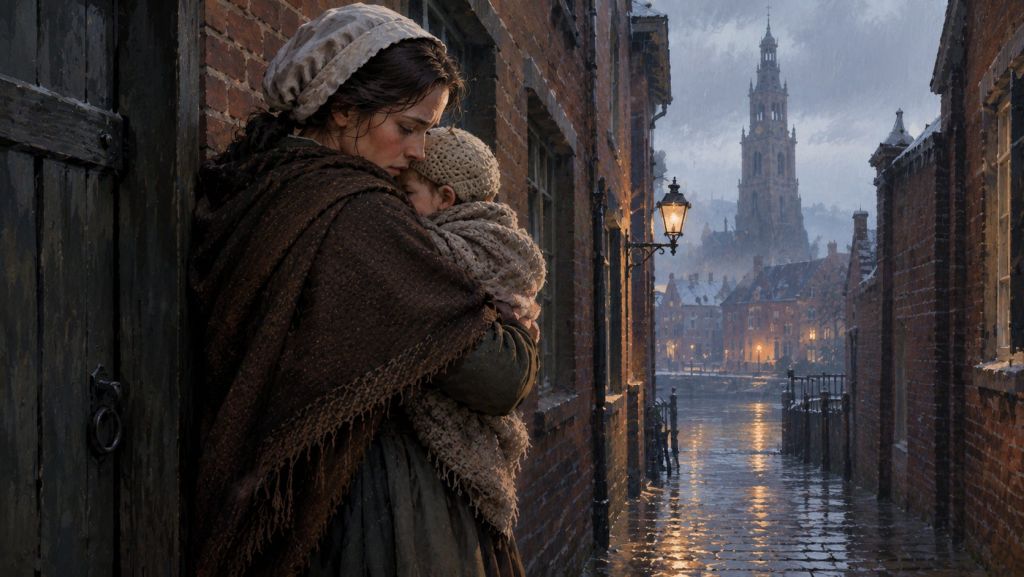
Geertje quickly pulled the door closed behind her and hugged her child tight to her chest. There was a chill in the air, and she stayed close to the walls of the buildings to escape the fierce wind.
Her rapid footsteps took her to the door of the Nieuwe Kerk in Groningen, almost an hour too early for the service. Geertje pushed against the heavy wooden door and slipped inside, where she could take shelter from the harsh weather. She slipped into a pew in the back row and gently rocked Albert to keep him quiet.
Her mind drifted back…
After Bartholomeus had passed away, her life with their three children became hard. It was already not good in the last months of his life, as he couldn’t work anymore and money was tight. But once he was gone, and she had the care of their three young children, she had turned to begging. It was forbidden – that much she knew, but what else could she do. She had mouths to feed.
Men would see her on the streets and told her they would give her money only if she would ‘go with them’. Of course, she understood what that meant. She wasn’t that kind of woman. All she wanted was money to buy food for her children. It wasn’t as if she hadn’t tried other ways to get money. Her knuckles still hurt from knocking on so many doors asking for cleaning jobs, but work was as scarce as food.
There were days she got enough money to cook meals for two days, and other days one meal had to last them two days. Those were the days she couldn’t bear listening to the low wails of her children, while feeling the painful grumbling of her own stomach.
Then it got worse.
Two days passed without a single meal. Geertje was at her wit’s end, fearing for her children’s lives. She set out that day, leaving her children with the neighbor, determined to steal food. Sitting on the edge of the market square, she observed the hustle and bustle, planning her moves, and was surprised when a well-dressed woman dropped a copper coin at her feet. The man at her side didn’t even look at her.
She snatched up the coin and quickly slipped it into the pocket of her dress, and when she looked up, it was straight into the eyes of a man standing across the square. He casually strolled from one stall to the next, alternating his gaze from the wares to her.
Once she could almost touch him, he turned his back on her as if she were nothing.
“Please, sir,” she begged. “Some money?”
“What do you offer?”
“My children have to eat, sir.”
“I will give you silver coins if you come with me.”
Geertje was quiet for a while. With one silver coin, she could feed her children for a month if they lived frugally. Maybe she should…
“How many?”
“Five coins,” he said without hesitation.
“Seven,” she almost whispered.
“Let’s go.”
Geertje couldn’t believe her ears and almost forgot to follow him when he strode away. She quickly got up and almost ran after him, just in time reminding herself not to look too eager. The moment she realized what she was about to do, she actually dragged her feet. It was her grumbly tummy, the memory of her wailing children, and the thought of the silver coins that made her continue following him and pulled her through the next hour.
Where she now sat in the church, Geertje shook her head to get rid of the memory and hugged Albert tighter. That’s all it took. Only that one time. She kissed her son on the top of his head when he stirred.
He settled down, and her thoughts drifted off again, to when Albert was only a tiny baby. By then, not only had the silver coins run out, but she had also found a cleaning job.
That was where she met Jan. He was the brother of her employer and seemed interested in her from the first time they saw each other. She couldn’t remember how it happened, but one day, they found themselves alone in the house. She was cleaning one of the upstairs bedrooms when he entered. By the time she dropped her dress back into place, he had declared his love to her.
Six weeks later, she discovered she was pregnant. Again. The next time she saw Jan, she told him about her condition. She’d never seen eyes being soft and hard at the same time.
“We can get married, but I will not raise your bastard as my child.”
That was the moment Geertje knew she had to secure the future of her four children. Her first three children would get their part of their inheritance, however small, from her marriage with Bartholomeus.
And for Albert?
Since she didn’t know who his father was – they had never exchanged names, and had never seen each other again – there was only one way she could turn.
Her head jerked up when she heard a sound at the front of the church and realized the service was about to begin.
It was time to baptize her child.
Her illegitimate son.
While her patronym wasn’t mentioned on the document, we have possibly also found the entry of the death of Geertje Martens on 16 December 1770. It mentions her leaving behind three daughters and three sons – Trijntien, Anna, Janna, Marten, Albert and Derk.

Because Pieter Jans Alpherts (Alberts) was named as the uncle of Geertje Martens on her marriage certificate, and because the first and only son of her and Bartholomeus was given the name Marten, we could infer from this that her father was Marten Jans, and thus that her grandfather bore the name Jan. This also fits the naming pattern of our line of the Kuiper family through the generations.
At first, we determined that Marten Jans must have been born between 1695 and 1700. Upon further investigation, we found what we believe can be his baptism on 27 October 1696. His parents were Jan Martens (which would also fit the male naming pattern) and Marriche Jans.
Marten Jans had a sister called Jantje. She received the female version of the name Jan, which could either suggest her maternal grandfather had already passed when she was born, or her maternal grandmother was also named Jantje.


Marten Jans married Trijntje Jans on 13 November 1725. Besides Geertje Martens, we found four other baptism records with their names on them:
The first two boys probably died as children, and we don’t know if the third boy made it to adulthood.
The further we go back, the more difficult it becomes to follow a clear line through the records. Names change, documents disappear, and sometimes all we are left with are fragments and clues. We will never know everything about the people who came before us, but that doesn’t mean we should stop looking for them.
We felt it was important to name these ancestors and share as many of their stories as we could find. Because every name represents a life that was once lived.
After all, without them, we wouldn’t be here. And if only for that, they have to be honored.


One thought on “BECOMING KUIPER – Part 11: A Name, a Mother, a Mystery”