 11

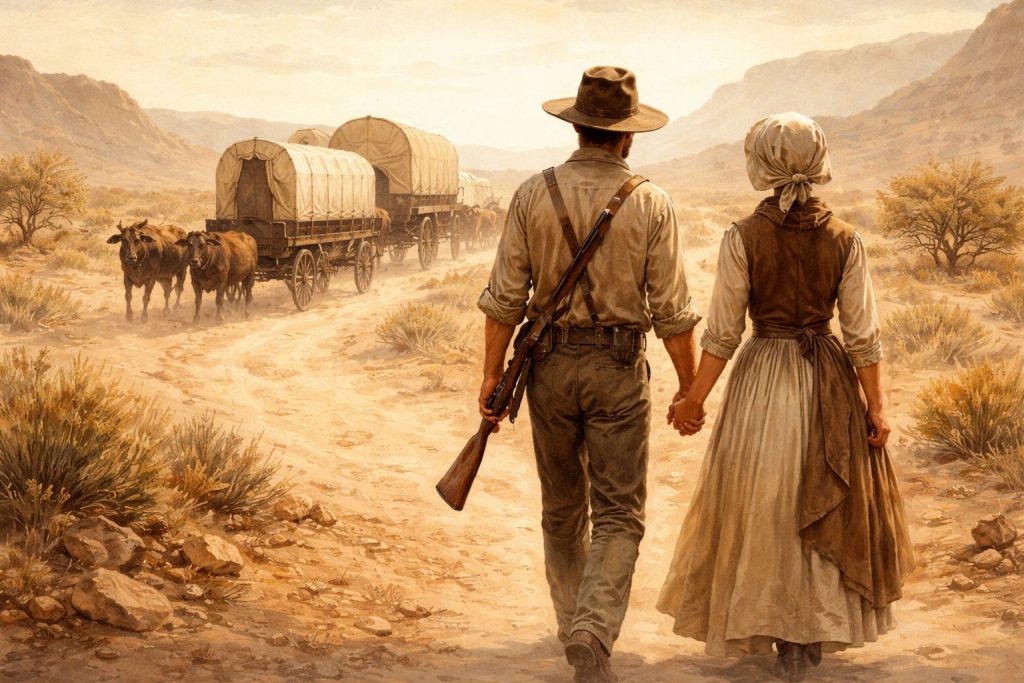
For our family, there was no living memory left to guide us. There were no grandparents or great-aunts who could tell stories about the Dorsland Trek. No voices that remembered the wagons, the road, or the land beyond the desert.
All we knew was that our Vorster family had been part of the Dorsland Trek. That single fact was our starting point. Everything else had to be found – piece by piece – through records and careful research.
For a long time, we believed we already understood the Vorster Dorsland story, because the pieces we had seemed to fit.
We knew the Vorster name belonged to the Dorsland Trek, and we knew Angola played a role. So we began building the story the only way we could: with dates, with places, and with careful reasoning.
The Dorsland Trek began in the late 1870s. Barend Johannes Marthinus Vorster, born in 1845, and Aletta Johanna Steyn, born in 1849, were young adults during that time. Their children were born between 1868 and 1886.
Looking at those dates, the conclusion felt logical. Families usually trekked together. Parents led, and children followed. So we believed Barend and Aletta must have packed their wagon and taken their children north.
When we could not find clear records of some family members later on, we assumed the long road – like it did for so many others – had taken its toll.
When Pieter Jacobus Vorster, born in 1868, later appeared in Angola, and all his children were born there, it seemed to confirm that story. The baptism records of his children appeared to be the proof. At the time, this was not guesswork – it was the most careful conclusion we could reach with the information we had.
Over the past weeks, something changed.
One document appeared. Then another. And then another. Marriage records, birth registrations, death notices, and church lists.
Of course, we already knew that Barend and Aletta – and all of their children – were born in the Transvaal. That had never been in doubt. But one document in particular stopped us completely in our tracks.
They were married in the Transvaal. Not in Angola. Not after the trek. But before.
That single record unsettled everything we thought we knew. How could this be true if we believed they met and married in Angola? Did they return to the Transvaal at some point? Did they leave with a later group? Had we misunderstood the timing entirely?
For weeks, we let this discovery sink in. We returned to our notes, our timelines, and our assumptions. We asked questions. We searched again. And then we reached out for help.
Through our growing research network, we found our helpline: Louw du Plessis, a man in his mid-seventies who has built deep knowledge of the Dorsland Trek while researching his own ancestors over many years. With his guidance, context, and endless patience, the confusion slowly began to clear.
What had first felt impossible suddenly began to make sense. Dates started to align, routes shifted, and decisions became human again. Piece by piece, the puzzle began to fall into place.
Once we accepted this, the story became simpler – and stronger than it had ever been. Our Vorster Dorsland story does not begin with the parents. It begins with one man.
He was born in the Transvaal. He married in the Transvaal. And then, at some point, he made a decision that changed everything.
He joined the Dorsland Trek, together with his wife, Cecilia Johanna Steyn, born in 1872, and travelled north into Angola. There, their children were born. There, a new branch of the family began.
Especially in recent days, documents and fragments have surfaced one after another. Each new discovery changes the picture just a little more.
We will never fully know all the facts of the Dorsland Trek, nor can we ever truly understand the suffering, fear, and loss experienced by those who walked that road. But we can tell the story through the records that remain, and through the words of those who lived it and wrote about it.
What we do know now is this: the life they endured, and the losses they carried, were even more heartbreaking than we had imagined.
Some stories need time before they are ready to be fully told.
In the weeks to come, we will share the stories and the records we have found. We will tell you about the final days before Pieter and Cecilia began the long road north. We will share the heartbreaking stories of hardship and loss, but also of strength. And we will tell the story of the two orphaned children Pieter took in as his own.
Each of these stories will tell another part of the Vorster family’s journey and their place within the Dorsland Trek.
Together, these stories will slowly form a clearer picture – one step, one document, and one life at a time.


