 11

On 7 November 2025, exactly 70 years after the SS Zuiderkruis arrived in Cape Town, after departing from Amsterdam on 22 October 1955, we shared the story of how our family ended up in South Africa. We followed their journey around the west side of Africa, visiting the port of Las Palmas on the Canary Islands.
Since then, we have received photos of the departure of the family — father Jan Kuiper, born 4 September 1906, mother Ottolina van Doeland, born 1 December 1912, and children Marten Kuiper, born 13 May 1936, Anna Kuiper, born 1 December 1938, Roelfke Kuiper, born 3 May 1944 and Geertje Kuiper, born 4 June 1947.
Other family members also departed from the Netherlands and headed for South Africa, such as the future husband, Henk Zonnenberg, of Anna Kuiper,as well as the future wife, Jansje Riddersma, of Marten Kuiper.
From the information we have now, Henk Zonnenberg departed from the Netherlands in 1954, and Jansje Riddersma, together with her parents and siblings, left their home country three months before the Kuiper family, on 13 July 1955.
On 22 October 1955, the Kuiper family boarded the SS Zuiderkruis to sail to a country that would nestle itself deep into their hearts. All of them left the country at different times many years later, except for Jan Kuiper, who passed away in 1972 and is buried in Vanderbijlpark.

But this is not about his passing, but about those moments they boarded the ship, and waved to the family that stayed behind.

We think the sign on the side of the boardwalk said Zuid Afrika Lijn — South Africa Line, but this is only a guess. On the boardwalk, to the left of the photo, it might be Marten Kuiper and Roelfke Kuiper (waving).

Right under the front end of the lifeboat, there are six people. The two to the right are unfamiliar to us, but the other four are Geertje Kuiper and Roelfke Kuiper in the front, and Anna Kuiper and Marten Kuiper right behind them.

Now the four of them have moved to a higher level. Roelfke Kuiper, Geertje Kuiper and Anna Kuiper in the front, with Marten Kuiper behind them. The two smaller ones were waving.

This is at the rear of the ship, and the photo shows Geertje Kuiper (8 years old), Jan Kuiper, Roelfke Kuiper (11 years old), Anna Kuiper (16 years old) and Marten Kuiper (19 years old). Anna and her mother, Ottolina van Doeland, would be the first to celebrate birthdays in South Africa, both on 1 December.
On the back of this image were the words:
Eet ze An. Henk.
Zeg Mart wat heb jij een reclame bord op je buik hangen, moet je maar eens goed lezen wat erop staat.
(Ik denk niet dat … (niet leesbaar)
Translated:
Bon Apetit An. Henk.
Hey Mart, what an advertising sign you have on your stomach! You should really read what it says.
(I don’t think… (unreadable)
A bit of a joke between family members!
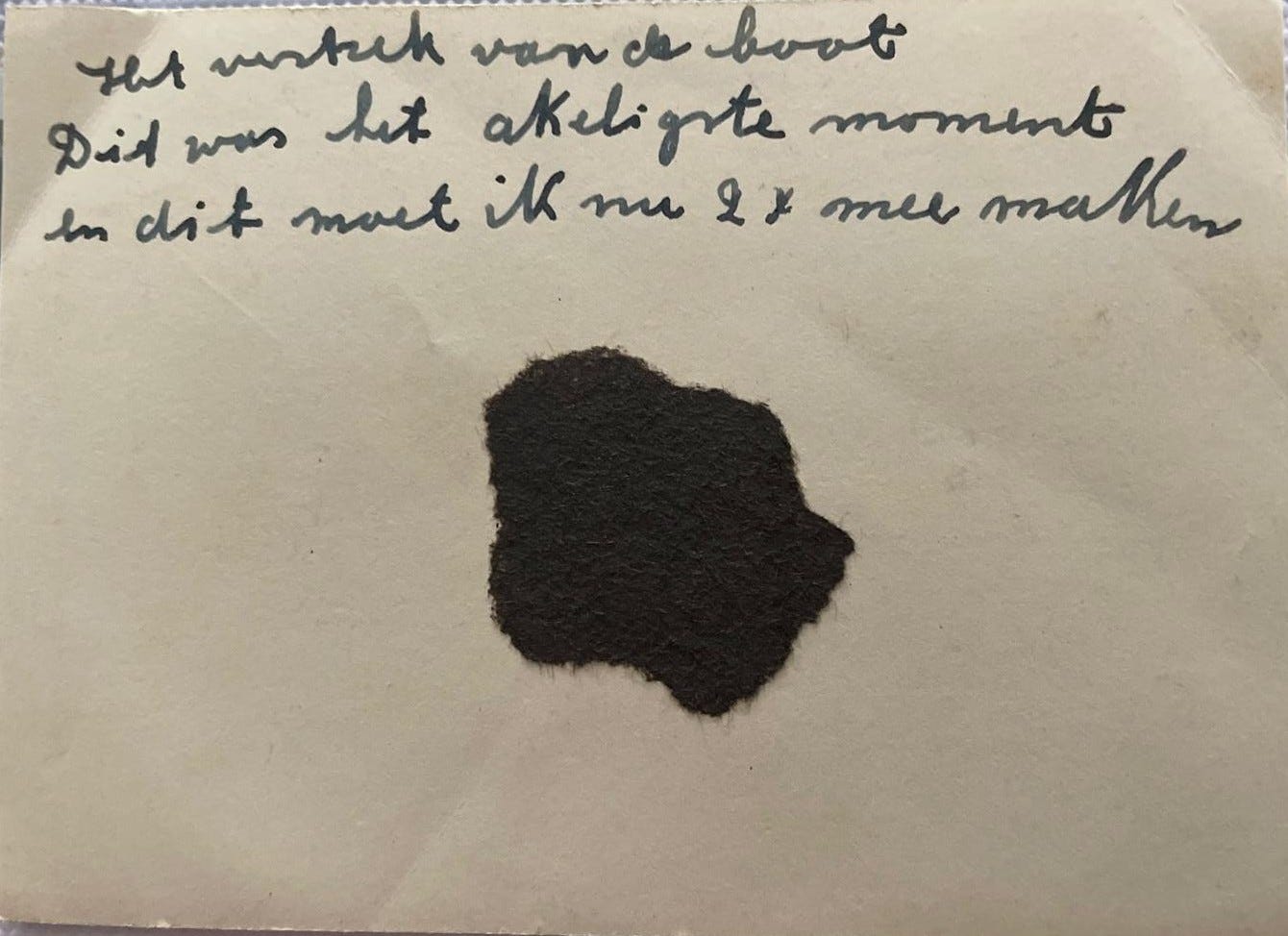
As the header image, we have shared the words on the back of the image below. It reads:
Het vertrek van de boot.
Dit was het akeligste moment en dit moet ik nu 2x meemaken
Translated:
The departure of the boat.
This was the worst moment and I have to go through this twice.

At first we thought this was written by Henk Zonnenberg, but since he departed from the Netherlands before the Kuiper family, it is believed the sister of Ottolina van Doeland — Stijn — must have written it. That she had to go through this twice might imply that she either also witnessed the departure of the Riddersma family, or that of family members on her husband’s side.
Old photographs are silent witnesses of important family moments. They show us who stood where, who leaned into whom, who dared to smile and who did not. A single image can reveal so much. Clothes, posture, emotions. Photographs speak. Even when we forget the names, the photograph remembers. It carries the weight of ordinary days that later became history, and it asks us to look closely, not just at faces, but at what was possible in that moment.
For me, old photos fill gaps left by stories that were never told or only half remembered. They allow me to trace our family history. Each photograph is an invitation to slow down and acknowledge that I come from somewhere, from people who lived full lives before I ever entered the frame. In that sense, family photographs do not just show where we came from; they help us understand how we carry that past into the present.
Photographs are worth more than words can ever express.


