 11

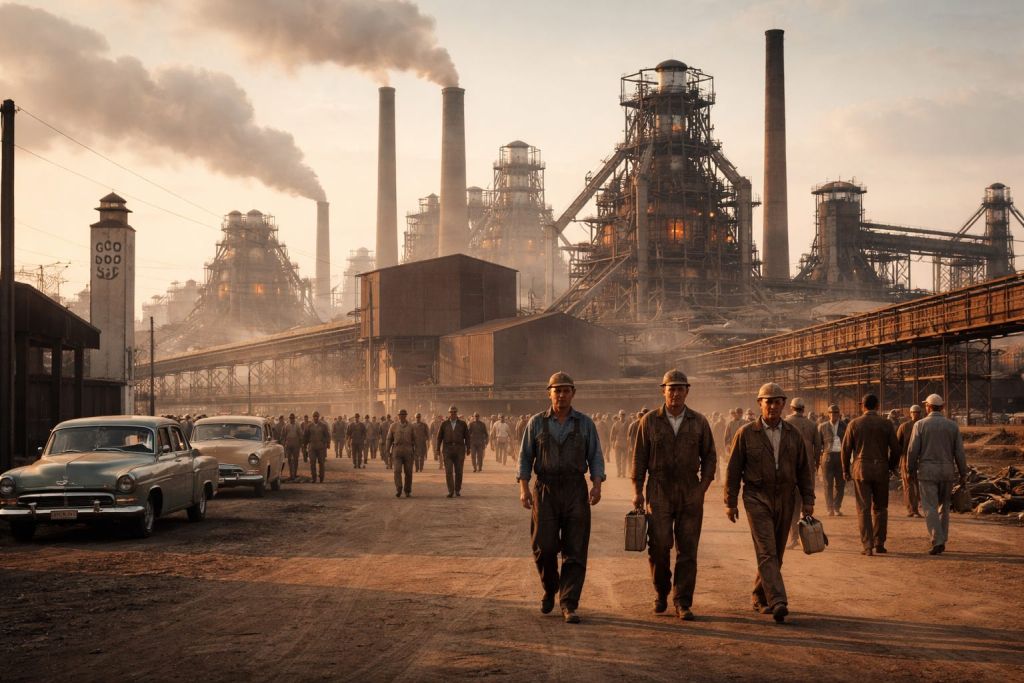
In 1928, Dr. Hendrik van der Bijl started a state organization in terms of the Iron and Steel Act, No 11 of 1928, and called it ISCOR – the South African Iron and Steel Corporation. He and Dr. Frederik “Frikkie” Meyer, who had been a student of Albert Einstein during his studies in Berlin, were among the best known of several people who drove the establishment of this state-owned entity.
The first works of ISCOR were in Pretoria, South Africa, and its aim was manufacturing iron and a range of steel products, and offering job opportunities for communities near its plants. They produced the first steel on 4 April 1934. The expansion of the company was driven by the world’s need for steel, as well as the local manufacture of various necessities.
In 1941, Dr. van der Bijl and his fellow directors revived the idea of a new steel works near Vereeniging, South Africa. A plate rolling mill was their initial project, addressing immediate war needs, while also serving as a component of a future steel works. The Plate Mill went into production in 1943, and ISCOR started trading in 1947.
Directly after the war, the decision was made to build a fully integrated steelworks, and building started in 1947. This new factory was so big that they had to build houses for its employees.
Dr. Hendrik van der Bijl died of cancer in 1948, and in 1949, to honor him, they named the town after him – Vanderbijlpark. When His Excellency the Governor General, Dr E.G. Jansen, officially opened ISCOR’s second steelworks on 4 October 1952, he also declared Vanderbijlpark a municipality.
Several production units started up in 1953.
When they finally arrived at their company house in Vanderbijlpark close to the end of 1955, Jan Kuiper was grateful for the job his employer in the Netherlands – the Willem Smit Machinefabriek in Nijmegen – had helped him secure. It was at least one positive thing about accepting the post-war government subsidy to relocate to South Africa.
With his profession, he could support his family, no matter the country. As a fitter and turner, he worked from technical drawings and used tools like lathes, grinders, and drills to fabricate and fit precise metal parts. He was a highly skilled person involved in manufacturing, assembling, installing, maintaining and repairing complex machinery and mechanical systems.
At the beginning of 1956, with his wife still getting their house in order, and enrolling their two youngest – 11-year-old Roelie and 8-year-old Géke – in school, Jan walked through the gates at ISCOR, ready to start his employment.
Post World War II until into the 1970s, ISCOR actively recruited skilled foreign immigrants, especially from Europe. They needed workers because of the company’s massive industrial expansion. Mines focused on regional black labor, but ISCOR wanted white personnel. This was because of the apartheid government’s industrial policy to maintain a high white-to-black ratio for skilled positions. The priority was to hire these immigrants instead of training local black workers for artisan roles.
ISCOR mainly targeted countries like Britain, Germany, Switzerland, Sweden, Norway, Italy and the Netherlands. Recruitment from Greece followed later. They needed artisans such as bricklayers, electricians, fitters and turners, as well as engineers. As an incentive, ISCOR provided the worker with free passage to South Africa, subsidized housing with rentals capped at a maximum of 20% of their income, and access to home ownership schemes and membership in exclusive workers’ clubs.
He was 16-years-old when he finally bid goodbye to the orphanage, the last and youngest of his siblings. At this age, they deemed him old enough to go out into the wide world and take care of himself.
It was the end of 1957 when Willem Johannes (Willie) Vorster boarded the train in Johannesburg, using the ticket the orphanage had provided, and headed for Vanderbijlpark. There, he would be in a hostel until he could secure other housing. Two years before, his brother had also headed to Vanderbijlpark to do an apprenticeship at ISCOR. It was thanks to this brother, Ben, that Willie would also train at the steel factory.
Willie wanted to be a welder. He wanted to learn how to use the intense heat and specialized equipment to fuse metal parts. It fascinated him. He’d been told he would have to read blueprints, then select techniques to create strong bonds for construction, manufacturing and repair. It was right up his alley that he had to deliver high-quality, precise work.
Deep in his heart, Willie was an artist. However, it would be many years before he tried his hand at painting, and even more years still before he would take orders from others to make gates, barbecues and anything else he could make by welding it together.
There are almost no records of this, except maybe in company archives, but after the Second World War, large post-war industrial companies like ISCOR often ran extensive training programs for the youth. Those youths included orphans and disadvantaged children. It helped the children – in that time, children often started working at sixteen – to earn their own money and build a future, and in turn, the companies could build their workforce.
ISCOR, known for its strong internal training schemes, offered those children not only a job, but also a roof over their heads. Orphanages and welfare organizations often partnered with industries to place young adults into stable jobs.
Halfway through 1964, six months before her wedding to Willie Vorster, Geertje (Géke) Kuiper left school. Her first job was with a bank, where her fascination with money started. She left there after nine months because it was too far from home. After a brief detour as a parts clerk in a garage, she returned to the banking world. Once again, she left a few months later, as she and Willie wanted to start a family.
She was unemployed for all of 1967 following my birth in February of that year. Then, for the first four months of 1968, she worked in the office of a mine in Uis, Namibia. The birth of my brother, Deon, saw her unemployed again in 1969, and then at the end of 1970, she once again worked at a bank, but because of the lack of promotional aspects, she left in May 1971.
In July 1971, two months before her father had reached retirement age, she started working at ISCOR, as a clerk in the personnel department. Most of the work she did had to do with money.
Geke worked there for 5 years, and it isn’t an enormous leap to think her father might have tipped her off about the vacancy. When he stopped working, it was time for the new generation to take over, even though the nature of their work couldn’t be further apart.
There had never been a mandatory retirement age set by law in South Africa. The retirement age was determined by agreements in the employee’s contract, the company policy or the rules of the retirement fund. However, the Public Service Act sets the retirement age of public service at 60.
ISCOR enforced a mandatory retirement age of 65 for men and 60 years for women, typically following the prevailing national and private sector pension norms. Early retirement options might have been available.
In the mid-70s, the eligibility for pension schemes wasn’t uniform across all workers. A majority of the black employees, particularly migrant and contract workers, were often excluded because of various requirements, such as long service periods or being hourly paid.
Except for Jan Kuiper (1906 – 1972), Willie Vorster (1941 – 2021) and Geke Kuiper (1947 – 2017), there were two more family members who worked at ISCOR, although we don’t have the exact dates for that, but seeing their ages, it can be accepted that they once were colleagues of Jan.
Hendrik Lodewyk (Louis) du Plessis (1941 – 2018), who later became the husband of Roelfke, daughter of Jan Kuiper, also worked at ISCOR. Just like his future father-in-law, he was a fitter and turner.
Hendrik Berend (Henk) Zonnenberg (1937 – 2020) first worked in Nijmegen at the Willem Smit Machinefabriek, and upon his immigration to South Africa, had the same profession at ISCOR. He also became a son-in-law of Jan Kuiper, as he was already in a relationship with Jan Kuiper’s oldest daughter, Anna, before they left the Netherlands.
Henk Zonnenberg was a tool and die maker, which is a craftsperson who designs, builds, repairs, and maintains precision tools, dies (molds/stamps), jigs, fixtures, and gauges used to cut, shape, and form materials like metal and plastic into complex products. To do this, he used a blend of advanced CAD/CAM technology and traditional machining or hand-finishing techniques to achieve micron-level accuracy for the automotive, aerospace and medical industries.
To say ISCOR was part of our family history would be an understatement. I can still remember the ashtrays with the company logo right in the middle, the steel cufflinks, and the napkin rings. I only occasionally saw the latter two, but the ashtrays were always visible, as both my parents smoked.
My father moved from ISCOR to other companies, always practicing his profession of a welder, and eventually was a teacher for the last twenty years of his life, teaching youngsters how to weld. He was forever busy in the garage, making security gates, security bars for the windows, and he even fabricated barbecues from oil drums, or drew his own design and made it.
ISCOR no longer exists as my family knew it. It has a different name now, and different owners. The hostels may still be there, and training schemes for youngsters may still exist.
There will always be a place for those who want to work with their hands, as long as steel is shaped by people.
In our family, ISCOR lived on in calloused hands, in muscle memory. It lived on in a welder who became a teacher, passing on precision and patience to boys who needed both. It lived on in a clerk who understood numbers and necessity. My family carried their skills across the ocean, and brought it to one of the biggest companies in South Africa.
ISCOR didn’t just make steel. It helped families to build their lives.


