 11

It was on the morning of 21 October 1955 that she watched her parents close the door to their home on Zichtstraat 48, Nijmegen for the last time. Feeling the tension thickening the air, eight-year-old Geertje Kuiper — Géke, they called her — clasped her mother’s hand tightly.
She was the youngest of four siblings. Two were born before the war — a brother eleven years older, and a sister nine years older. Then there was her sister, who was born a year before the war ended, three years before Géke. Some days she hated her for all the attention she got because of being sickly, but mostly they got along just fine.
Géke was sad they had to leave. As they got into the taxi to go to the station, she glanced at their house once more, then at the neighbors’ houses on either side. Her cousins from her father’s side lived on the right, and from her mother’s side on the left. Would she ever see them again? The little girl pressed her face to her mother’s arm, fighting the tears, determined not to cry.
I’m not a baby, she thought, pressing her lips firmly together.
The rhythmic clickety-clack of the train wheels on the track and the familiar scent of her mom next to her lulled Géke to sleep on the train to Amsterdam. She only woke when her mom stroked her hair and gently prodded her when they rolled into Amsterdam station in the late afternoon.
Her father and brother gathered their luggage together, while each woman and the two young girls got a suitcase to carry.
“Will we take a taxi again, Mommy?” asked Géke, looking up at her mom with her bright blue eyes.
She followed her mom’s gaze to her father, who’d heard her question, but left it to his wife to decide.
“No,” her mom said. “It’s too expensive here. We’ll walk. It’s not far.”
It might not have been far for the adults, but soon Géke wished she was still small enough to be carried. Her legs were tired, and all she wanted to do was sit down somewhere. Just as she opened her mouth to complain, she saw the doll.
She pulled on her mom’s arm to get closer to the shop window. Inside was a doll almost as tall as she was.
“Look, Mommy. It’s a walking doll. Please, please, please may I have it? Pleeeeaaaassse?”
“No,” her mom said, “come on, we have to go.”
“But, Mommy, ple — ”
“I said no.”
Her mom grabbed her hand and turned to walk away.
“Mommy, please! I really want th — ”
“Geertje Kuiper, had I not just said no?”
She knew that tone and knew her mom’s decision was final. Instead of tears, she felt anger. Here they were dragging her to another country, and she wasn’t even allowed to take a doll with her! Sulking and totally forgetting about her tired legs, she fell into pace next to her mother.
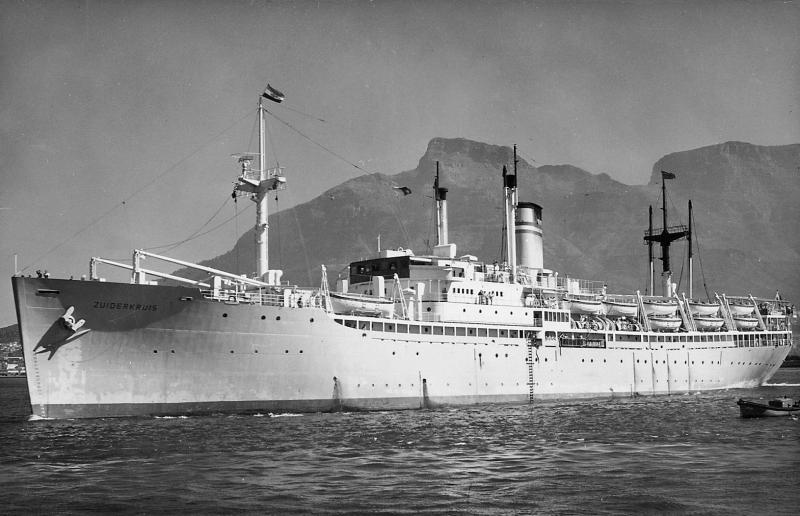
In the harbor, her mother gave their papers to the officials, who then directed them to their ship, the SS Zuiderkruis. Before they walked up the gangway, Géke stopped and let go of her mother’s hand. In awe, she looked up at the large ship. She’d almost forgotten about the doll. Almost.
It took them a while to find their cabins. Her brother had to share a cabin with another single young man. Her parents were in another cabin, while the eldest daughter shared a cabin with the two younger ones. None of their cabins offered them a view of the ocean.
“I guess they couldn’t spare us more money,” Géke heard her mother grumble to her father. “Subsidy, they call it. It’s nothing other than severance pay.”
She didn’t know what her mother meant, and once she heard they would go to the lounge for dinner, she’d already forgotten those words.
By the next morning, the 812 passengers emigrating to South Africa, North and South Rhodesia had boarded. Excitement tinged with fear coursed through Géke’s little body when the ship started moving. Her parents stood on either side of her at the railing as they watched first Amsterdam, then their country of birth disappear into the horizon, until only water surrounded them.
On 22 October 1955, father Jan Kuiper, born 4 September 1906, mother Ottolina van Doeland, born 1 December 1912, and children Marten Kuiper, born 13 May 1936, Anna Kuiper, born 1 December 1938, Roelfke Kuiper, born 3 May 1944 and Geertje Kuiper, born 4 June 1947 were on board the SS Zuiderkruis, sailing to their new home in South Africa.
It was ten years after the Second World War had ended. In those years, the Netherlands received over one billion dollars from the Marshall Plan aid to import necessary goods and equipment. The funds were used to revive the industries for food production, textiles and aviation, but also for purchasing agricultural equipment and supplies, so that sector could also recover. Some of the money went to stimulate tourism, as well as to help stabilize inflation, build houses and reclaim land. It resulted in the suspension of rationing in 1948.
Despite all this, the country still suffered. The population grew explosively because of a post-war ‘baby boom’, and over 120.000 people had to be repatriated to the Netherlands after the Dutch East Indies had gained independence in 1949. The pressure on resources and space was huge. Even though the production industry had been restored, there was economic hardship, resulting in high unemployment and a general struggle to recover and rebuild.
Already in 1945, the former Minister of Finance, engineer Van den Broek, addressed the Dutch population in a cinema commercial. He encouraged them to seek their fortunes elsewhere. By then, the Dutch government actively pursued a population policy, asking its citizens to consider settling in other countries. They had agreements with Australia and Canada that needed workers to keep their economies afloat.
The campaign worked. In a 1948 survey, it showed that 32 percent of the Dutch population seriously considered emigrating. In his New Year’s address in 1950, Prime Minister Willem Drees reinforced the sentiment: “Some of our people must dare to seek their future in larger areas than their own country.”
Queen Juliana echoed those words in her speech from the throne that same year: “…rapid population growth and the limited amount of available land require vigorous promotion of emigration.”
In 1951, the Dutch government had set a target of 60.000 Dutch people to emigrate annually.
The passenger ships that transported the Dutch to their new homes were not designed to accommodate large numbers of emigrants. Waiting two years before departure was not uncommon. Migrants could also fly with KLM, but many preferred to go by ship because of the more generous luggage capacity. The ships, which were often converted warships, had room for furniture and other items. The overseas journey was sometimes unpleasant, but mostly the emigrants experienced it more like a vacation, with the stewards waiting on them.
How long Jan Kuiper and his family had to wait to finally board the SS Zuiderkruis, and whether they boarded on 21 October 1955 or only on the 22nd is unknown. They had, however, received a subsidy from the government, just like all the Dutch citizens who had left the country to move to another continent.
Ottolina Kuiper-van Doeland — my grandmother, called Lien — always spoke of the money as ‘severance pay’, and it’s only by researching the history of their emigration that I sensed something negative in those words.
On 12 January 1944, the Oregon Shipbuilding Corporation in Portland launched the Cranston Victory. It was one of the many Victory ships constructed at this major emergency shipyard during World War II. They’d reinforced the hull for wartime, and the ship could transport approximately 1.600 troops. Unlike the Liberty ships, also constructed in the same period by the same company, there was ventilation and heating in the Victory accommodations.
The South Atlantic Steamship Co. of Savannah briefly operated the ship under the American flag before putting it up for sale in 1946.
After the war, in 1947, the Dutch government bought the Cranston Victory, renamed it the SS Zuiderkruis, and entrusted it to the Royal Rotterdam Lloyd. At first, they used it to transport soldiers to the Dutch East Indies and New Guinea. While in its military role, the ship also transported Moluccan soldiers and their families to the Netherlands.
In 1951, the NDSM (Nederlandsche Dok en Scheepsbouw Maatschappij — Dutch Dock and Shipbuilding Company) in Amsterdam converted the SS Zuiderkruis into an emigrant ship. They added an extra deck, moved the bridge forward and adapted the accommodations for 841 passengers. They also added a sports deck and a sun deck at the rear of the ship.
Many emigrants boarded the ship to sail from the Netherlands to their new countries, but it also repatriated many people back to the country from the Dutch East Indies and Indonesia.
In 1961, the newly established Trans-Ocean Shipping Company in The Hague acquired the ship’s operations. They further adapted the ship for low-cost tourism, with an additional lounge, swimming pool and split cabins. In 1962, the Royal Netherlands Navy in Den Helder leased the SS Zuiderkruis as an accommodation ship and gave it the pennant number A853.
A pennant number is a unique identification code for a naval ship, and always has a letter and numbers, to distinguish it from other ships of the same type. Historically, the number equaled the type of ship, such as ‘R’ for aircraft carrier, ‘D’ for destroyer, ‘S’ for submarine, or ‘F’ for frigates. The ‘A’ used for the SS Zuiderkruis identified it as a Royal Navy auxiliary ship.
On 29 October 1969, the SS Zuiderkruis was sold for scrapping to Intershiltra in Rotterdam, but then subsequently sold to a Spanish ship-breaking yard. On 27 November 1969, the ship arrived at Bilbao, Spain, where the dismantling and scrapping started.


We tracked the October 1955 voyage of the SS Zuiderkruis through news reports. Until the digital age started, most newspapers recorded the movement of ships in a daily column called ‘Shipping messages’.
On 22 October 1955, the ship left the harbor of Amsterdam, then passed the Isle of Wight, a British island to the south of the mainland on the 23rd. Different papers mentioned that the SS Zuiderkruis passed Ushant, Finisterre and Oporto on the 24th.


Ushant is a French island that marks the westernmost point of France, belongs to Brittany, and is at the southwestern end of the English Channel. Approximately 400 nautical miles to the southwest lies Finisterre, or Cape Finisterre, which is a rocky peninsula on the west coast of Galicia, Spain. The name Finisterre comes from the Latin finis terrae, which means ‘end of the earth’, as in Roman times they believed this place to be the end of the known world. Oporto is approximately 122 nautical miles south of Finisterre, and the second largest city in Portugal, after Lisbon.
On 25 October 1955, the papers mentioned that the SS Zuiderkruis was ‘across Lisbon’. This meant the ship sailed at the same latitude as Lisbon, but outside the coastline, so somewhere at sea to the west of Portugal. It never docked at Lisbon.

In fact, the only place the ship docked en route to Cape Town was at Las Palmas. This probably happened on 26 October 1955, as there is no mention of the ship in the papers for this date, but all newspapers mentioned the ship departed from the capital of the island Gran Canaria on the 27th, on route to Cape Town, South Africa. Las Palmas is the larger of the two capitals on the Canary Islands. The other is Santa Cruz de Tenerife — Santa Cruz for short — on the island of Tenerife.
After four days of being surrounded by water and having explored every nook and cranny of the ship, Géke and Roelfke — called Roelie — now hung side by side on the railing of the SS Zuiderkruis. They were both happy to see land again.
Roelie’s shrill voice slowly drifted to the background as every detail of the tropical island imprinted itself on her younger sister. The clear blue sky, the slight curves of the landscape, the palm trees… everything pulled at Géke.
Where she’d been indifferent to the fact that they were moving to another country, an excitement now bubbled inside the eight-year-old girl. Would South Africa be as beautiful as this? The slow movement of the ship allowed her to take it all in. She enjoyed the warmth of the wind, and in her young mind decided she preferred this to the cold of the home she’d left behind.
I want to live here, Géke thought.
By the time the ship had docked, the girl was still at the railing, watching as crewmen lowered the gangway. Soon after, she saw passengers disembarking. Just as she wanted to turn around, she heard her sister’s sharp voice.
“Géke, you have to come. Mom wants to see you!”
Excitement coursed through her little body, and she rushed towards her parents, who were in the ship’s lounge. Disappointment replaced her eagerness when she noticed the cups of tea on the table.
“Can we go off the ship too?” she pleaded, but already feared the answer. Had her parents planned to disembark, they wouldn’t have been having tea right now.
“No, my child,” her mother said, her voice gentle and filled with an unspoken apology. “We need to be frugal with the money we have. We don’t know how long it will be before your father receives his first salary.”
The little girl glanced at the stoic face of her father. He never contradicted his wife. Unlike in Amsterdam, this time Géke couldn’t stop herself from crying.
On 27 October 1955, the SS Zuiderkruis departed from Las Palmas, and on the 28th it passed Cabo Blanco, which is also known as Cap Blanc in French. That, however, was the name in colonial times, as nowadays it’s shown on the world map as Ras Nouadhibou. It’s not the westernmost point of Africa, but because of the tilt of the earth, at least twice a year it’s the last place in Africa where the sun sets.


The newspapers mentioned the ship passed Dakar on 29 October 1955, but also Cape Verde. Both places are roughly on the same latitude. There are no messages for the 30th, but on the 31st they passed Cape Palmas. This is a headland at the extreme southeastern end of the coast of Liberia, Africa.
The next day, the first day of November and the month in which they were to reach their new country, placed them at 560 nautical miles southeast of Monrovia, which is an area of open sea southeast of the Liberian coast.
On 2 November 1955, the ship sailed 675 miles east of Ascension. The papers misspelled it as Ascuncion, which briefly confused me, as that is the capital of Paraguay in South America.
Then we discovered Ascension Island, which is an isolated volcanic island in the Atlantic Ocean, more or less halfway between South America and Africa. On the same day, the papers mentioned them as being 520 miles north-northeast of St. Helena. This volcanic and tropical island lies to the west of the continent of Africa, and geographically the Southern African nations of Angola and Namibia are the closest.


Their journey was drawing to an end. On 3 November 1955, they sailed 1000 miles northwest of Cape Town, and the next day they were 575 miles northwest of Walvisbaai, which currently is the second-largest city of Namibia, and the largest coastal city of the country. There was no mention of the ship on the 5th, but on the 6th they were 330 miles north of Cape Town.
On 7 November 1955, the SS Zuiderkruis arrived at Cape Town, South Africa.
As the ship rounded the southern tip of South Africa and turned its bow towards the harbor of Cape Town, the majestic view of Table Mountain greeted the Kuiper family, where they stood in the same spot they had when leaving their country of birth seventeen days earlier.
From the oldest to the youngest, they longed to be on terra firma again, but nerves and tension kept them rooted to the spot, while other passengers already moved toward the exit to leave the ship as soon as possible.
Despite the unease, and despite starting the journey with feelings of sadness about leaving behind what they had known for all of their lives, they were now excited to embrace this country as their new home. Here they were far away from the aftereffects of the devastating world war, and from the rumours that another might be upon them soon.
The previous evening, Géke and Roelie had sat on the bed, watching their mother while she packed all their belongings, and laid out their clothes for their disembarkation in Cape Town.
“No, Mommy,” Géke complained. “Not a dress. I want to wear shorts.”
“Most definitely not, young lady,” her mother retorted.
“But why-y-y?” she sing-songed her complaint.
“Because we have to make a good impression. We have to go through immigration control, and I want them to see we’re good people.”
That made Géke frown, but before she could say anything, Roelie chipped in.
“I’ll wear my dress, Mommy.”
She looked at Géke, daring her to contradict, but Géke just scowled and left it at that.
Now, standing there in her dress and cardigan, Géke was happy she hadn’t worn shorts. Despite the clear blue skies, it was nowhere near as warm as it was back in Las Palmas. A cool wind blew in from the sea, and thankfully the cardigan she had on kept her from shivering.
She held tight onto her mother’s hand when they walked down the gangway. Left and right, she saw guards in uniform. They scared her, even though they seemed friendly enough.
Standing in line, they slowly shuffled towards the low brown-brick building. When they reached the door, Géke’s young heart beat furiously in her chest. She glanced up at her mother, then her father, and sensing the tension emanating from them, she kept quiet. She didn’t want to burden them with her fear — fear of the unknown.
Géke needn’t have worried. Once inside the building, a friendly lady beckoned them to her counter.
“English?” the woman asked, looking from her father to her mother, then to her two older siblings.
Everyone shook their heads. There had never been any reason for them to speak English, and it would be many years before it was taught in schools in the Netherlands. Here in South Africa, however, it was one of the two official languages.
“Okay, Afrikaans it is.”
As she said this, a plump, forty-something woman moved closer to them.
“Ik ben tolk,” she said — I’m a translator — and then continued sounding quite patronizing, “maar het is beter om zo snel mogelijk Afrikaans te leren, dus luister goed!” It’s better to learn Afrikaans quickly, so listen up!
She nodded at the official behind the counter, who turned her attention to the head of the family.
“Wat is julle name?” What are your names?
Jan Kuiper just looked at her for a few seconds, then at his wife. He had understood the question, but he always left these kinds of things to her. Ottolina Kuiper-van Doeland dug into her bag and pulled out five passports. One by one, the woman recorded their names and prepared an immigration pass for each of them.
“Ons moet gou-gou foto’s van julle maak,” she said, pointing to an impromptu photo booth against the opposite wall.
We need to take photographs of you all.
Despite the Afrikaans pronunciation of the word ‘foto’s’ being so different from the Dutch, they all understood it. Anna Kuiper — called Ans — took Roelie and Géke with her and upon their return, Jan and Marten went to the booth. With Marten still inside, and Jan returning, Lien made her way there too.
“Waar gaan julle bly?” Where will you settle?
Five faces stared back at her, not one of them grasping the meaning of the official’s words. The translator, seeing their confusion, jumped in.
“Ze vraagt waar jullie gaan wonen.”
Lien smiled at her thankfully, while Géke’s eyes jumped from one face to the other, her mouth open. She clasped her mother’s dress tightly in her fist, trying hard to suppress the panic rising inside her.
I don’t know how to speak Afrikaans, she thought. I only know Dutch. How can I ever make friends if I can’t speak to them? I wish we had never moved here. I want to go home!
“Vanderbijlpark,” she heard her mother say.
The official nodded, then turned her attention to the cards she had in front of her. When she had noted down all the needed information, she pushed the passes toward Lien.
“Dit moet julle altyd by julle hê.” You need to always have this with you.
Again, the translator had to repeat the words in Dutch, fuelling the fear in the youngest member of the family.
When the woman behind the counter spoke again, the panic inside her subsided somewhat as Géke realized she understood every word.
“Welkom in Suid-Afrika.” Welcome to South Africa.
An hour later, they used their green immigration documents for the first time when they boarded the northbound train, heading for the Transvaal, and the town where their new home waited: Vanderbijlpark.


2 thoughts on “October 1955: Voyage Of The SS Zuiderkruis”