 11

At the end of The Mother Who Left, I posed two questions, of which one was:
What had happened to Christina Gesina?
I grew up knowing that my father was one of six siblings, of whom he was the youngest. They were:
No one had ever mentioned that they had a sister who had died as a baby. I couldn’t understand how a child could disappear so completely from a family memory.
The first I heard of this child was when someone replied to my request to find more information on the Schoeman man my ouma (grandmother) Vorster-Nel married after my grandfather. I dismissed it, thinking this person was mistaken.
Then came the message of the lady who was the granddaughter of the sister of my paternal grandmother, ouma Vorster-Nel.
She mentioned she had a record of only two children of my paternal grandparents. The young Christina Gesina, and my aunt Cielie — Cecilia Johanna — and asked me about the rest of their siblings.
With her message, she sent me the death certificate of Christina Gesina.
When I saw the cause of death — malaria — I started digging into what malaria outbreaks looked like in that part of South-West Africa in those years.
In the 1930s, malaria was a seasonal, everyday risk in the far north of northern South-West Africa (now Namibia), but it wasn’t a problem across the entire territory. The wet season brought plenty of mosquito breeding sites and repeated waves of fever and sickness to the area that today roughly corresponds to Kavango, Zambezi and parts of Ovamboland — the riverine and floodplain zones.
Quinine was the usual treatment offered at mission clinics and some colonial medical posts. Many villages had only improvised prevention and patchy access to medicine.
Outjo, on the higher plateau near Etosha, and Gobabis, were not malaria hot-spots. Their geography and drier climate made sustained transmission unlikely.
However, that didn’t mean people living there could never get malaria. Unusually heavy rains, pools of standing water, or infected travellers returning from the endemic north could spark isolated cases or small outbreaks. Outjo and Gobabis faced lower, intermittent risk rather than the seasonal burden of the far north.
Records of malaria cases in the 1930s are patchy, as colonial reports focused on epidemics and central towns, while much of the everyday suffering appears in missionary letters, clinic notes and later historical reconstructions. However, we know malaria is seasonal, and it hit children and those with poor access to care the hardest.
Outside, the sound of crickets filled the air. Even though it was officially autumn, it was warm outside, and the sun shone abundantly. Now and then the wind swept up a cloud of red dust.
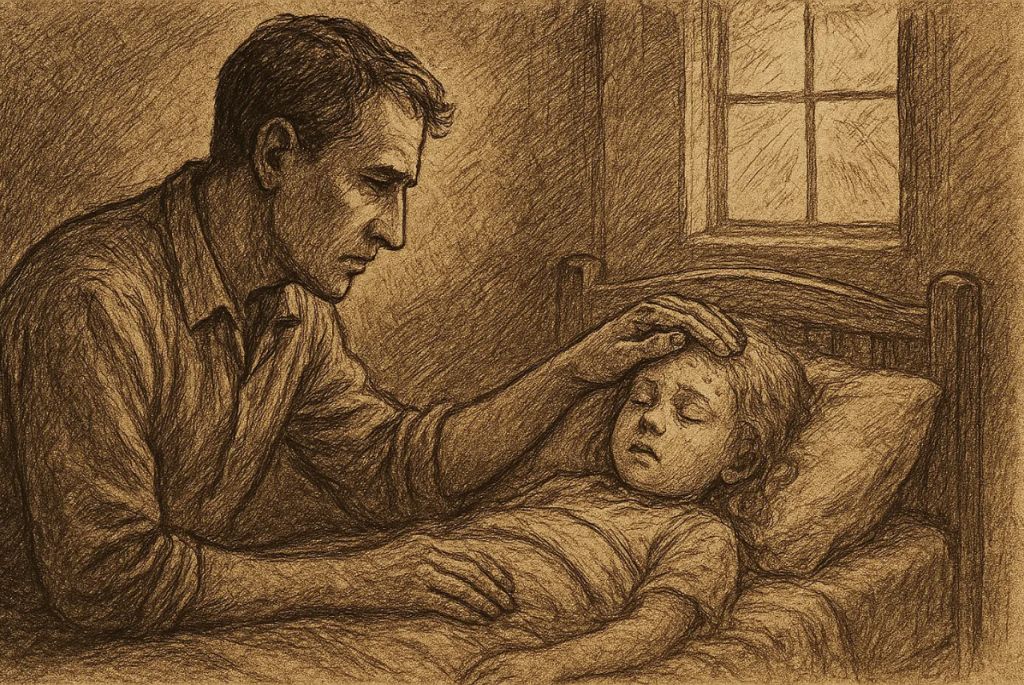
Inside the dark room, Pieter is unaware of the balmy weather outside. He felt helpless as he sat staring at his baby girl. Sweat glistened on her forehead, and her face was unnaturally red because of the fever that had taken hold of her body thirteen days ago.
The day before, the doctor had visited for the second time since Christina had fallen ill. When he left, he shook Pieter’s hand in greeting, and said in a grave voice: “It won’t be long now.”
Somewhere in the house he heard the laughter of Ouboet, their three-year-old son. Immediately after, he heard Anna quieting the little one.
Anna. She wanted to be in here with him, but the doctor had forbidden her. The risk of her catching malaria was too big. She might survive it, but with her being seven months pregnant, there was no knowing what it would do to their unborn child.
A moan from the little one snapped him out of his reverie. He leaned forward and wiped the sweat from her forehead. Only when he sat down again did he notice the silence.
She was no longer breathing.
It was on 1 April 1934 that Christina Gesina Vorster, aged one year, eleven months and twelve days old passed away from malaria. She was the second child of Pieter Jacobus Vorster b.1903 and Anna Johanna Dorothea Nel b. 1911.
Her date of birth isn’t recorded, but using the age listed on her death certificate I calculated it as 20 April 1932.
Like so many children who died young, she slipped out of living memory. By naming her again, we honor her brief life and restore her place in our story.


