 11

Continued from…
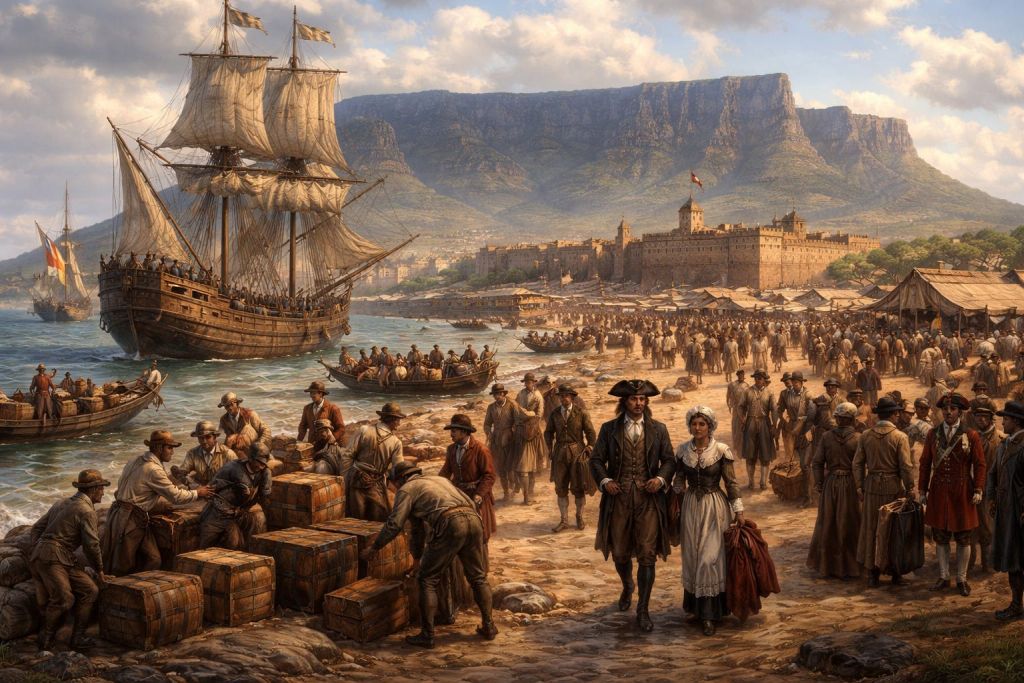
The anchor hits the water with a deep and heavy sound that rolls across the bay before slowly disappearing into silence. I stand at the side of the ship, my hands wrapped around the rough wood of the railing, while my eyes remain fixed on the land before me. It is closer now than it has ever been, no longer a distant shape on the horizon, but something real and unmoving.
The mountain rises high above everything, its flat top stretching wide across the sky in a way that feels almost unnatural, as if it does not belong to the earth below it.
“Table Mountain,” someone says behind me.
I hear the words, but I do not answer. After everything we have endured, after the storms and the endless water, we have finally reached land. And yet, standing here, I do not feel that anything has ended.
Guillaume steps beside me, steady as always.
“This is it,” he says quietly.
I nod, but my voice does not follow. Around us, the ship begins to move with purpose again as men pull ropes and shout orders. The long stillness of the journey has ended, and something new has begun.
But I do not yet understand what that something is.
I do not know the rules of this place, nor the life that waits for us beyond the shore. All I know is that the world behind us is gone, and that there is no path that leads back to it.
When François du Toit and his brother Guillaume du Toit arrived at the Cape in 1686, they entered a world that was already firmly established, ordered, and controlled.
Their ship anchored in Table Bay, the main point of entry to the settlement. From there, every step they took was guided by the system of the Dutch East India Company.
The Cape was not an open land where people could simply begin again as they wished. It was a carefully managed outpost, built to serve the needs of the Company and its ships traveling between Europe and Asia. Everything was regulated. Movement, trade, land, and even personal freedom existed within clear limits.
Like all new arrivals, François and Guillaume would have been taken to the Castle of Good Hope. This large stone fortress stood as the center of authority at the Cape. Inside its walls, officials recorded names, origins, and intentions. In that moment, the brothers were no longer unknown travelers. They became part of the colony.
They were required to take an oath of loyalty. This was not a simple formality. It bound them to the States-General of the Dutch Republic, to the Prince of Orange, and to the Dutch East India Company itself. From that point on, they lived under its authority.
Although they were later allowed to become free burghers, this freedom had limits. The Company decided who received land, what could be traded, and at what price goods could be sold. Farmers were expected to supply passing ships, often at fixed prices that favored the Company. Independence existed, but it was never complete.
This system had its roots in the earlier years of the settlement, when Jan van Riebeeck established the refreshment station in 1652. By the time the Du Toit brothers arrived, the structure he had created had grown stronger, not weaker.
For newcomers like François and Guillaume, survival depended not only on hard work, but also on understanding this system. They had escaped one form of control in Europe, only to enter another, quieter one at the edge of the world.

The story of the Dutch Cape began with a man named Jan van Riebeeck. Born in 1619 in Culemborg, the Netherlands, he was a determined official for the Dutch East India Company (VOC).
After spending years in Asia, he was sent to the tip of Africa in 1652. His mission was not to build a city, but a “refreshment station”—a place where ships could find fresh water and vegetables on their long journey to the East.
When Van Riebeeck arrived at Table Bay with his wife, Maria de la Queillerie, and their children, the land was wild and the work was hard. He was a strict leader who oversaw the building of the first wooden fort and the planting of the famous Company’s Garden. Although he only stayed at the Cape for ten years before moving back to Asia—where he eventually died in Batavia (now Jakarta) in 1677—his arrival changed the course of history forever.
As the settlement grew, the wooden fort was no longer strong enough to protect the Company’s interests. In 1666, a few years after Van Riebeeck left, the construction of the Castle of Good Hope began. This massive, star-shaped stone fortress was built using the labor of soldiers, sailors, and enslaved people. Its thick walls were designed to defend the colony against rival European powers from the sea.
Today, it remains the oldest colonial building in South Africa, a silent witness to the centuries of power, trade, and conflict that started with a small group of Dutch settlers on a windy beach.


Jan van Riebeeck was a very important figure in South Africa, especially during the Apartheid years. At that time, the white government (Afrikaners) saw him as the ‘founding father’ of their country. To honor him, they put his face on almost all the money and stamps.
However, there is a funny mistake in this history. For many years, everyone believed the man on the banknotes was Van Riebeeck. But later, researchers found out it was actually a man named Bartholomew Vermuyden. The artist used the wrong portrait! So, for decades, South Africans were using money with the face of a man who had nothing to do with their history.
The new government, led by Nelson Mandela, wanted to unite the people. They felt that keeping Van Riebeeck on the money was a problem. To many South Africans, his image was a painful reminder of colonialism and the beginning of white rule. They wanted the money to feel like it belonged to everyone.
In 1992, just before the big change, the government decided to stop using portraits of people. Instead, they chose something that all South Africans are proud of: their incredible nature. They put the ‘Big Five’ animals on the notes—the Rhino, Elephant, Lion, Buffalo, and Leopard. This was a neutral way to make the money feel ‘South African’ without picking sides in history.
Later, in 2012, the government added the face of Nelson Mandela to the front of the banknotes. Because he is seen as the ‘Father of the Nation’ for the new South Africa, people loved it. They even started calling the money ‘Randelas’.
By removing the old portraits, they also solved that funny mistake from before. They no longer had to worry about whether the face on the money was really Jan van Riebeeck or that other man, Bartholomew Vermuyden. They traded a confusing history for a future that everyone could celebrate.”
The first years at the Cape were marked by uncertainty and adaptation.
Unlike the larger groups of Huguenots who would arrive later, François and Guillaume entered a colony where French was rarely spoken. Most settlers were Dutch or German, and daily life required communication, cooperation, and adjustment.
During these early years, the brothers remained together and worked side by side, learning how to live in this new environment.
In 1687, only a year after their arrival, Guillaume du Toit took an important step. He was granted land near Stellenbosch, in an area that was slowly expanding as more settlers moved inland. His farm became known as Aan’t Pad, a name that reflected its position along one of the wagon routes leading away from the settlement.
These routes were more than simple paths. They connected farms, people, and trade. Along them moved supplies, news, and the slow growth of a new society. A farm along such a route was never completely isolated. It became part of something larger.
Guillaume built his life there with his wife, Sara Couchet, and their daughters. While he had no sons to carry on his name, his work laid an early foundation for the Du Toit presence at the Cape.
Years later, in 1710, he expanded his land by acquiring the neighboring farm of Watergang, across the Plankenburg River. This showed that his efforts had taken root in a land that had once been unknown to him.
Over time, the area would change. The land of Aan’t Pad would become part of what is now known as Cloetesdal, and later Cloetesville. Even the name Du Toit would remain in the landscape, carried forward long after the original farm had passed into other hands.
While François would later build his own path, it was here, on this piece of land, that the family first became firmly connected to the soil of the Cape.
When the Du Toit brothers arrived, the land was not empty.
Long before European ships entered Table Bay, the Cape was home to the Khoikhoi people. They moved across the land with their cattle, following the seasons and the needs of their herds. Their knowledge of the land was deep and shaped by generations of living within it.
In the early years of the settlement, contact between the Khoikhoi and the Europeans was cautious. Trade took place. Cattle and sheep were exchanged for metal tools, tobacco, and other goods brought by ships. For a time, both sides depended on each other.
But this balance did not last.
As the settlement grew, more land was needed. Farms expanded, and grazing areas changed. What had once been shared space became contested ground. Misunderstanding, pressure, and conflict slowly replaced the earlier cooperation.
At the same time, enslaved people were brought to the Cape from other parts of the world. Many came from regions such as Madagascar, India, and the Indonesian archipelago. They worked in households, on farms, and for the Company itself. Their labor became an essential part of life in the colony.
This created a complex society.
Europeans, Khoikhoi, and enslaved people lived in the same space, but not as equals. Power rested with the Company and its settlers, while others lived under growing restriction.
For newcomers like François and Guillaume, this was the reality they entered. The Cape was not only a place of new beginnings, but also a place where different worlds met, often in uneasy ways.

In the middle of this changing world stood a young woman named Krotoa, also known as Eva. She was born around 1643 among the Khoi people near the Cape. As a young girl, she was taken into the household of Jan van Riebeeck, where she grew up between two worlds. She learned Dutch and Portuguese and became an interpreter, helping the Dutch and the Khoi understand each other. In those early years, the Dutch depended on her knowledge, her voice, and her ability to move between cultures.
For a time, Krotoa believed that something good could grow between the two sides. She helped with trade, carried messages, and stood in moments where peace was fragile. She was trusted, respected, and needed.
But as the colony grew stronger, her place began to disappear.
She was baptized into the Christian faith and married a European man, taking the name Eva. For a short while, her life seemed steady. Then her husband was killed far from home, and everything changed. Without him, and without the same need for her skills, she became isolated. The world she had helped build no longer had space for her.
Her life grew harder. She struggled, and over time she was judged by the same people she had once served. In 1669, she was imprisoned and then banished to Robben Island. There, she was separated from her children and from the land that had once been her home.
She returned to the mainland more than once, trying to find her place again, but each time she was sent back into exile. Her life became a cycle of return and rejection, as if there was no longer a place where she truly belonged.
At the same time, the Khoikhoi themselves faced devastating loss. In 1713, a smallpox epidemic brought by a passing ship spread through the Cape and killed much of the population. Entire families disappeared, and surviving communities were left without land, cattle, or stability. Many were forced into service on settler farms just to survive, bound by systems that left them little freedom in practice, even when they were called “free” on paper.
In 1674, Krotoa died at the Cape. She was buried within the walls of the settlement, but even in death, her story did not find rest. About a hundred years later, her remains were removed and placed in an unmarked grave. The exact place where she lies today is unknown.
It is a quiet ending for a woman who once stood at the center of everything.
Krotoa’s life speaks of a person who tried to bridge two worlds that were moving further apart. In the end, she was left standing between them, remembered by neither as she had once been. Yet her story remains, carried forward as a reminder of the cost of that crossing.
Two years after the brothers’ arrival, the Cape began to change.
In 1688 and 1689, larger groups of Huguenot refugees arrived. They came as families, not as individuals, carrying what remained of their past lives with them.
Their arrival was part of a broader movement, driven by events in France, where Protestant communities faced increasing pressure after the revocation of the Edict of Nantes in 1685.
By this time, François and Guillaume were no longer new arrivals.
They understood the system of the Company. They knew how the land worked, how authority was structured, and what was required to survive. Where others felt lost, they had begun to find direction.
Because of this, their role slowly changed. They were no longer only men who needed help. They became men who could give it. They could speak the language of the newcomers, but they were also learning the language of the colony. They knew where to go, whom to speak to, and how to begin.
In this way, they stood between two worlds.
They look at us the way we once looked at others.
I see it in their eyes. The same confusion. The same silence. The same question that has no easy answer.
A man stands in front of me, holding the hand of a young boy. His clothes are worn, his face marked by the journey. He speaks quickly in French, his words pressing forward as if they are trying to escape.
I understand him.
That alone changes something.
Guillaume answers first, calm as always. He explains where they must go, what they must do, who they must speak to. His voice is steady, as if this place no longer holds uncertainty for him.
I watch how the man listens, how he holds on to every word.
I remember that feeling.
The man thanks us and moves on with his family.
For a moment, I remain where I am.
“They look lost,” I say.
Guillaume nods. “So did we.”
The wind moves across the land, carrying voices with it. There are more people now. More movement. More life than before.
I look out over the valley.
It no longer feels empty. And somewhere in that quiet understanding, something shifts inside me.
We are no longer at the beginning.
Guillaume du Toit spent many years working the land at Aan’t Pad, building a life with quiet persistence. For nearly four decades, he farmed the soil near Stellenbosch, shaping a place that would outlast him. Although he had no sons to inherit the land itself, his spirit was woven into the very name he carried—a name that held a deeper promise than he might have realized.
In the old tongues, Guillaume means “resolute protector.” It comes from words meaning “will” and “helmet,” describing a man with the strength to shield what he loves. While his own name sounded uniquely French amidst the changing landscape, it was simply the elegant ancestor of the name William. He was the first “Willem” of his line, a resolute protector who laid the foundation for all the Willems who would follow in the generations after him.
After his time, the farm passed into new hands. In 1739, it was bought by Jacob Cloete, who gave the land a new name: Cloetesdal. As the decades passed, the quiet fields of Cloetesdal began to change. The land was divided and developed as the settlement of Stellenbosch expanded northward.
By the nineteenth century, the region had begun to transform more rapidly. Land once used for farming became part of a growing town. Streets formed, houses were built, and new structures appeared where fields had once been.
In 1862, when the railway reached Stellenbosch, a station was built on land that had once belonged to Guillaume. Around it, a small community formed, known as Du Toitsville.
Eventually, the old farm of Cloetesdal grew into the modern suburb of Cloetesville. Though the original farm disappeared, the name remained. It became part of the landscape, carried forward through time as a quiet reminder of the man who had once stood there.
Guillaume’s legacy was not written in title deeds, but in the character of his descendants. The “will” to protect and the strength to build lived on. Even as his French name softened into the many Willems of the future, the meaning stayed the same: a steady heart, a protective hand, and the courage to begin again.


They had arrived at the Cape as strangers, uncertain and unprepared for the world they had entered. In the beginning, their lives were shaped by rules, by distance, and by the slow process of learning how to survive in an unfamiliar land.
But time changed them.
Through work, through patience, and through quiet endurance, François and Guillaume found their place. They learned not only how to live in this new world, but also how to help others do the same. Without fully realizing it, they had crossed an invisible line. They were no longer only men who had fled. They had become men who could stand.
And soon, for François, the land would open in a new way.
Continued here…


2 thoughts on “BLOOD OF THE HUGUENOT – Part 11: A New Land”