 11

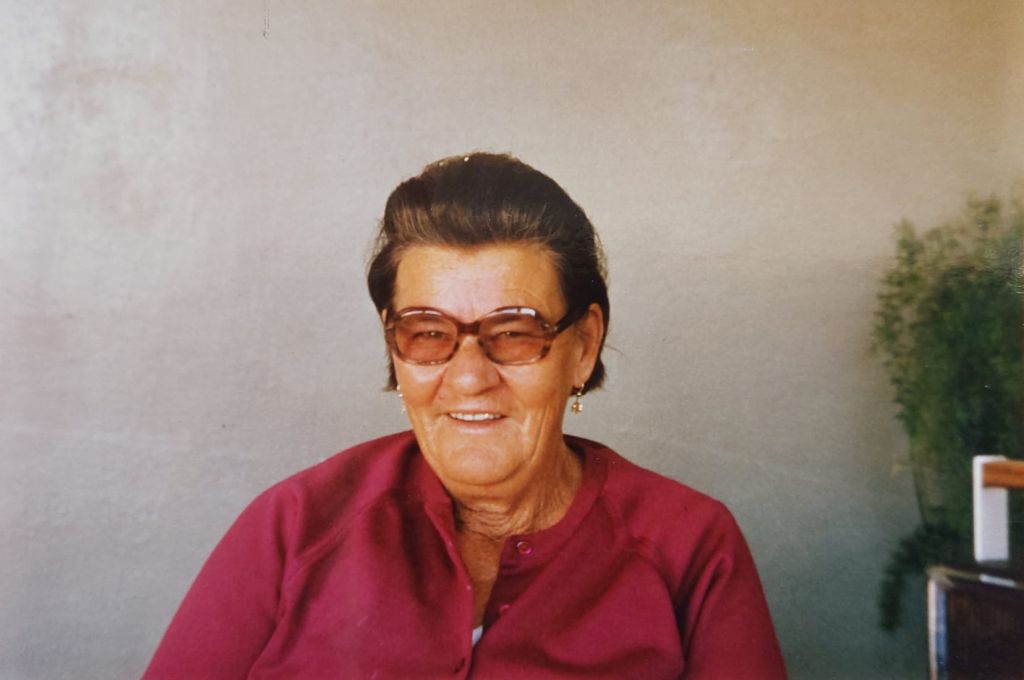
Anna Johanna Dorothea Nel, born 11 June 1911, was my paternal grandmother. I saw her only once in my life. Perhaps I called her ouma (grandmother), or maybe, as a shy eleven- or twelve-year-old girl, I kept my distance. I might have quietly observed or avoided the woman who had abandoned her children, as my father never hid the fact that he had grown up partly in an orphanage because his mother had left them.
Being a mother myself, I simply cannot fathom how a woman can walk away from her children. That question and knowledge have been with me all my life.
We had information about my paternal grandfather — oupa Vorster — and the means to learn more. But finding information about ouma Vorster-Nel was difficult.
The story, according to my brother, was this:
During the Second World War, in 1942–1943, my grandfather fought in North Africa, while ouma Vorster-Nel stayed on their farm in South-West Africa with their six children. The neighbour’s wife — surname Du Plessis — had a difficult pregnancy. My grandmother, being a midwife, helped deliver the baby, where the mother died, but the baby survived. Ouma Vorster then helped the father with the baby, and when my grandfather returned from war, she left him to be with the child’s father.
This seemed plausible. After all, her grave bore the Du Plessis surname.
When she left, oupa Vorster returned to the Transvaal with their six minor children. By the time their divorce came through in July 1946, the oldest son was almost sixteen, and my father — the youngest — had just turned five. Ouma Vorster-Nel had left about 3–4 years earlier.
When Susan and I began researching the family tree, we wanted to know more. We wanted to find out more about the Du Plessis man for whom my grandmother had abandoned her children.
I asked my paternal cousin Pieter to speak to his mother — the only surviving sibling of those six children — but the trauma ran too deep, and she avoided the subject. Later, I heard she had spoken to another paternal cousin, Meisie, thirteen years older than I am, and whom I haven’t seen even once in my childhood.
I contacted Meisie, initially to ask about her own branch of the family, as I needed this for our family tree. Then came the sentence that changed everything:
I suppose you know our grandmother had two more kids?
I was stunned. Her words implied she meant biological children. I insisted those were the Du Plessis children — the baby from the tragic childbirth story, so not children of my grandmother, but stepchildren.
Meisie paused, thought, and then said:
No… Schoeman.
A surname I had never heard before or connected to my grandmother — or so I thought.
I remembered asking my father about family members when I first worked on the family tree back in 2020. I went back to our chats, and there it was:
Uncle Ouboet’s wife was Anna, maiden name Schoeman. She was the daughter of my mother’s second husband.
Second husband.
Schoeman.
The story was shifting.
Susan and I searched everywhere, yet we found no record of ouma Vorster-Nel with a Schoeman man. It was incredibly frustrating, so I posted a call for more information in four Facebook groups. I received fragments of information from each of them.
One person mentioned that Anna Johanna Dorothea Nel married Daniel Jacobus du Plessis, born 22 January 1898, on 4 December 1961. That left an unexplained gap of 17–18 years between her leaving the Vorster household and this marriage.
Checking his records, we found:
His children, however, were born between 1919 and 1926 — far too early to match the “baby she delivered in the 1940s” story.

Then I noticed something else: The late wife of Du Plessis, Opperman, was the sister of the Opperman woman who had been the first wife of Pieter Jacobus Vorster b.1903, my grandfather. The two men died years apart, but the Opperman connection meant my grandfather and Daniel du Plessis had likely known each other.

Still, none of this explained the gap — or the Schoeman surname.
With the Du Plessis connection collapsing, I shifted focus to my father’s oldest brother, uncle Ouboet (Petrus Johannus Vorster, b.1930), who had married Anna Dorothea Schoeman,b.1929. According to my father, she was the daughter of his mother’s second husband.
I still refused to believe this without proof.
Years ago, my brother had uploaded documents to FamilySearch. Among them, I found a 1964 baptism register: all of uncle Ouboet and Anna Dorothea Schoeman’s children were baptised on the same day, with special permission — likely because the oldest child was eleven, and the youngest three.
The children were:

That was when everything fell into place.
Traditional naming customs were:
The pattern was unmistakable:
The puzzle pieces started fitting together. If my reasoning was correct, it meant:
The pattern was undeniable.
Just then, Meisie forwarded me a message from our aunt:
My mother had two kids with Schoeman: Saartjie and Stoffel.
I could do nothing yet with that information, but could connect the name of the son, Stoffel, to the name of my grandmother’s alleged second husband: Christoffel Daniel Wilhelm Schoeman.
I opened geni.com, typed Christoffel Daniel Wilhelm Schoeman, set the birth range to 1895–1915, and there he was:

We hadn’t found her earlier because we were searching under her maiden name, Nel, not her married name.
Two children were listed too, but their names were set to private, probably because they were still alive.

I wrote the account holder, and within an hour the names of those two children were visible:
Everything aligned.
Soon after, a woman messaged me on Facebook, saying we were direct family — her grandmother had been the sister of my ouma Vorster-Nel. She confirmed:
This direct family member didn’t know my grandmother personally, but her older brother had visited there often. She promised to ask him what he could remember of her as a person.
Part of me hopes he will say she was harsh, or cold, or troubled — anything that makes it easier to understand why she left her six children, or makes me feel she had regrets.
Another part of me simply wants to know:
My heart breaks — not for her, but for the children she had abandoned, and for the generations that followed.
The trauma of being abandoned by their mother and growing up in an orphanage shaped our parents’ lives. That shaped us — my generation — as it influenced the way our parents raised us.
We all carry the burden of what she’d left behind.
This new relative mentioned something else: My paternal grandparents had a seventh child — Christina Gesina, born in 1932, died in 1934. My father had never mentioned her, and neither had any of his siblings.
That discovery left us overwhelmed because of filling in eighteen lost years… but also left us with two new questions:
The investigation continues.


2 thoughts on “The Mother Who Left”