 11

Continued from…
To truly understand the deep history of the Du Toit family, we must first look at the group of people they belonged to. They were known as the Huguenots. Their lives were shaped by a time of massive change that moved across Europe like a powerful storm, overturning old traditions and bringing new ways of thinking.
For many centuries, almost everyone in the kingdom of France followed the Catholic Church. In those days, religion was not just a private belief—it was the very foundation of society. It influenced the laws of the land, the way children were taught, and even the loyalty people were expected to show to their King. In every town and village, the stone church stood at the center of the community. The sound of its heavy iron bells told people when to wake, when to work, and when to rest. To live outside the Church was almost unthinkable.
But slowly, new ideas began to spread. They moved through the crowded streets of the cities and reached the quiet countryside. These ideas changed how people thought about faith, God, and power. Many people started to ask difficult questions. They felt the Church had become too rich and too far removed from the people. They believed that faith should be personal—something that lives in the heart of every individual, not just in a grand building.
One of the most important voices in this movement was a French scholar named John Calvin. He taught that a person’s life should be honest, disciplined, and deeply connected to the Bible. He argued that every person, whether rich or poor, should be able to read the Word of God in their own language, rather than hearing it only in Latin. His ideas spread quickly, carried in secret by books hidden in merchant wagons and by brave preachers who traveled from village to village at great personal risk.


In France, the people who followed these new Protestant ideas became known as the Huguenots. At first, the name was used as an insult by their enemies, but the believers soon wore it with pride. It became a badge of their identity and their shared strength.
Their way of worship looked very different from the traditions of the past. The Huguenots chose simplicity over display. They removed the gold decorations, the statues, and the expensive paintings from their meeting places. Instead, they focused on prayer, listening to the Bible, and the singing of psalms. These songs often echoed through the night during secret meetings in the woods or in private homes.
Because they believed that every person should study the Bible for themselves, education became the heartbeat of their community. Huguenot children were taught to read and write from a very young age. They were raised to be independent thinkers so they would never have to depend on others to explain their faith to them.
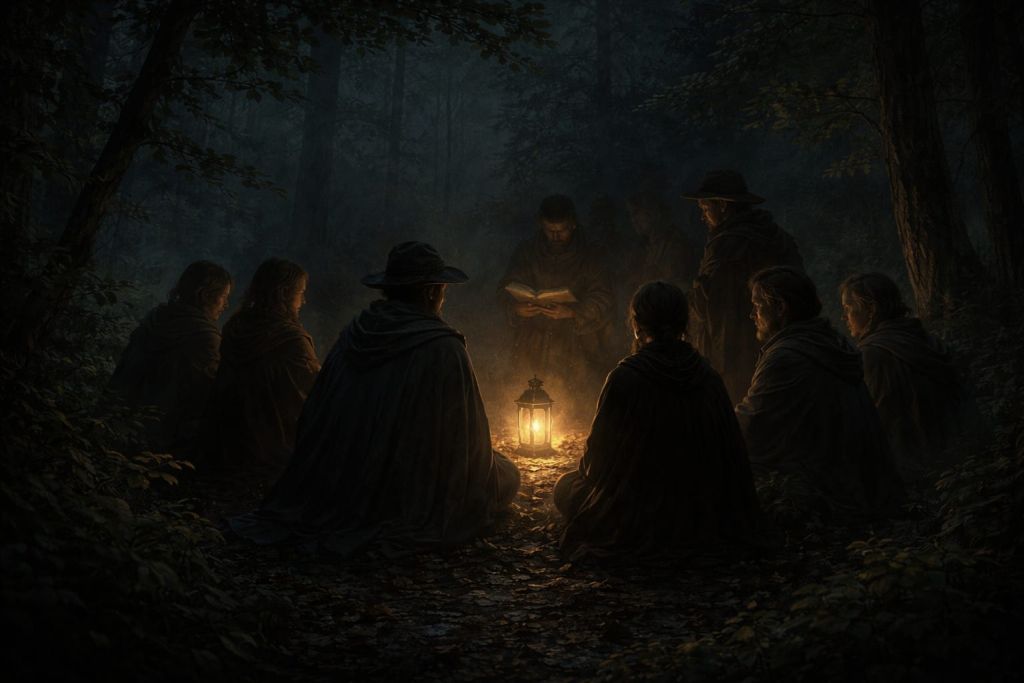
The moon is hidden behind thick, dark clouds, and the forest is almost pitch black. The only light comes from a single lantern, but it is covered by my father’s heavy wool coat to keep it from being seen. We move slowly through the trees, our feet stepping carefully over the dry branches. We are not walking toward a grand church with ringing bells or stained-glass windows. Instead, we are heading deep into the woods, toward a small clearing where others are already waiting in the shadows.
My father’s hand holds mine so tightly that I can feel his heartbeat through his skin. Every few steps, he stops to listen. In the distance, I hear a soft, low voice. It is a preacher reading from the Bible. He is not speaking in Latin, the language of the old church, but in words we actually understand—our own language. The sound is quiet, like the wind moving through the leaves, but it carries a strength that makes my chest feel warm despite the cold.
We must be very careful tonight. We stay low to the ground and move like shadows, making sure that not even the owls in the trees above can hear us. We know the danger. If the King’s soldiers find us here, this place of prayer will quickly turn into a place of fear. Our neighbors, our friends, and my own family would be taken away as prisoners. In this forest, silence is our only shield.
When we finally reach the clearing, we find a small group of people standing close together. We stand so close that we feel like one big group, hiding together in the night. No one speaks loudly. No one dares to make a sudden move. The air feels heavy and damp, and every small sound—a snapping twig or a rustling leaf—seems as loud as a thunderclap.
Then, the singing begins. It is soft and careful, as if the voices are hiding inside the darkness itself. The psalms rise slowly, passing from one person to the next, and I feel the melody move through me like a quiet, unbreakable strength. It is a song of hope in a land that has become dangerous for people like us.
In that moment, standing there in the cold dark, I understand something I had never felt before. Our faith is not something that a King can take away or lock behind a door. Our faith lives inside us, like a fire. It is a flame that cannot be seen by our enemies, but it continues to burn bright, even in the deepest darkness of the night.
For a family like the Du Toits, being a Huguenot was not just something they did on Sundays. It was a way of life that shaped every hour of their day. It guided how they worked in their shops, how they spoke to neighbors at the market, and how they raised their children. They valued honesty, discipline, and a strong sense of responsibility.
Because of this focus on learning and hard work, many Huguenot families became very successful. They were known throughout France as skilled craftsmen, expert weavers, and hardworking farmers who produced the best crops. They built strong reputations for quality and reliability. In many towns, they became the backbone of the local economy.
However, this success brought a new kind of trouble. France was still a Catholic land, ruled by a powerful King who believed that for a country to be strong, everyone had to follow the same religion. To the King and his advisors, the Huguenots were not just different—they were a threat to the unity of the kingdom. They were seen as people who might choose their faith over their loyalty to the crown.
Faith lived deep in their hearts, but the King saw it as a threat to his power. The days of peace were fading away like the evening light. A storm of trouble was coming, and the Du Toit family was standing right in its path.
Continued here…


2 thoughts on “BLOOD OF THE HUGUENOT – Part 3: The People of the Book”